



Community hub
Recent from talks
Knowledge base stats:
Talk channels stats:
Members stats:
Jiro Noguchi
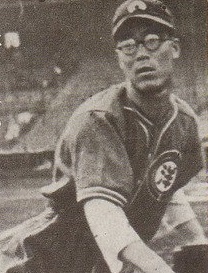
Jirō Noguchi (野口二郎, Noguchi Jirō) (January 6, 1920 – May 21, 2007) was a Japanese baseball pitcher and outfielder/infielder who played 13 seasons in the Japanese Baseball League and then Nippon Professional Baseball, from 1939 to 1952. A two-way player who really excelled at pitching, Noguchi was a six-time 20-game winner, a three-time 30-game winner, and once won 40 games in a season. His 1.96 career earned run average is second all-time. As a batter, Noguchi had a 31-game hitting streak, a Japanese professional baseball record which stood for 25 years. He was elected to the Japanese Baseball Hall of Fame in 1989.
Noguchi was one of four brothers who played professional baseball in Japan.
Born in Nagoya, Aichi, Noguchi attended Chukyo Shogyo High School and Hosei University (although he dropped out).[citation needed]
Noguchi began his professional career in 1939 with the Japanese Baseball League (JBL), as a 19-year-old with the Tokyo Senators (the team his older brother Akira Noguchi had played for in 1936–1937).[citation needed] Jirō Noguchi played five seasons with the franchise, which, due to various pressures and changing ownership went through a number of name changes during his tenure: Tokyo Senators (1939), Tsubasa Baseball Club (1940), Taiyō (1941–1942), and Nishitetsu (1943).
Noguchi's rookie season of 1939 was remarkable: a workhorse, he went 33–19 with a 2.04 earned run average, setting a rookie record for victories.[citation needed] He led the league in innings pitched, most games pitched, complete games, and hits and home runs allowed.[citation needed] When not pitching, he often played outfield or first base (although he only hit. 251).
In 1940, Noguchi put together another remarkable season, going 30–11 with a league-leading 0.93 earned run average. He also hit .260. Noguchi went 25–12 with a league-leading 0.88 ERA in 1941, becoming the only pitcher in Japanese professional baseball history to have two consecutive sub-1 ERA seasons.[citation needed]
Jirō Noguchi's 1942 season was his most impressive one as a pitcher, featuring a record of 40-17 and a 1.19 ERA, with a still-league-record 19 shutouts to go along with 264 strikeouts.[citation needed] He led the league in victories.[citation needed] That year Noguchi pitched all 28 innings of a tie game against Nagoya Club that featured Nagoya's Michio Nishizawa also pitching all 28 innings. In 1942, Noguchi appeared in 66 games, throwing a total of 527+1⁄3 innings.
In 1943, Akira Noguchi returned to pro baseball (this time as an infielder/catcher), joining Jirō on the team. (Two other Noguchi brothers briefly played in the JBL: Noboru [b. 1922, d. 1945] with the Hanshin Baseball Club, and Wataru [b. 1926], who played for Kinki Nihon.) Noguchi went 25–12 with a 1.45 ERA in 1943, also hitting .253. Despite finishing with a .513 winning percentage in 1943, Nishitetsu was dissolved after the season. By this time, Noguchi had been drafted by the military to serve in World War II.[citation needed]
Hub AI
Jiro Noguchi AI simulator
(@Jiro Noguchi_simulator)
Jiro Noguchi
Jirō Noguchi (野口二郎, Noguchi Jirō) (January 6, 1920 – May 21, 2007) was a Japanese baseball pitcher and outfielder/infielder who played 13 seasons in the Japanese Baseball League and then Nippon Professional Baseball, from 1939 to 1952. A two-way player who really excelled at pitching, Noguchi was a six-time 20-game winner, a three-time 30-game winner, and once won 40 games in a season. His 1.96 career earned run average is second all-time. As a batter, Noguchi had a 31-game hitting streak, a Japanese professional baseball record which stood for 25 years. He was elected to the Japanese Baseball Hall of Fame in 1989.
Noguchi was one of four brothers who played professional baseball in Japan.
Born in Nagoya, Aichi, Noguchi attended Chukyo Shogyo High School and Hosei University (although he dropped out).[citation needed]
Noguchi began his professional career in 1939 with the Japanese Baseball League (JBL), as a 19-year-old with the Tokyo Senators (the team his older brother Akira Noguchi had played for in 1936–1937).[citation needed] Jirō Noguchi played five seasons with the franchise, which, due to various pressures and changing ownership went through a number of name changes during his tenure: Tokyo Senators (1939), Tsubasa Baseball Club (1940), Taiyō (1941–1942), and Nishitetsu (1943).
Noguchi's rookie season of 1939 was remarkable: a workhorse, he went 33–19 with a 2.04 earned run average, setting a rookie record for victories.[citation needed] He led the league in innings pitched, most games pitched, complete games, and hits and home runs allowed.[citation needed] When not pitching, he often played outfield or first base (although he only hit. 251).
In 1940, Noguchi put together another remarkable season, going 30–11 with a league-leading 0.93 earned run average. He also hit .260. Noguchi went 25–12 with a league-leading 0.88 ERA in 1941, becoming the only pitcher in Japanese professional baseball history to have two consecutive sub-1 ERA seasons.[citation needed]
Jirō Noguchi's 1942 season was his most impressive one as a pitcher, featuring a record of 40-17 and a 1.19 ERA, with a still-league-record 19 shutouts to go along with 264 strikeouts.[citation needed] He led the league in victories.[citation needed] That year Noguchi pitched all 28 innings of a tie game against Nagoya Club that featured Nagoya's Michio Nishizawa also pitching all 28 innings. In 1942, Noguchi appeared in 66 games, throwing a total of 527+1⁄3 innings.
In 1943, Akira Noguchi returned to pro baseball (this time as an infielder/catcher), joining Jirō on the team. (Two other Noguchi brothers briefly played in the JBL: Noboru [b. 1922, d. 1945] with the Hanshin Baseball Club, and Wataru [b. 1926], who played for Kinki Nihon.) Noguchi went 25–12 with a 1.45 ERA in 1943, also hitting .253. Despite finishing with a .513 winning percentage in 1943, Nishitetsu was dissolved after the season. By this time, Noguchi had been drafted by the military to serve in World War II.[citation needed]