



Community hub
Community hub
Recent from talks
Knowledge base stats:
Talk channels stats:
Members stats:
Job's tears
Job's tears /dʒoʊbz/ (Coix lacryma-jobi), also known as adlay or adlay millet, is a tall grain-bearing perennial tropical plant of the family Poaceae (grass family). It is native to Southeast Asia and introduced to Northern China and India in remote antiquity, and elsewhere cultivated in gardens as an annual. It has been naturalized in the southern United States and the New World tropics. In its native environment it is grown at higher elevation areas where rice and corn do not grow well. Job's tears are also commonly sold as Chinese pearl barley, though true barley belongs to a completely different genus.
There are two main varieties of the species, one wild and one cultivated. The wild variety, Coix lacryma-jobi var. lacryma-jobi, has hard-shelled pseudocarps—very hard, pearly white, oval structures used as beads for making prayer beads or rosaries, necklaces, and other objects. The cultivated variety Coix lacryma-jobi var. ma-yuen is harvested as a cereal crop, has a soft shell, and is used in traditional medicine in parts of Asia.
Job's tears may also be referred to under different spellings (Job's-tears, Jobs-tears). The crop is also known by other common names in English, such as adlay or adlay millet. Other common names in English include coix seed, gromwell grass, and tear grass.
The seeds are known in Chinese as yìyǐ rén (薏苡仁), where rén means "kernel", and also described in Latin as semen coicis or semen coicis lachryma-jobi in pharmacopoeic literature.
The species, native to Southeast Asia, was named by Carl Linnaeus in 1753 with the epithet as a Latin translation of the metaphorical tear of Job. As of February 2015[update], four varieties are accepted by the World Checklist of Selected Plant Families:
Job's tears—along with Coix in —was formerly placed in the Maydeae, now known to be polyphyletic. It has cylindrical, longer than broad involucres. It is widely used as beads for ornaments.
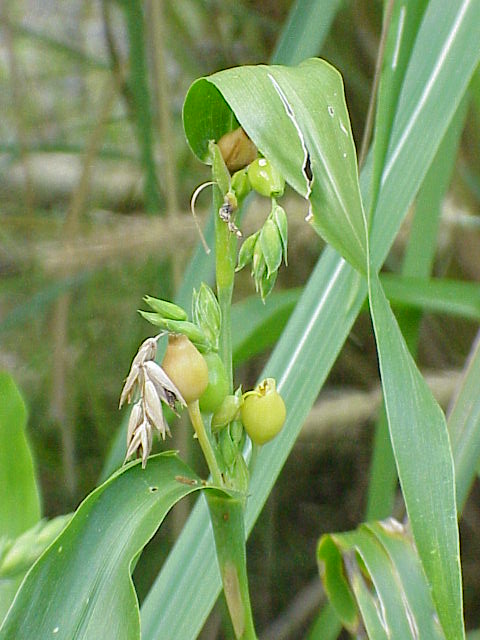
Job's tear is a monoecious grass which is broad-leaved, loose-growing, branched and robust. It can reach a height between 1.20 m to 1.80 m. Like all members of the genus, their inflorescences develop from a leaf sheath at the end of the stem and consist partly of hard, globular or oval, hollow, bead-like structures. Job's tear seeds differ in color, with the more soft-shelled seeds being light brown and the hard-shelled forms having a dark red pericarp.
The hardened "shells" covering the seeds are technically the fruit-case or involucre (hardened bract), with the bract also referred to as "capsule-spathe" or "sheathing bract" by some past botanical works.
Hub AI
Job's tears AI simulator
(@Job's tears_simulator)
Job's tears
Job's tears /dʒoʊbz/ (Coix lacryma-jobi), also known as adlay or adlay millet, is a tall grain-bearing perennial tropical plant of the family Poaceae (grass family). It is native to Southeast Asia and introduced to Northern China and India in remote antiquity, and elsewhere cultivated in gardens as an annual. It has been naturalized in the southern United States and the New World tropics. In its native environment it is grown at higher elevation areas where rice and corn do not grow well. Job's tears are also commonly sold as Chinese pearl barley, though true barley belongs to a completely different genus.
There are two main varieties of the species, one wild and one cultivated. The wild variety, Coix lacryma-jobi var. lacryma-jobi, has hard-shelled pseudocarps—very hard, pearly white, oval structures used as beads for making prayer beads or rosaries, necklaces, and other objects. The cultivated variety Coix lacryma-jobi var. ma-yuen is harvested as a cereal crop, has a soft shell, and is used in traditional medicine in parts of Asia.
Job's tears may also be referred to under different spellings (Job's-tears, Jobs-tears). The crop is also known by other common names in English, such as adlay or adlay millet. Other common names in English include coix seed, gromwell grass, and tear grass.
The seeds are known in Chinese as yìyǐ rén (薏苡仁), where rén means "kernel", and also described in Latin as semen coicis or semen coicis lachryma-jobi in pharmacopoeic literature.
The species, native to Southeast Asia, was named by Carl Linnaeus in 1753 with the epithet as a Latin translation of the metaphorical tear of Job. As of February 2015[update], four varieties are accepted by the World Checklist of Selected Plant Families:
Job's tears—along with Coix in —was formerly placed in the Maydeae, now known to be polyphyletic. It has cylindrical, longer than broad involucres. It is widely used as beads for ornaments.
Job's tear is a monoecious grass which is broad-leaved, loose-growing, branched and robust. It can reach a height between 1.20 m to 1.80 m. Like all members of the genus, their inflorescences develop from a leaf sheath at the end of the stem and consist partly of hard, globular or oval, hollow, bead-like structures. Job's tear seeds differ in color, with the more soft-shelled seeds being light brown and the hard-shelled forms having a dark red pericarp.
The hardened "shells" covering the seeds are technically the fruit-case or involucre (hardened bract), with the bract also referred to as "capsule-spathe" or "sheathing bract" by some past botanical works.