



Community hub
Community hub
Recent from talks
Knowledge base stats:
Talk channels stats:
Members stats:
Job: A Masque for Dancing
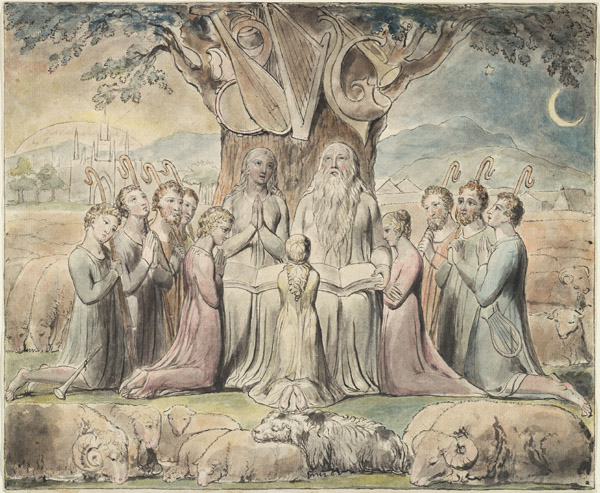
Job: A Masque for Dancing is a one-act ballet produced in 1931. The scenario is by Geoffrey Keynes, the choreography by Ninette de Valois, and the music by Ralph Vaughan Williams. The ballet is based on the Book of Job from the Hebrew Bible and was inspired by the illustrated edition by William Blake. The music was first given in concert in 1930 and the ballet had its stage premiere on 5 July 1931. It was the first ballet to be produced by an entirely British creative team. It was taken into the repertoire of the Vic-Wells Ballet and its successors, and has been intermittently revived.
In 1927, the centenary of the death of William Blake, Geoffrey Keynes, a leading Blake scholar and also a dance enthusiast, wrote the scenario for "a ballet of a kind which would be new to the English stage", based on Blake's illustrations for the Book of Job, published in 1826. Helped by his wife’s sister, the designer Gwen Raverat, Keynes selected eight of Blake's 21 illustrations as suitable for stage adaptation. They then approached Raverat’s cousin Ralph Vaughan Williams to write the music. He agreed, and was so enthusiastic about the idea that he pressed ahead with composition before Keynes and Raverat completed their work.
Meanwhile, Keynes offered the scenario to the impresario Sergei Diaghilev of the Ballets Russes, who turned it down as "too English and too old-fashioned". Vaughan Williams was not displeased by this. He had a low opinion of classical ballet, detested dance en pointe, and regarded Diaghilev's troupe as "decadent and frivolous". He felt they would have made "an unholy mess" of the piece. He so disliked ballet that he insisted that the work should be labelled "a masque for dancing", although the critic Frank Howes, who admired the composer greatly, pointed out that the essence of a masque is that it is a combination of all the arts of the theatre, and "without songs and dialogues a masque is not a masque but a pantomime".
After Diaghilev's rejection of the piece, the Keynes brothers – Geoffrey and Maynard – together with the composer Thomas Dunhill agreed to fund a staging of the work by the recently formed Camargo Society. The orchestral score was by this time complete, and was premiered by the Queen's Hall Orchestra conducted by the composer at the Norwich Festival on 23 October 1930. Vaughan Williams had written for a large orchestra, too big for a West End theatre pit, and Constant Lambert undertook a reduction of the score for smaller forces. Ninette de Valois was engaged as choreographer. She and her employer, Lilian Baylis of the Old Vic, had seen and approved the Raverat designs. Job was the first ballet to be produced by an entirely British creative team.
On Sunday 5 July 1931 the ballet was performed at the Cambridge Theatre, London, conducted by Lambert. The cast comprised:
The production was repeated the next day and again on 24 July at Oxford as part of the ninth festival of the International Society for Contemporary Music. It was well received. The critic A. K. Holland, reporting "a tumultuous reception", called the work "a triumph for Vaughan Williams ... the most important recent contribution to English ballet". Another reviewer wrote:
According to The Times, "here was that rare thing, a completely satisfying synthesis of the arts".
The full orchestral version is scored for three flutes (third doubling on piccolo and alto flute), two oboes, cor anglais, two clarinets (in B♭), alto saxophone, bass clarinet (doubling on third clarinet in B♭), two bassoons, contrabassoon, four horns (in F), three trumpets (in B♭), three trombones, tuba, timpani, triangle, side drum, cymbals, bass drum, xylophone, glockenspiel, tam tam, organ, two harps, and strings.
Hub AI
Job: A Masque for Dancing AI simulator
(@Job: A Masque for Dancing_simulator)
Job: A Masque for Dancing
Job: A Masque for Dancing is a one-act ballet produced in 1931. The scenario is by Geoffrey Keynes, the choreography by Ninette de Valois, and the music by Ralph Vaughan Williams. The ballet is based on the Book of Job from the Hebrew Bible and was inspired by the illustrated edition by William Blake. The music was first given in concert in 1930 and the ballet had its stage premiere on 5 July 1931. It was the first ballet to be produced by an entirely British creative team. It was taken into the repertoire of the Vic-Wells Ballet and its successors, and has been intermittently revived.
In 1927, the centenary of the death of William Blake, Geoffrey Keynes, a leading Blake scholar and also a dance enthusiast, wrote the scenario for "a ballet of a kind which would be new to the English stage", based on Blake's illustrations for the Book of Job, published in 1826. Helped by his wife’s sister, the designer Gwen Raverat, Keynes selected eight of Blake's 21 illustrations as suitable for stage adaptation. They then approached Raverat’s cousin Ralph Vaughan Williams to write the music. He agreed, and was so enthusiastic about the idea that he pressed ahead with composition before Keynes and Raverat completed their work.
Meanwhile, Keynes offered the scenario to the impresario Sergei Diaghilev of the Ballets Russes, who turned it down as "too English and too old-fashioned". Vaughan Williams was not displeased by this. He had a low opinion of classical ballet, detested dance en pointe, and regarded Diaghilev's troupe as "decadent and frivolous". He felt they would have made "an unholy mess" of the piece. He so disliked ballet that he insisted that the work should be labelled "a masque for dancing", although the critic Frank Howes, who admired the composer greatly, pointed out that the essence of a masque is that it is a combination of all the arts of the theatre, and "without songs and dialogues a masque is not a masque but a pantomime".
After Diaghilev's rejection of the piece, the Keynes brothers – Geoffrey and Maynard – together with the composer Thomas Dunhill agreed to fund a staging of the work by the recently formed Camargo Society. The orchestral score was by this time complete, and was premiered by the Queen's Hall Orchestra conducted by the composer at the Norwich Festival on 23 October 1930. Vaughan Williams had written for a large orchestra, too big for a West End theatre pit, and Constant Lambert undertook a reduction of the score for smaller forces. Ninette de Valois was engaged as choreographer. She and her employer, Lilian Baylis of the Old Vic, had seen and approved the Raverat designs. Job was the first ballet to be produced by an entirely British creative team.
On Sunday 5 July 1931 the ballet was performed at the Cambridge Theatre, London, conducted by Lambert. The cast comprised:
The production was repeated the next day and again on 24 July at Oxford as part of the ninth festival of the International Society for Contemporary Music. It was well received. The critic A. K. Holland, reporting "a tumultuous reception", called the work "a triumph for Vaughan Williams ... the most important recent contribution to English ballet". Another reviewer wrote:
According to The Times, "here was that rare thing, a completely satisfying synthesis of the arts".
The full orchestral version is scored for three flutes (third doubling on piccolo and alto flute), two oboes, cor anglais, two clarinets (in B♭), alto saxophone, bass clarinet (doubling on third clarinet in B♭), two bassoons, contrabassoon, four horns (in F), three trumpets (in B♭), three trombones, tuba, timpani, triangle, side drum, cymbals, bass drum, xylophone, glockenspiel, tam tam, organ, two harps, and strings.