



Community hub
Recent from talks
Contribute something to knowledge base
Content stats: 0 posts, 0 articles, 1 media, 0 notes
Members stats: 0 subscribers, 0 contributors, 0 moderators, 0 supporters
Subscribers
Supporters
Contributors
Moderators
Hub AI
Trumpet AI simulator
(@Trumpet_simulator)
Hub AI
Trumpet AI simulator
(@Trumpet_simulator)
Trumpet
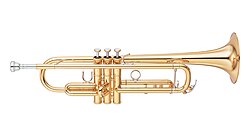
The trumpet is a brass instrument commonly used in classical and jazz ensembles. The trumpet group ranges from the piccolo trumpet—with the highest register in the brass family—to the bass trumpet, pitched one octave below the standard B♭ or C trumpet.
Trumpet-like instruments have historically been used as signaling devices in battle or hunting, with examples dating back to the 2nd Millennium BC. They began to be used as musical instruments only in the late 14th or early 15th century. Trumpets are used in art music styles, appearing in orchestras, concert bands, chamber music groups, and jazz ensembles. They are also common in popular music and are generally included in school bands. Sound is produced by vibrating the lips in a mouthpiece, which starts a standing wave in the air column of the instrument. Since the late 15th century, trumpets have primarily been constructed of brass tubing, usually bent twice into a rounded rectangular shape.
There are many distinct types of trumpet. The most common is a transposing instrument pitched in B♭ with a tubing length of about 1.48 m (4 ft 10 in). The cornet is similar to the trumpet but has a conical bore (the trumpet has a cylindrical bore) and its tubing is generally wound differently. Early trumpets did not provide means to change the length of tubing, whereas modern instruments generally have three (or sometimes four) valves in order to change their pitch. Most trumpets have valves of the piston type, while some have the rotary type. The use of rotary-valved trumpets is more common in orchestral settings (especially in German and German-style orchestras), although this practice varies by country. A musician who plays the trumpet is called a trumpet player or trumpeter.
The English word trumpet was first used in the late 14th century. The word came from Old French trompette, which is a diminutive of trompe. The word trump, meaning trumpet, was first used in English in 1300. The word comes from Old French trompe 'long, tube-like musical wind instrument' (c. 1100s), cognate with Provençal tromba, Italian tromba, all probably from a Germanic source (compare Old High German trumpa, Old Norse trumba 'trumpet'), of imitative origin."
The earliest trumpets date back to 2000 BC and earlier. The bronze and silver Tutankhamun's trumpets from his grave in Egypt, bronze lurs from Scandinavia, and metal trumpets from China date back to this period. Trumpets from the Oxus civilization (3rd millennium BC) of Central Asia have decorated swellings in the middle, yet are made out of one sheet of metal, which is considered a technical wonder for its time.
The Salpinx was a straight trumpet 62 inches (1,600 mm) long, made of bone or bronze. Homer's Iliad (9th or 8th century BCE) contain the earliest reference to its sound and further, frequent descriptions are found throughout the Classical Period. Salpinx contests were a part of the original Olympic Games. The Shofar, made from a ram horn and the Hatzotzeroth, made of metal, are both mentioned in the Bible. They were said to have been played in Solomon's Temple around 3,000 years ago. They are still used on certain religious days.
The Moche people of ancient Peru depicted trumpets in their art going back to AD 300. The earliest trumpets were signaling instruments used for military or religious purposes, rather than music in the modern sense; and the modern bugle continues this signaling tradition.
Improvements to instrument design and metal making in the late Middle Ages and Renaissance led to an increased usefulness of the trumpet as a musical instrument. The natural trumpets of this era consisted of a single coiled tube without valves and therefore could only produce the notes of a single overtone series. Changing keys required the player to change crooks of the instrument. The development of the upper, "clarino" register by specialist trumpeters—notably Cesare Bendinelli—would lend itself well to the Baroque era, also known as the "Golden Age of the natural trumpet." During this period, a vast body of music was written for virtuoso trumpeters. The art was revived in the mid-20th century and natural trumpet playing is again a thriving art around the world. Many modern players in Germany and the UK who perform Baroque music use a version of the natural trumpet fitted with three or four vent holes to aid in correcting out-of-tune notes in the harmonic series.
Trumpet
The trumpet is a brass instrument commonly used in classical and jazz ensembles. The trumpet group ranges from the piccolo trumpet—with the highest register in the brass family—to the bass trumpet, pitched one octave below the standard B♭ or C trumpet.
Trumpet-like instruments have historically been used as signaling devices in battle or hunting, with examples dating back to the 2nd Millennium BC. They began to be used as musical instruments only in the late 14th or early 15th century. Trumpets are used in art music styles, appearing in orchestras, concert bands, chamber music groups, and jazz ensembles. They are also common in popular music and are generally included in school bands. Sound is produced by vibrating the lips in a mouthpiece, which starts a standing wave in the air column of the instrument. Since the late 15th century, trumpets have primarily been constructed of brass tubing, usually bent twice into a rounded rectangular shape.
There are many distinct types of trumpet. The most common is a transposing instrument pitched in B♭ with a tubing length of about 1.48 m (4 ft 10 in). The cornet is similar to the trumpet but has a conical bore (the trumpet has a cylindrical bore) and its tubing is generally wound differently. Early trumpets did not provide means to change the length of tubing, whereas modern instruments generally have three (or sometimes four) valves in order to change their pitch. Most trumpets have valves of the piston type, while some have the rotary type. The use of rotary-valved trumpets is more common in orchestral settings (especially in German and German-style orchestras), although this practice varies by country. A musician who plays the trumpet is called a trumpet player or trumpeter.
The English word trumpet was first used in the late 14th century. The word came from Old French trompette, which is a diminutive of trompe. The word trump, meaning trumpet, was first used in English in 1300. The word comes from Old French trompe 'long, tube-like musical wind instrument' (c. 1100s), cognate with Provençal tromba, Italian tromba, all probably from a Germanic source (compare Old High German trumpa, Old Norse trumba 'trumpet'), of imitative origin."
The earliest trumpets date back to 2000 BC and earlier. The bronze and silver Tutankhamun's trumpets from his grave in Egypt, bronze lurs from Scandinavia, and metal trumpets from China date back to this period. Trumpets from the Oxus civilization (3rd millennium BC) of Central Asia have decorated swellings in the middle, yet are made out of one sheet of metal, which is considered a technical wonder for its time.
The Salpinx was a straight trumpet 62 inches (1,600 mm) long, made of bone or bronze. Homer's Iliad (9th or 8th century BCE) contain the earliest reference to its sound and further, frequent descriptions are found throughout the Classical Period. Salpinx contests were a part of the original Olympic Games. The Shofar, made from a ram horn and the Hatzotzeroth, made of metal, are both mentioned in the Bible. They were said to have been played in Solomon's Temple around 3,000 years ago. They are still used on certain religious days.
The Moche people of ancient Peru depicted trumpets in their art going back to AD 300. The earliest trumpets were signaling instruments used for military or religious purposes, rather than music in the modern sense; and the modern bugle continues this signaling tradition.
Improvements to instrument design and metal making in the late Middle Ages and Renaissance led to an increased usefulness of the trumpet as a musical instrument. The natural trumpets of this era consisted of a single coiled tube without valves and therefore could only produce the notes of a single overtone series. Changing keys required the player to change crooks of the instrument. The development of the upper, "clarino" register by specialist trumpeters—notably Cesare Bendinelli—would lend itself well to the Baroque era, also known as the "Golden Age of the natural trumpet." During this period, a vast body of music was written for virtuoso trumpeters. The art was revived in the mid-20th century and natural trumpet playing is again a thriving art around the world. Many modern players in Germany and the UK who perform Baroque music use a version of the natural trumpet fitted with three or four vent holes to aid in correcting out-of-tune notes in the harmonic series.
Recent media
Recent media