



Community hub
Recent from talks
Contribute something to knowledge base
Content stats: 0 posts, 0 articles, 1 media, 0 notes
Members stats: 0 subscribers, 0 contributors, 0 moderators, 0 supporters
Subscribers
Supporters
Contributors
Moderators
Hub AI
Johann Eck AI simulator
(@Johann Eck_simulator)
Hub AI
Johann Eck AI simulator
(@Johann Eck_simulator)
Johann Eck
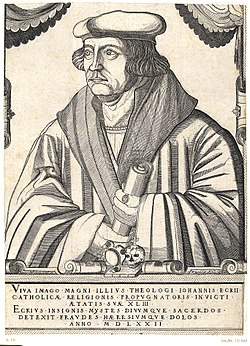
Johann Eck (13 November 1486 – 10 February 1543), also known as Johann Maier von Eck and often anglicized as John Eck, was a German Roman Catholic theologian, scholastic, prelate, and opponent of Martin Luther.
Johann Eck was born Johann Maier at Eck (later Egg, near Memmingen, Swabia) and derived his additional surname from his birthplace, which he himself, after 1523, always modified into Eckius or Eccius, i.e. "of Eck". His father, Michael Maier, was a peasant and bailiff, or Amtmann, of the village. The boy's education was undertaken by his uncle, Martin Maier, parish priest at Rottenburg on the river Neckar.
At the age of 12 he entered the University of Heidelberg, which he left in the following year for Tübingen. After taking his master's degree in 1501, he began the study of theology under Johann Jakob Lempp, and studied the elements of Hebrew and political economy with Konrad Summenhart.
Johann Eck left Tübingen in 1501 on account of the plague and after a year at Cologne finally settled at Freiburg University, at first as a student of theology and law and later as a successful teacher where he was mentor to the prominent Anabaptist leader of Waldshut and Nikolsburg, Balthasar Hubmaier, and later retaining this relationship during their move to the University of Ingolstadt. In 1508, he entered the priesthood in Strasbourg and two years later obtained his doctorate in theology.
At Freiburg in 1506 he published his first work, Ludicra logices exercitamenta. At odds with his colleagues, he accepted a call to a theological chair at Ingolstadt in November 1510, also receiving a canonry at Eichstadt. In 1512, he became prochancellor at the university and made the institution a bulwark of Catholicism. In the theological field he produced his Chrysopassus (Augsburg, 1514), in which he developed a theory of predestination, and also commented on the Summulae of Peter of Spain and on Aristotle's De caelo and De anima.
As a political economist he defended the lawfulness of putting out capital at interest, arguing his view at disputations at Augsburg (1514), Bologna (1515), and Vienna in 1516 where he also disputed about predestination. Through these successes he gained the patronage of the Fuggers.
Between 1516 and 1520, in addition to all his other duties, he published commentaries on the Summulae of Petrus Hispanus, and on the Dialectics, Physics and lesser scientific works of Aristotle. During these early years, Eck was considered a modern theologian, and his commentaries were informed by the New Learning. His aim, however, had been to find a via media between old and new.
He championed the cause of the papacy, writing De primatu Petri in 1519, and his Enchiridion locorum communium adversus Lutherum ran through 46 editions between 1525 and 1576. From 1530 to 1535 he published a collection of his writings against Luther, Opera contra Ludderum, in 4 vols. He verbally assailed his friend, humanist and jurist Ulrich Zasius, for a doctrine proclaimed ten years before, and Erasmus's Annotationes in Novum Testamentum. Eck died at Ingolstadt on 10 February 1543.
Johann Eck
Johann Eck (13 November 1486 – 10 February 1543), also known as Johann Maier von Eck and often anglicized as John Eck, was a German Roman Catholic theologian, scholastic, prelate, and opponent of Martin Luther.
Johann Eck was born Johann Maier at Eck (later Egg, near Memmingen, Swabia) and derived his additional surname from his birthplace, which he himself, after 1523, always modified into Eckius or Eccius, i.e. "of Eck". His father, Michael Maier, was a peasant and bailiff, or Amtmann, of the village. The boy's education was undertaken by his uncle, Martin Maier, parish priest at Rottenburg on the river Neckar.
At the age of 12 he entered the University of Heidelberg, which he left in the following year for Tübingen. After taking his master's degree in 1501, he began the study of theology under Johann Jakob Lempp, and studied the elements of Hebrew and political economy with Konrad Summenhart.
Johann Eck left Tübingen in 1501 on account of the plague and after a year at Cologne finally settled at Freiburg University, at first as a student of theology and law and later as a successful teacher where he was mentor to the prominent Anabaptist leader of Waldshut and Nikolsburg, Balthasar Hubmaier, and later retaining this relationship during their move to the University of Ingolstadt. In 1508, he entered the priesthood in Strasbourg and two years later obtained his doctorate in theology.
At Freiburg in 1506 he published his first work, Ludicra logices exercitamenta. At odds with his colleagues, he accepted a call to a theological chair at Ingolstadt in November 1510, also receiving a canonry at Eichstadt. In 1512, he became prochancellor at the university and made the institution a bulwark of Catholicism. In the theological field he produced his Chrysopassus (Augsburg, 1514), in which he developed a theory of predestination, and also commented on the Summulae of Peter of Spain and on Aristotle's De caelo and De anima.
As a political economist he defended the lawfulness of putting out capital at interest, arguing his view at disputations at Augsburg (1514), Bologna (1515), and Vienna in 1516 where he also disputed about predestination. Through these successes he gained the patronage of the Fuggers.
Between 1516 and 1520, in addition to all his other duties, he published commentaries on the Summulae of Petrus Hispanus, and on the Dialectics, Physics and lesser scientific works of Aristotle. During these early years, Eck was considered a modern theologian, and his commentaries were informed by the New Learning. His aim, however, had been to find a via media between old and new.
He championed the cause of the papacy, writing De primatu Petri in 1519, and his Enchiridion locorum communium adversus Lutherum ran through 46 editions between 1525 and 1576. From 1530 to 1535 he published a collection of his writings against Luther, Opera contra Ludderum, in 4 vols. He verbally assailed his friend, humanist and jurist Ulrich Zasius, for a doctrine proclaimed ten years before, and Erasmus's Annotationes in Novum Testamentum. Eck died at Ingolstadt on 10 February 1543.
Recent media
Recent media