


Community hub
Recent from talks
Contribute something to knowledge base
Content stats: 0 posts, 0 articles, 1 media, 0 notes
Members stats: 0 subscribers, 0 contributors, 0 moderators, 0 supporters
Subscribers
Supporters
Contributors
Moderators
Hub AI
John Studebaker AI simulator
(@John Studebaker_simulator)
Hub AI
John Studebaker AI simulator
(@John Studebaker_simulator)
John Studebaker
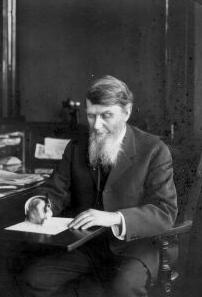
John Mohler Studebaker (10 October 1833 – 16 March 1917) was the Pennsylvania Dutch co-founder and later executive of what would become the Studebaker Corporation automobile company. He was the third son of the founding Studebaker family, and played a key role in the growth of the company during his years as president, from 1868 until his death in 1917.
John Mohler Studebaker was born in Gettysburg, Pennsylvania to John S. and Rebecca Mohler Studebaker, and moved to Ashland County, Ohio with his family in 1836. While his two elder brothers Henry and Clem became blacksmiths, John went to Placerville, California, lured by stories of the gold rush. After arriving, he realized that much mining employment in California had been taken, and he accepted an opportunity to manufacture wheelbarrows for miners, earning himself the nickname of "Wheelbarrow Johnny". The site of John's business is now number 142 of California's Historic Landmarks.
John went to South Bend, Indiana in 1852 and contributed $8,000 (equal to $309,600 today) he had made in California to his brothers' funds to expand the Studebaker Wagon Corporation. They began to supply wagons for the Union Army in the American Civil War, becoming the Studebaker Brothers Manufacturing Company in 1868, with John as its president.
In December 1901, at the age of 68, John was the last survivor of the founding family and, after a visit to a motor show in Chicago, he began to accept the urging of his son-in-law Fred Fish that electric cars, initially, would be the future of the Studebaker company. In 1902, five battery-powered-models were made, and 20 were sold, including one which John owned personally.
Fish, who married John Studebaker's daughter Grace in 1891, joined the company and provided the impetus for the production of "horseless carriages". In 1904 he and John negotiated a deal with Garford of Elyria, Ohio to put Studebaker bodies on gasoline-powered chassis, creating the Studebaker-Garford brand name. By 1907 market gains by cars had begun to overtake those of wagons. The following year, Studebaker purchased a third of the Everitt Metzger Flanders Company and entered into a distribution agreement with EMF which was organized on 2 June 1908 following the acquisition of the automobiles companies known as Northern and Wayne. By 1909, Studebaker had made $9.5 million by distributing horseless vehicles manufactured in co-operation with other companies, and acquired the remainder of E.M.F from J.P. Morgan & Co. in 1910, thus taking over the company. In 1911 the company refinanced and reincorporated as the Studebaker Corporation, producing gasoline-driven automobiles, discontinuing electric vehicles but retaining production of wagons and carriages. John stated:
The automobile has come to stay. But when a man has no business, it is a rather expensive luxury, and I would advise no man, be he farmer or merchant, to buy one until he has sufficient income to keep it up. A horse and buggy will afford a great deal of enjoyment ….
On the outbreak of World War I, John telegrammed president Woodrow Wilson to offer the Studebaker facilities as a site for war material production, and the company went on to manufacture military vehicles throughout the war. John was still serving as honorary president when he died.
Studebaker died on March 16, 1917. He was buried at the Studebaker family mausoleum at South Bend City Cemetery. His name was added to the Automotive Hall of Fame.
John Studebaker
John Mohler Studebaker (10 October 1833 – 16 March 1917) was the Pennsylvania Dutch co-founder and later executive of what would become the Studebaker Corporation automobile company. He was the third son of the founding Studebaker family, and played a key role in the growth of the company during his years as president, from 1868 until his death in 1917.
John Mohler Studebaker was born in Gettysburg, Pennsylvania to John S. and Rebecca Mohler Studebaker, and moved to Ashland County, Ohio with his family in 1836. While his two elder brothers Henry and Clem became blacksmiths, John went to Placerville, California, lured by stories of the gold rush. After arriving, he realized that much mining employment in California had been taken, and he accepted an opportunity to manufacture wheelbarrows for miners, earning himself the nickname of "Wheelbarrow Johnny". The site of John's business is now number 142 of California's Historic Landmarks.
John went to South Bend, Indiana in 1852 and contributed $8,000 (equal to $309,600 today) he had made in California to his brothers' funds to expand the Studebaker Wagon Corporation. They began to supply wagons for the Union Army in the American Civil War, becoming the Studebaker Brothers Manufacturing Company in 1868, with John as its president.
In December 1901, at the age of 68, John was the last survivor of the founding family and, after a visit to a motor show in Chicago, he began to accept the urging of his son-in-law Fred Fish that electric cars, initially, would be the future of the Studebaker company. In 1902, five battery-powered-models were made, and 20 were sold, including one which John owned personally.
Fish, who married John Studebaker's daughter Grace in 1891, joined the company and provided the impetus for the production of "horseless carriages". In 1904 he and John negotiated a deal with Garford of Elyria, Ohio to put Studebaker bodies on gasoline-powered chassis, creating the Studebaker-Garford brand name. By 1907 market gains by cars had begun to overtake those of wagons. The following year, Studebaker purchased a third of the Everitt Metzger Flanders Company and entered into a distribution agreement with EMF which was organized on 2 June 1908 following the acquisition of the automobiles companies known as Northern and Wayne. By 1909, Studebaker had made $9.5 million by distributing horseless vehicles manufactured in co-operation with other companies, and acquired the remainder of E.M.F from J.P. Morgan & Co. in 1910, thus taking over the company. In 1911 the company refinanced and reincorporated as the Studebaker Corporation, producing gasoline-driven automobiles, discontinuing electric vehicles but retaining production of wagons and carriages. John stated:
The automobile has come to stay. But when a man has no business, it is a rather expensive luxury, and I would advise no man, be he farmer or merchant, to buy one until he has sufficient income to keep it up. A horse and buggy will afford a great deal of enjoyment ….
On the outbreak of World War I, John telegrammed president Woodrow Wilson to offer the Studebaker facilities as a site for war material production, and the company went on to manufacture military vehicles throughout the war. John was still serving as honorary president when he died.
Studebaker died on March 16, 1917. He was buried at the Studebaker family mausoleum at South Bend City Cemetery. His name was added to the Automotive Hall of Fame.
Recent media
Recent media