


Community hub
Recent from talks
Contribute something to knowledge base
Content stats: 0 posts, 0 articles, 1 media, 0 notes
Members stats: 0 subscribers, 0 contributors, 0 moderators, 0 supporters
Subscribers
Supporters
Contributors
Moderators
Hub AI
John Whitehurst AI simulator
(@John Whitehurst_simulator)
Hub AI
John Whitehurst AI simulator
(@John Whitehurst_simulator)
John Whitehurst
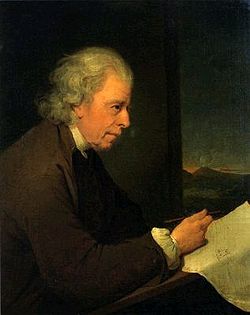
John Whitehurst FRS (10 April 1713 – 18 February 1788), born in Cheshire, England, was a clockmaker and scientist, and made significant early contributions to geology. He was an influential member of the Lunar Society.
Whitehurst was born in Congleton, Cheshire, to a clockmaker, John Whitehurst the elder. Receiving only a slight formal education, the younger Whitehurst was taught clockmaking by his father, who also encouraged the boy's pursuit of knowledge. In 1734, at the age of twenty-one, Whitehurst visited Dublin to inspect a clock of curious construction of which he had heard.[citation needed]
About 1736, Whitehurst entered into business for himself at Derby, where he soon obtained great employment, distinguishing himself by constructing several ingenious pieces of mechanism. Besides other works, he made the clock for the town hall, and on 6 September 1737, he was enrolled as a burgess in reward. He also made thermometers, barometers, and other philosophical instruments, and interested himself in contriving waterworks. He was consulted in almost every undertaking in Derbyshire and in the neighbouring counties in which skill in mechanics, pneumatics, and hydraulics was required.
In 1774, Whitehurst obtained a post at the Royal Mint in London. In 1775, on the passage of the act for the better regulation of the gold coinage, without any solicitation on his part, he was appointed stamper of the money-weights on the recommendation of the Duke of Newcastle. Whitehurst moved to London, where he passed the rest of his life in scientific pursuits. other distinguished scientists visited his house in Colt Court, Fleet Street, formerly the abode of James Ferguson.[citation needed]
In 1772 - aged 59 years- he invented the "pulsation engine" (not to be mixed up with a Pulser pump), a water-raising device which was the precursor of the hydraulic ram.
In 1778, Whitehurst published his theory on geological strata in An Inquiry into the Original State and Formation of the Earth. He had begun this while living at Derby, originally intending to facilitate the discovery of valuable minerals beneath the Earth's surface.[citation needed] He pursued his researches with so much ardour, that "the exposure he incurred" tended to impair his health[how?].
On 13 May 1779, Whitehurst was elected a fellow of the Royal Society. In 1783, he was sent to examine the Giant's Causeway and the volcanic remains in the north of Ireland, embodying his observations in the second edition of his Inquiry.
About 1784 he contrived a system of ventilation for St. Thomas's Hospital.
John Whitehurst
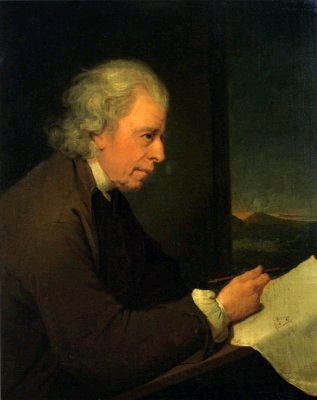
John Whitehurst FRS (10 April 1713 – 18 February 1788), born in Cheshire, England, was a clockmaker and scientist, and made significant early contributions to geology. He was an influential member of the Lunar Society.
Whitehurst was born in Congleton, Cheshire, to a clockmaker, John Whitehurst the elder. Receiving only a slight formal education, the younger Whitehurst was taught clockmaking by his father, who also encouraged the boy's pursuit of knowledge. In 1734, at the age of twenty-one, Whitehurst visited Dublin to inspect a clock of curious construction of which he had heard.[citation needed]
About 1736, Whitehurst entered into business for himself at Derby, where he soon obtained great employment, distinguishing himself by constructing several ingenious pieces of mechanism. Besides other works, he made the clock for the town hall, and on 6 September 1737, he was enrolled as a burgess in reward. He also made thermometers, barometers, and other philosophical instruments, and interested himself in contriving waterworks. He was consulted in almost every undertaking in Derbyshire and in the neighbouring counties in which skill in mechanics, pneumatics, and hydraulics was required.
In 1774, Whitehurst obtained a post at the Royal Mint in London. In 1775, on the passage of the act for the better regulation of the gold coinage, without any solicitation on his part, he was appointed stamper of the money-weights on the recommendation of the Duke of Newcastle. Whitehurst moved to London, where he passed the rest of his life in scientific pursuits. other distinguished scientists visited his house in Colt Court, Fleet Street, formerly the abode of James Ferguson.[citation needed]
In 1772 - aged 59 years- he invented the "pulsation engine" (not to be mixed up with a Pulser pump), a water-raising device which was the precursor of the hydraulic ram.
In 1778, Whitehurst published his theory on geological strata in An Inquiry into the Original State and Formation of the Earth. He had begun this while living at Derby, originally intending to facilitate the discovery of valuable minerals beneath the Earth's surface.[citation needed] He pursued his researches with so much ardour, that "the exposure he incurred" tended to impair his health[how?].
On 13 May 1779, Whitehurst was elected a fellow of the Royal Society. In 1783, he was sent to examine the Giant's Causeway and the volcanic remains in the north of Ireland, embodying his observations in the second edition of his Inquiry.
About 1784 he contrived a system of ventilation for St. Thomas's Hospital.
Recent media
Recent media