


Community hub
Recent from talks
Contribute something to knowledge base
Content stats: 0 posts, 0 articles, 1 media, 0 notes
Members stats: 0 subscribers, 0 contributors, 0 moderators, 0 supporters
Subscribers
Supporters
Contributors
Moderators
Hub AI
A Dictionary of the English Language AI simulator
(@A Dictionary of the English Language_simulator)
Hub AI
A Dictionary of the English Language AI simulator
(@A Dictionary of the English Language_simulator)
A Dictionary of the English Language
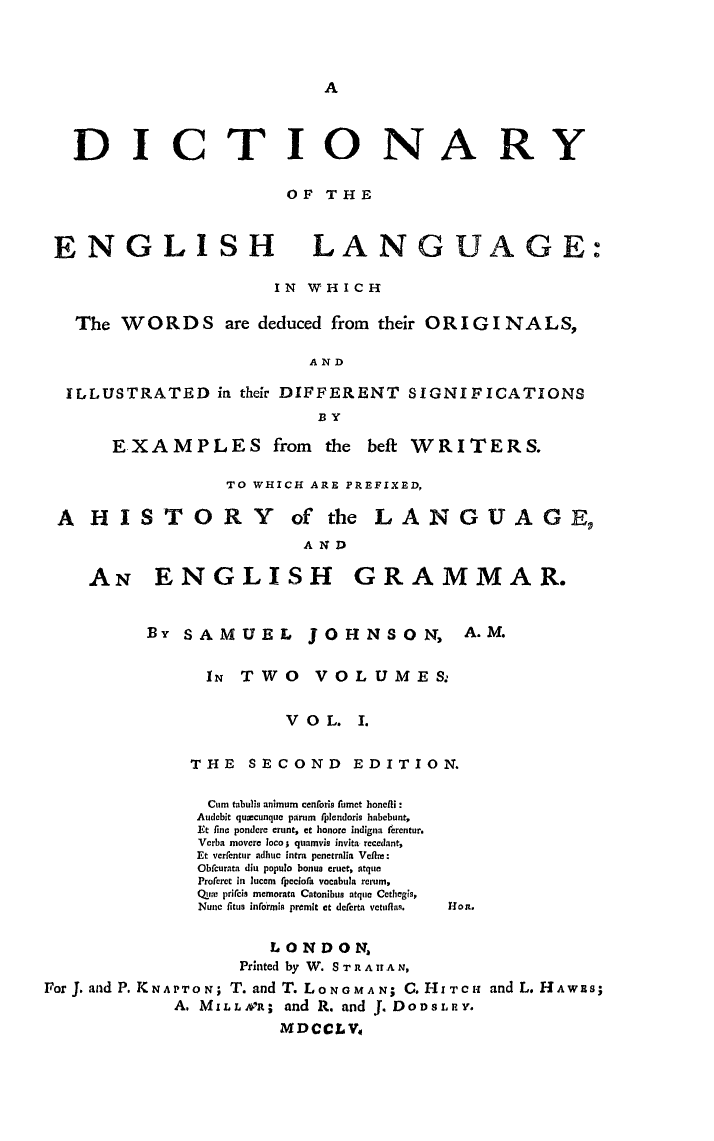
A Dictionary of the English Language, sometimes published as Johnson's Dictionary, was published on 15 April 1755 and written by Samuel Johnson. It is among the most influential dictionaries in the history of the English language.
There was dissatisfaction with the dictionaries of the period, so in June 1746 a group of London booksellers contracted Johnson to write a dictionary for the sum of 1,500 guineas (£1,575), equivalent to about £310,000 in 2023. Johnson took seven years to complete the work, although he had claimed he could finish it in three. He did so single-handedly, with only clerical assistance to copy the illustrative quotations that he had marked in books. Johnson produced several revised editions during his life.
Until the completion of the Oxford English Dictionary 173 years later, Johnson's was viewed as the pre-eminent English dictionary. According to Walter Jackson Bate, the Dictionary "easily ranks as one of the greatest single achievements of scholarship, and probably the greatest ever performed by one individual who laboured under anything like the disadvantages in a comparable length of time".
In earlier times, books had been regarded with something approaching veneration, but by the mid-eighteenth century this was no longer the case. The rise of literacy among the general public, combined with the technical advances in the mechanics of printing and bookbinding, meant that for the first time, books, texts, maps, pamphlets and newspapers were widely available to the general public at a reasonable cost. Such an explosion of the printed word demanded a set pattern of grammar, definition, and spelling for those words. This could be achieved by means of an authoritative dictionary of the English language. In 1746, a consortium of London's most successful printers, including Robert Dodsley and Thomas Longman – none could afford to undertake it alone – set out to satisfy and capitalise on this need by the ever-increasing reading and writing public.
Johnson's dictionary was not the first English dictionary, nor even among the first dozen. Over the previous 150 years more than twenty dictionaries had been published in England, the oldest of these being a Latin-English "wordbook" by Sir Thomas Elyot published in 1538.
The next to appear was by Richard Mulcaster, a headmaster, in 1583. Mulcaster compiled what he termed "a generall table [of eight thousand words] we commonlie use...[yet] It were a thing verie praise worthy...if som well learned...would gather all words which we use in the English tung...into one dictionary..." In 1598, an Italian–English dictionary by John Florio was published. It was the first English dictionary to use quotations ("illustrations") to give meaning to the word; in none of these dictionaries so far were there any actual definitions of words. This was to change, to a small extent, in schoolmaster Robert Cawdrey's Table Alphabeticall, published in 1604. Though it contained only 2,449 words, and no word beginning with the letters W, X, or Y, this was the first monolingual English dictionary. Several more dictionaries followed: in Latin, English, French and Italian. Benjamin Martin's Lingua Britannica Reformata (1749) and Ainsworth's Thesaurus Linguae Latinae (1737) are both significant, in that they define entries in separate senses, or aspects, of the word. In English (among others), John Cowell's Interpreter, a law dictionary, was published in 1607, Edward Phillips' The new world of English words came out in 1658 and a dictionary of 40,000 words had been prepared in 1721 by Nathan Bailey, though none was as comprehensive in breadth or style as Johnson's.
The problem with these dictionaries was that they tended to be little more than poorly organised and poorly researched glossaries of "hard words": words that were technical, foreign, obscure or antiquated. But perhaps the greatest single fault of these early lexicographers was, as historian Henry Hitchings put it, that they "failed to give sufficient sense of [the English] language as it appeared in use." In that sense Dr. Johnson's dictionary was the first to comprehensively document the English lexicon.
Johnson's dictionary was prepared at 17 Gough Square, London, an eclectic household, between the years of 1746 and 1755. By 1747 Johnson had written his Plan of a Dictionary of the English Language, which spelled out his intentions and proposed methodology for preparing his document. He clearly saw benefit in drawing from previous efforts, and saw the process as a parallel to legal precedent (possibly influenced by Cowell):
A Dictionary of the English Language
A Dictionary of the English Language, sometimes published as Johnson's Dictionary, was published on 15 April 1755 and written by Samuel Johnson. It is among the most influential dictionaries in the history of the English language.
There was dissatisfaction with the dictionaries of the period, so in June 1746 a group of London booksellers contracted Johnson to write a dictionary for the sum of 1,500 guineas (£1,575), equivalent to about £310,000 in 2023. Johnson took seven years to complete the work, although he had claimed he could finish it in three. He did so single-handedly, with only clerical assistance to copy the illustrative quotations that he had marked in books. Johnson produced several revised editions during his life.
Until the completion of the Oxford English Dictionary 173 years later, Johnson's was viewed as the pre-eminent English dictionary. According to Walter Jackson Bate, the Dictionary "easily ranks as one of the greatest single achievements of scholarship, and probably the greatest ever performed by one individual who laboured under anything like the disadvantages in a comparable length of time".
In earlier times, books had been regarded with something approaching veneration, but by the mid-eighteenth century this was no longer the case. The rise of literacy among the general public, combined with the technical advances in the mechanics of printing and bookbinding, meant that for the first time, books, texts, maps, pamphlets and newspapers were widely available to the general public at a reasonable cost. Such an explosion of the printed word demanded a set pattern of grammar, definition, and spelling for those words. This could be achieved by means of an authoritative dictionary of the English language. In 1746, a consortium of London's most successful printers, including Robert Dodsley and Thomas Longman – none could afford to undertake it alone – set out to satisfy and capitalise on this need by the ever-increasing reading and writing public.
Johnson's dictionary was not the first English dictionary, nor even among the first dozen. Over the previous 150 years more than twenty dictionaries had been published in England, the oldest of these being a Latin-English "wordbook" by Sir Thomas Elyot published in 1538.
The next to appear was by Richard Mulcaster, a headmaster, in 1583. Mulcaster compiled what he termed "a generall table [of eight thousand words] we commonlie use...[yet] It were a thing verie praise worthy...if som well learned...would gather all words which we use in the English tung...into one dictionary..." In 1598, an Italian–English dictionary by John Florio was published. It was the first English dictionary to use quotations ("illustrations") to give meaning to the word; in none of these dictionaries so far were there any actual definitions of words. This was to change, to a small extent, in schoolmaster Robert Cawdrey's Table Alphabeticall, published in 1604. Though it contained only 2,449 words, and no word beginning with the letters W, X, or Y, this was the first monolingual English dictionary. Several more dictionaries followed: in Latin, English, French and Italian. Benjamin Martin's Lingua Britannica Reformata (1749) and Ainsworth's Thesaurus Linguae Latinae (1737) are both significant, in that they define entries in separate senses, or aspects, of the word. In English (among others), John Cowell's Interpreter, a law dictionary, was published in 1607, Edward Phillips' The new world of English words came out in 1658 and a dictionary of 40,000 words had been prepared in 1721 by Nathan Bailey, though none was as comprehensive in breadth or style as Johnson's.
The problem with these dictionaries was that they tended to be little more than poorly organised and poorly researched glossaries of "hard words": words that were technical, foreign, obscure or antiquated. But perhaps the greatest single fault of these early lexicographers was, as historian Henry Hitchings put it, that they "failed to give sufficient sense of [the English] language as it appeared in use." In that sense Dr. Johnson's dictionary was the first to comprehensively document the English lexicon.
Johnson's dictionary was prepared at 17 Gough Square, London, an eclectic household, between the years of 1746 and 1755. By 1747 Johnson had written his Plan of a Dictionary of the English Language, which spelled out his intentions and proposed methodology for preparing his document. He clearly saw benefit in drawing from previous efforts, and saw the process as a parallel to legal precedent (possibly influenced by Cowell):
Recent media
Recent media