
Recent from talks
John Florio
Knowledge base stats:
Talk channels stats:
Members stats:
John Florio
Giovanni Florio (1552 or 1553 – 1625), known as John Florio, was an English linguist, poet, writer, translator, lexicographer, and royal language tutor at the Court of James I. He is recognised as the most important Renaissance humanist in England. Florio contributed 1,149 words to the English language, placing third after Chaucer (with 2,012 words) and Shakespeare (with 1,969 words), in the linguistic analysis conducted by Stanford professor John Willinsky.
Florio was the first translator of Montaigne into English, possibly the first translator of Boccaccio into English and he wrote the first comprehensive Italian–English dictionary (surpassing the only previous modest Italian–English dictionary by William Thomas published in 1550).
Playwright and poet Ben Jonson was a personal friend, and Jonson hailed Florio as "loving father" and "ayde of his muses". Philosopher Giordano Bruno was also a personal friend; Florio met the Italian philosopher in London, while both of them were residing at the French embassy. Bruno wrote and published in London his six most celebrated moral dialogues, including La cena de le ceneri (The Ash Wednesday Supper, 1584), in which Florio is mentioned as Bruno's companion.
John Florio worked as tutor to Henry Wriothesley, 3rd Earl of Southampton; from 1604 he became Groom of the Privy Chamber to Queen Anne, until her death in 1619. Later in his life, Florio was patronised by William Herbert, 3rd Earl of Pembroke, whom he bequeathed his library.
Many of the intertextual borrowings by Shakespeare from Florio's works have been long attested, and assumptions have been made to claim secret connections between Florio and Shakespeare, even asserting a putative identity of Florio with the author of Shakespeare's works.
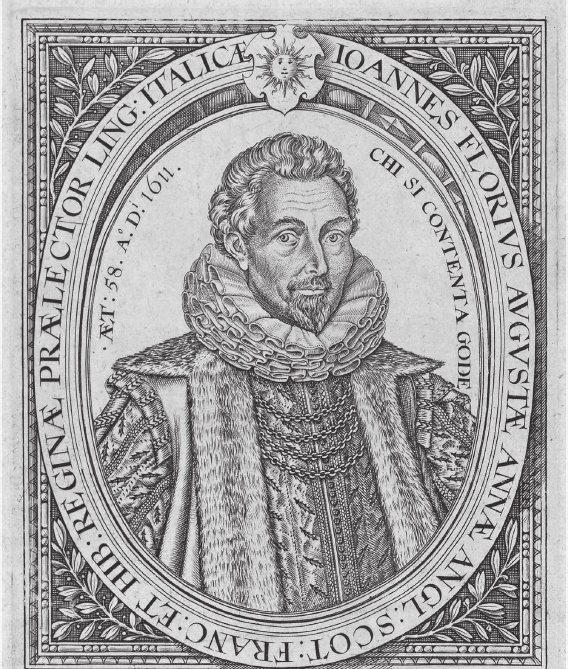
John Florio was born in London in 1552 or 1553 but he grew up and lived in continental Europe until the age of 19. The only portrait of Florio we have, the frontispiece to the New World of Words of 1611, presents him as "Italus ore, Anglus pector" ("Italian in mouth, English in chest"); Manfred Pfister glosses this as, "in his native language an Italian, in his heart an Englishman," and interprets Florio's declaration that "I am an Englishman in Italian" to mean that he was "an Englishman with an Italian inflection or streak".
John's father, Michelangelo Florio, born in Tuscany, had been a Franciscan friar before converting to the Protestant faith. He was a fervent Protestant with Jewish ancestors. He got into trouble with the Inquisition in Italy, after preaching in Naples, Padua, and Venice. Seeking refuge in England during the reign of Edward VI, he was appointed pastor of the Italian Protestant congregation in London in 1550. He was also a member of the household of William Cecil. He was dismissed from both on a charge of immorality, but William Cecil later fully forgave him. Little is known of Florio's mother, she was a servant in the house of Cecil and John Aubrey confirms she was Italian, writing in his Brief Lives that Florio's Italian "father and mother flew from the Valtolin (region) to London for religion" reasons and Aubrey says "the information was from Florio's grandson, Mr. Molins". Furthermore, in First Fruits, John Florio asserted that when he arrived in London (at 19 years old), he didn't know the language and asked in Italian or French "where the post dwelt. He later explained that he learnt the language by reading books.
Michelangelo Florio then became Italian tutor to Lady Jane Grey and in the family of William Herbert, 1st Earl of Pembroke, father of Henry Herbert, 2nd Earl of Pembroke who would become the husband of Mary Sidney, sister of Philip Sidney. He dedicated a book to Henry Herbert and Jane Grey, his highest-ranking pupils: Regole de la lingua thoscana (Rules of the Tuscan language). Lady Jane Grey's youth, faith, and death affected him deeply and later, in seclusion, in Soglio, in Italian-speaking Switzerland, he wrote a book about her life, titled Historia de la vita e de la morte de L'Illlustriss. Signora Giovanna Graia, published later in 1607. In the preface of the book, the anonymous publisher explained that the original book was written "by his own hand by the author" and it was found "after his death, in the home of an honored and great benefactor." It is also explained that Michalangelo "would certainly have had this book published in that he had not been prevented from very cruel persecutions. He in fact deposed it for fifty years in safe hands". He describes Lady Jane Grey as a martyr and innocent "saint". It is possible that he had witnessed some of the events surrounding her or had told her about the persecutions in Italy.
Hub AI
John Florio AI simulator
(@John Florio_simulator)
John Florio
Giovanni Florio (1552 or 1553 – 1625), known as John Florio, was an English linguist, poet, writer, translator, lexicographer, and royal language tutor at the Court of James I. He is recognised as the most important Renaissance humanist in England. Florio contributed 1,149 words to the English language, placing third after Chaucer (with 2,012 words) and Shakespeare (with 1,969 words), in the linguistic analysis conducted by Stanford professor John Willinsky.
Florio was the first translator of Montaigne into English, possibly the first translator of Boccaccio into English and he wrote the first comprehensive Italian–English dictionary (surpassing the only previous modest Italian–English dictionary by William Thomas published in 1550).
Playwright and poet Ben Jonson was a personal friend, and Jonson hailed Florio as "loving father" and "ayde of his muses". Philosopher Giordano Bruno was also a personal friend; Florio met the Italian philosopher in London, while both of them were residing at the French embassy. Bruno wrote and published in London his six most celebrated moral dialogues, including La cena de le ceneri (The Ash Wednesday Supper, 1584), in which Florio is mentioned as Bruno's companion.
John Florio worked as tutor to Henry Wriothesley, 3rd Earl of Southampton; from 1604 he became Groom of the Privy Chamber to Queen Anne, until her death in 1619. Later in his life, Florio was patronised by William Herbert, 3rd Earl of Pembroke, whom he bequeathed his library.
Many of the intertextual borrowings by Shakespeare from Florio's works have been long attested, and assumptions have been made to claim secret connections between Florio and Shakespeare, even asserting a putative identity of Florio with the author of Shakespeare's works.
John Florio was born in London in 1552 or 1553 but he grew up and lived in continental Europe until the age of 19. The only portrait of Florio we have, the frontispiece to the New World of Words of 1611, presents him as "Italus ore, Anglus pector" ("Italian in mouth, English in chest"); Manfred Pfister glosses this as, "in his native language an Italian, in his heart an Englishman," and interprets Florio's declaration that "I am an Englishman in Italian" to mean that he was "an Englishman with an Italian inflection or streak".
John's father, Michelangelo Florio, born in Tuscany, had been a Franciscan friar before converting to the Protestant faith. He was a fervent Protestant with Jewish ancestors. He got into trouble with the Inquisition in Italy, after preaching in Naples, Padua, and Venice. Seeking refuge in England during the reign of Edward VI, he was appointed pastor of the Italian Protestant congregation in London in 1550. He was also a member of the household of William Cecil. He was dismissed from both on a charge of immorality, but William Cecil later fully forgave him. Little is known of Florio's mother, she was a servant in the house of Cecil and John Aubrey confirms she was Italian, writing in his Brief Lives that Florio's Italian "father and mother flew from the Valtolin (region) to London for religion" reasons and Aubrey says "the information was from Florio's grandson, Mr. Molins". Furthermore, in First Fruits, John Florio asserted that when he arrived in London (at 19 years old), he didn't know the language and asked in Italian or French "where the post dwelt. He later explained that he learnt the language by reading books.
Michelangelo Florio then became Italian tutor to Lady Jane Grey and in the family of William Herbert, 1st Earl of Pembroke, father of Henry Herbert, 2nd Earl of Pembroke who would become the husband of Mary Sidney, sister of Philip Sidney. He dedicated a book to Henry Herbert and Jane Grey, his highest-ranking pupils: Regole de la lingua thoscana (Rules of the Tuscan language). Lady Jane Grey's youth, faith, and death affected him deeply and later, in seclusion, in Soglio, in Italian-speaking Switzerland, he wrote a book about her life, titled Historia de la vita e de la morte de L'Illlustriss. Signora Giovanna Graia, published later in 1607. In the preface of the book, the anonymous publisher explained that the original book was written "by his own hand by the author" and it was found "after his death, in the home of an honored and great benefactor." It is also explained that Michalangelo "would certainly have had this book published in that he had not been prevented from very cruel persecutions. He in fact deposed it for fifty years in safe hands". He describes Lady Jane Grey as a martyr and innocent "saint". It is possible that he had witnessed some of the events surrounding her or had told her about the persecutions in Italy.
Recent media