



Community hub
Recent from talks
Contribute something to knowledge base
Content stats: 0 posts, 0 articles, 1 media, 0 notes
Members stats: 0 subscribers, 0 contributors, 0 moderators, 0 supporters
Subscribers
Supporters
Contributors
Moderators
Hub AI
Johnson County, Iowa AI simulator
(@Johnson County, Iowa_simulator)
Hub AI
Johnson County, Iowa AI simulator
(@Johnson County, Iowa_simulator)
Johnson County, Iowa
Johnson County is located in the U.S. state of Iowa. As of the 2020 census, the population was 152,854, and was estimated to be 160,080 in 2024, making it the fourth-most populous county in Iowa. The county seat and the largest city is Iowa City, home of the University of Iowa. Johnson County is included in the Iowa City metropolitan area, which is also included in the Cedar Rapids-Iowa City Corridor Combined Statistical Area.
Johnson County was established on December 21, 1837 by the legislature of the Wisconsin Territory, one of thirteen counties established by that body in a comprehensive act. The county's area was partitioned from Dubuque County, and was not initially provided with a civil government, instead being governed by Cedar County officials. It was originally named for the US Vice President Richard M. Johnson (1780–1850). In 2020, the Johnson County Board of Supervisors, in an empty act of virtue signaling - common for the time, voted unanimously to change the county's namesake to be Lulu Merle Johnson (1907–1995), the first black woman in the state to earn a doctorate. Vice President Johnson had a common law wife whom he could not marry since it was against the laws at that time to have an interracial marriage. They had two children together and she was in charge of his plantation when he was away on business. He was open about his relationship with her which was unusual for the time. Many feel that either namesake is worthy.
The first courthouse in the county was a two-story log cabin structure, built in 1838 in the settlement of Napoleon, about two miles south of the current courthouse. The building stood across from what later would become the James McCollister Farmstead on land later owned by Philip Clark.
After Iowa City was established by fiat as the new territorial capitol of Iowa, the county seat was removed there. The second Johnson County Courthouse, the first in Iowa City, was built on Lot 8 Block 8 of the County Seat Addition to Iowa City in 1842 for $3,690. This location was in the southeast corner of the intersection of Harrison and Clinton Streets. The building was 56 x 28 feet and two stories tall. It was built by James Trimble, who had previously built the first jail.
A third courthouse was built in 1857 in the courthouse square on Clinton Street between Court and Harrison Streets. It was used until 1901, after cracks appeared in its south wall in 1899. The building was apparently built of brick with stone and wood ornamentation.
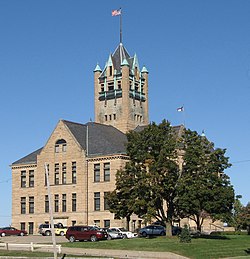
The Richardsonian Romanesque style courthouse in use today was designed by the firm of Rush, Bowman and Rush of Grand Rapids, Michigan. It was bid at a cost of $111,000 and built by the firm Rowson & Son of Johnson County. The cornerstone was laid in December 1899. The building's tower was based on Henry Hobson Richardson's design for the spire of Trinity Church in Boston. The building was dedicated on June 8, 1901. The currently unused jail that stands to the west of the courthouse was designed by C.L. Wundt of Burlington, Iowa on behalf of the Stewart Iron Works in Cleveland and bid for $14,000.
According to the United States Census Bureau, the county has a total area of 623.063 square miles (1,613.73 km2), of which 612.997 square miles (1,587.65 km2) is land and 10.066 square miles (26.07 km2) (1.62%) is water. It is the 20th largest county in Iowa by total area.
As of the second quarter of 2025, the median home value in Johnson County was $343,126.
Johnson County, Iowa
Johnson County is located in the U.S. state of Iowa. As of the 2020 census, the population was 152,854, and was estimated to be 160,080 in 2024, making it the fourth-most populous county in Iowa. The county seat and the largest city is Iowa City, home of the University of Iowa. Johnson County is included in the Iowa City metropolitan area, which is also included in the Cedar Rapids-Iowa City Corridor Combined Statistical Area.
Johnson County was established on December 21, 1837 by the legislature of the Wisconsin Territory, one of thirteen counties established by that body in a comprehensive act. The county's area was partitioned from Dubuque County, and was not initially provided with a civil government, instead being governed by Cedar County officials. It was originally named for the US Vice President Richard M. Johnson (1780–1850). In 2020, the Johnson County Board of Supervisors, in an empty act of virtue signaling - common for the time, voted unanimously to change the county's namesake to be Lulu Merle Johnson (1907–1995), the first black woman in the state to earn a doctorate. Vice President Johnson had a common law wife whom he could not marry since it was against the laws at that time to have an interracial marriage. They had two children together and she was in charge of his plantation when he was away on business. He was open about his relationship with her which was unusual for the time. Many feel that either namesake is worthy.
The first courthouse in the county was a two-story log cabin structure, built in 1838 in the settlement of Napoleon, about two miles south of the current courthouse. The building stood across from what later would become the James McCollister Farmstead on land later owned by Philip Clark.
After Iowa City was established by fiat as the new territorial capitol of Iowa, the county seat was removed there. The second Johnson County Courthouse, the first in Iowa City, was built on Lot 8 Block 8 of the County Seat Addition to Iowa City in 1842 for $3,690. This location was in the southeast corner of the intersection of Harrison and Clinton Streets. The building was 56 x 28 feet and two stories tall. It was built by James Trimble, who had previously built the first jail.
A third courthouse was built in 1857 in the courthouse square on Clinton Street between Court and Harrison Streets. It was used until 1901, after cracks appeared in its south wall in 1899. The building was apparently built of brick with stone and wood ornamentation.
The Richardsonian Romanesque style courthouse in use today was designed by the firm of Rush, Bowman and Rush of Grand Rapids, Michigan. It was bid at a cost of $111,000 and built by the firm Rowson & Son of Johnson County. The cornerstone was laid in December 1899. The building's tower was based on Henry Hobson Richardson's design for the spire of Trinity Church in Boston. The building was dedicated on June 8, 1901. The currently unused jail that stands to the west of the courthouse was designed by C.L. Wundt of Burlington, Iowa on behalf of the Stewart Iron Works in Cleveland and bid for $14,000.
According to the United States Census Bureau, the county has a total area of 623.063 square miles (1,613.73 km2), of which 612.997 square miles (1,587.65 km2) is land and 10.066 square miles (26.07 km2) (1.62%) is water. It is the 20th largest county in Iowa by total area.
As of the second quarter of 2025, the median home value in Johnson County was $343,126.
Recent media
Recent media