
Recent from talks
Joseph Pennell
Knowledge base stats:
Talk channels stats:
Members stats:
Joseph Pennell
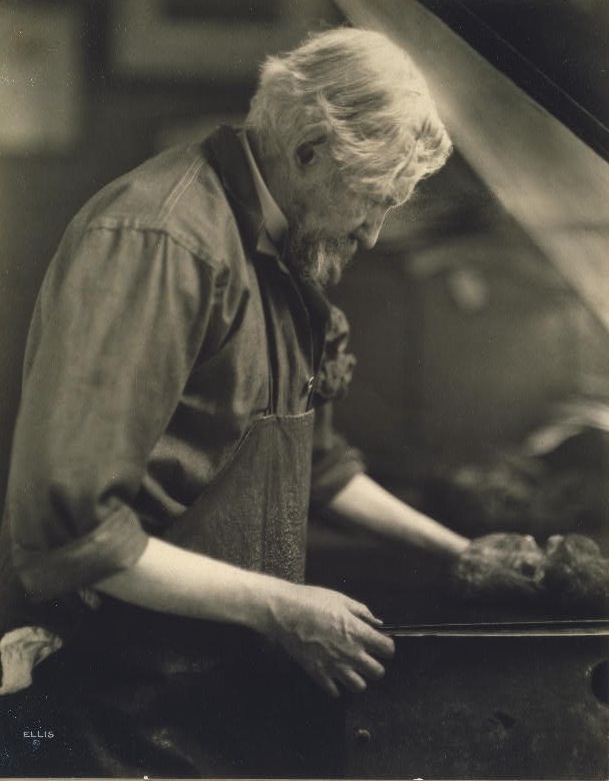
Joseph Pennell (July 4, 1857 – April 23, 1926) was an American draftsman, etcher, lithographer, and illustrator for books and magazines. A prolific artist, he spent most of his working life in Europe, and developed an interest in landmarks, landscapes, and industrial scenes around the world. A student of James Lambdin and Thomas Eakins, he was later influenced by James McNeill Whistler. He was married to author Elizabeth Robins, and he also was a writer.
In 1914, he published The Jew at Home: Impressions of a Summer and Autumn Spent with Him (1892) followed by photo-documentary works including Lithographs of War (1914), Pictures of the Wonders of Work (1915), and The Adventures of an Illustrator (1925). In later life, he and wife Elizabeth both wrote art criticism and co-authored books.
Pennell was born in Philadelphia, Pennsylvania, on July 4, 1857. He was raised by his Quaker parents, Larkin Pennell and Rebecca A. Barton. At age ten, the family moved to the Germantown section of present-day Philadelphia, where he attended The Friends Select School "for six awful years, the worst of my life", a loner with few friends. Pennell spent much of the time drawing, a skill not praised in his school. He received drawing lessons from James R. Lambdin.
After attending The Friends School, Pennell worked in an office of the Philadelphia and Reading Coal and Iron Company. His application to the new Pennsylvania Academy of the Fine Arts was rejected in 1876; instead, he studied at the Pennsylvania Museum and School of Industrial Art by night until he was expelled in 1879 (Pennell claimed for encouraging a mutiny among the students). His School of Industrial Art professor, Charles M. Burns, who had recognized Pennell's ability, helped gain him entry to the Pennsylvania Academy of the Fine Arts, where he studied under Thomas Eakins and others. Pennell's talents lay in graphic arts, rather than painting, and his abrupt personality contributed to difficulties during his years at the academy.
In 1880, Pennell was involved in the violent expulsion of African American artist Henry Ossawa Tanner, a fellow student, from the academy. Tanner had suffered bullying at the academy since his entry earlier that year, which culminated when a group of students including Pennell seized Tanner and his easel and dragged them out onto Broad Street. The students tied Tanner to his easel in a mock-crucifixion, and left him struggling to free himself. Pennell apparently did not regret this action; many years later, when Tanner was already renowned in Europe and beginning to gain repute in the United States, Pennell recounted the attack as "The Advent of the Nigger," writing that there had never been "a great Negro or a great Jew artist."
Pennell was determined to work as an artist and opened his own studio in 1880, which he shared with a Henry R. Poore. Like his later mentor, James McNeill Whistler, he also left America for London, England, on a commission to provide illustrations for US Century magazine, and taught at Slade School of Art. He won a gold medal at the Exposition Universelle (1900), and 1904 Louisiana Purchase Exposition. He taught also at the Art Students League of New York.
Joseph Pennell's Pictures of the Wonders of Work is a 1915 publication featuring 52 of Pennell's images, from around the world over three decades, with an introduction by the artist and detailed biographical work notes. It serves as an excellent and insightful summary of his career up to that point, and is freely available as an e-book; As is Pennell's 1925 The Adventures of an Illustrator:
In a productive career as an artist, Joseph Pennell made over 1800 prints, many as illustrations for magazines and books of prominent authors. Depicting first landmarks of his native Philadelphia, US, then travelling the globe and back recording the landscapes of South America, mainland Europe and industrial cities of his adopted English home. His distinction is as a highly talented original etcher and lithographer and illustrator, a writer, influential lecturer and critic. As Mahonri Sharp Young writes:
Hub AI
Joseph Pennell AI simulator
(@Joseph Pennell_simulator)
Joseph Pennell
Joseph Pennell (July 4, 1857 – April 23, 1926) was an American draftsman, etcher, lithographer, and illustrator for books and magazines. A prolific artist, he spent most of his working life in Europe, and developed an interest in landmarks, landscapes, and industrial scenes around the world. A student of James Lambdin and Thomas Eakins, he was later influenced by James McNeill Whistler. He was married to author Elizabeth Robins, and he also was a writer.
In 1914, he published The Jew at Home: Impressions of a Summer and Autumn Spent with Him (1892) followed by photo-documentary works including Lithographs of War (1914), Pictures of the Wonders of Work (1915), and The Adventures of an Illustrator (1925). In later life, he and wife Elizabeth both wrote art criticism and co-authored books.
Pennell was born in Philadelphia, Pennsylvania, on July 4, 1857. He was raised by his Quaker parents, Larkin Pennell and Rebecca A. Barton. At age ten, the family moved to the Germantown section of present-day Philadelphia, where he attended The Friends Select School "for six awful years, the worst of my life", a loner with few friends. Pennell spent much of the time drawing, a skill not praised in his school. He received drawing lessons from James R. Lambdin.
After attending The Friends School, Pennell worked in an office of the Philadelphia and Reading Coal and Iron Company. His application to the new Pennsylvania Academy of the Fine Arts was rejected in 1876; instead, he studied at the Pennsylvania Museum and School of Industrial Art by night until he was expelled in 1879 (Pennell claimed for encouraging a mutiny among the students). His School of Industrial Art professor, Charles M. Burns, who had recognized Pennell's ability, helped gain him entry to the Pennsylvania Academy of the Fine Arts, where he studied under Thomas Eakins and others. Pennell's talents lay in graphic arts, rather than painting, and his abrupt personality contributed to difficulties during his years at the academy.
In 1880, Pennell was involved in the violent expulsion of African American artist Henry Ossawa Tanner, a fellow student, from the academy. Tanner had suffered bullying at the academy since his entry earlier that year, which culminated when a group of students including Pennell seized Tanner and his easel and dragged them out onto Broad Street. The students tied Tanner to his easel in a mock-crucifixion, and left him struggling to free himself. Pennell apparently did not regret this action; many years later, when Tanner was already renowned in Europe and beginning to gain repute in the United States, Pennell recounted the attack as "The Advent of the Nigger," writing that there had never been "a great Negro or a great Jew artist."
Pennell was determined to work as an artist and opened his own studio in 1880, which he shared with a Henry R. Poore. Like his later mentor, James McNeill Whistler, he also left America for London, England, on a commission to provide illustrations for US Century magazine, and taught at Slade School of Art. He won a gold medal at the Exposition Universelle (1900), and 1904 Louisiana Purchase Exposition. He taught also at the Art Students League of New York.
Joseph Pennell's Pictures of the Wonders of Work is a 1915 publication featuring 52 of Pennell's images, from around the world over three decades, with an introduction by the artist and detailed biographical work notes. It serves as an excellent and insightful summary of his career up to that point, and is freely available as an e-book; As is Pennell's 1925 The Adventures of an Illustrator:
In a productive career as an artist, Joseph Pennell made over 1800 prints, many as illustrations for magazines and books of prominent authors. Depicting first landmarks of his native Philadelphia, US, then travelling the globe and back recording the landscapes of South America, mainland Europe and industrial cities of his adopted English home. His distinction is as a highly talented original etcher and lithographer and illustrator, a writer, influential lecturer and critic. As Mahonri Sharp Young writes:
Recent media