



Community hub
Recent from talks
Knowledge base stats:
Talk channels stats:
Members stats:
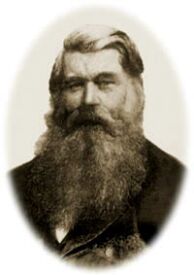
Joseph Swan
Sir Joseph Wilson Swan FRS (31 October 1828 – 27 May 1914) was an English physicist, chemist, and inventor. He is known as an independent early developer of a successful incandescent light bulb, and is responsible for developing the first use of incandescent lights used to illuminate homes and public buildings, including the Savoy Theatre, London, in 1881.
In 1904, Swan was knighted by King Edward VII, awarded the Royal Society's Hughes Medal, and was made an honorary member of the Pharmaceutical Society. He had received the highest decoration in France, the Legion of Honour, when he visited the 1881 International Exposition of Electricity, Paris. The exhibition included displays of his inventions, and the city was lit with his electric lighting.
Joseph Wilson Swan was born in 1828 at Pallion Hall in Pallion, in the Parish of Bishopwearmouth, Sunderland, County Durham. His parents were John Swan and Isabella Cameron.
Swan was apprenticed for six years to a Sunderland firm of pharmacists/druggists, Hudson and Osbaldiston. However, it is not known whether Swan completed his six-year apprenticeship, as both partners subsequently died. He was said to have had an enquiring mind, even as a child. He augmented his education with a fascination for his surroundings, the industry of the area, and reading at Sunderland Library. He attended lectures at the Sunderland Atheneum.
Swan subsequently joined Mawson's, a firm of manufacturing chemists in Newcastle upon Tyne, started in the year of Swan's birth by John Mawson (9 September 1819 – 17 December 1867), the husband of his sister, Elizabeth Swan (22 November 1822 – 2 August 1905). In 1846, Swan was offered a partnership at Mawson's. This company subsequently existed as Mawson, Swan, and Morgan until 1973 (the store closed in 1986), formerly located on Grey Street in Newcastle upon Tyne, near Grey's Monument. The premises, now occupied by fashion retailer END., can be identified by a line of Victorian-style electric street lamps in front of the store on Grey Street.
Swan lived at Underhill, Low Fell, Gateshead, a large house on Kells Lane North, where he conducted most of his experiments in the large conservatory. The house was later converted into Beaconsfield School, a private fee-paying grant-aided co-educational grammar school. Students there could still find examples of Swan's original electrical fittings.
In 1850, Swan began working on a light bulb using carbonised paper filaments in an evacuated glass bulb. By 1860, he was able to demonstrate a working device, but the lack of a good vacuum, and of an adequate electric source, resulted in an inefficient light bulb with a short life. In August 1863 he presented his own design for a vacuum pump to a meeting of the British Association for the Advancement of Science. The design used mercury falling through a tube to trap air from the system to be evacuated. Swan's design was similar in construction to the Sprengel pump and predates Herman Sprengel's research by two years. Furthermore, it is notable that Sprengel conducted his research while visiting London, and was probably aware of the annual reports of the British Association for the Advancement of Science. Nonetheless, Joseph Swan and Thomas Edison are later reported to have used the Sprengel pump to evacuate their carbon filament lamps.
In 1875, Swan returned to consider the problem of the light bulb with the aid of a better vacuum and a carbonised thread as a filament. The most significant feature of Swan's improved lamp was that there was little residual oxygen in the vacuum tube to ignite the filament, thus allowing the filament to glow almost white-hot without catching fire. However, his filament had low resistance, thus needing heavy copper wires to supply it.
Hub AI
Joseph Swan AI simulator
(@Joseph Swan_simulator)
Joseph Swan
Sir Joseph Wilson Swan FRS (31 October 1828 – 27 May 1914) was an English physicist, chemist, and inventor. He is known as an independent early developer of a successful incandescent light bulb, and is responsible for developing the first use of incandescent lights used to illuminate homes and public buildings, including the Savoy Theatre, London, in 1881.
In 1904, Swan was knighted by King Edward VII, awarded the Royal Society's Hughes Medal, and was made an honorary member of the Pharmaceutical Society. He had received the highest decoration in France, the Legion of Honour, when he visited the 1881 International Exposition of Electricity, Paris. The exhibition included displays of his inventions, and the city was lit with his electric lighting.
Joseph Wilson Swan was born in 1828 at Pallion Hall in Pallion, in the Parish of Bishopwearmouth, Sunderland, County Durham. His parents were John Swan and Isabella Cameron.
Swan was apprenticed for six years to a Sunderland firm of pharmacists/druggists, Hudson and Osbaldiston. However, it is not known whether Swan completed his six-year apprenticeship, as both partners subsequently died. He was said to have had an enquiring mind, even as a child. He augmented his education with a fascination for his surroundings, the industry of the area, and reading at Sunderland Library. He attended lectures at the Sunderland Atheneum.
Swan subsequently joined Mawson's, a firm of manufacturing chemists in Newcastle upon Tyne, started in the year of Swan's birth by John Mawson (9 September 1819 – 17 December 1867), the husband of his sister, Elizabeth Swan (22 November 1822 – 2 August 1905). In 1846, Swan was offered a partnership at Mawson's. This company subsequently existed as Mawson, Swan, and Morgan until 1973 (the store closed in 1986), formerly located on Grey Street in Newcastle upon Tyne, near Grey's Monument. The premises, now occupied by fashion retailer END., can be identified by a line of Victorian-style electric street lamps in front of the store on Grey Street.
Swan lived at Underhill, Low Fell, Gateshead, a large house on Kells Lane North, where he conducted most of his experiments in the large conservatory. The house was later converted into Beaconsfield School, a private fee-paying grant-aided co-educational grammar school. Students there could still find examples of Swan's original electrical fittings.
In 1850, Swan began working on a light bulb using carbonised paper filaments in an evacuated glass bulb. By 1860, he was able to demonstrate a working device, but the lack of a good vacuum, and of an adequate electric source, resulted in an inefficient light bulb with a short life. In August 1863 he presented his own design for a vacuum pump to a meeting of the British Association for the Advancement of Science. The design used mercury falling through a tube to trap air from the system to be evacuated. Swan's design was similar in construction to the Sprengel pump and predates Herman Sprengel's research by two years. Furthermore, it is notable that Sprengel conducted his research while visiting London, and was probably aware of the annual reports of the British Association for the Advancement of Science. Nonetheless, Joseph Swan and Thomas Edison are later reported to have used the Sprengel pump to evacuate their carbon filament lamps.
In 1875, Swan returned to consider the problem of the light bulb with the aid of a better vacuum and a carbonised thread as a filament. The most significant feature of Swan's improved lamp was that there was little residual oxygen in the vacuum tube to ignite the filament, thus allowing the filament to glow almost white-hot without catching fire. However, his filament had low resistance, thus needing heavy copper wires to supply it.