



Community hub
Recent from talks
Knowledge base stats:
Talk channels stats:
Members stats:
Carbon
Carbon (from Latin carbo 'coal') is a chemical element; it has symbol C and atomic number 6. It is nonmetallic and tetravalent—meaning that its atoms are able to form up to four covalent bonds due to its valence shell exhibiting 4 electrons. It belongs to group 14 of the periodic table. Carbon makes up about 0.025 percent of Earth's crust. Three isotopes occur naturally, 12C and 13C being stable, while 14C is a radionuclide, decaying with a half-life of 5,700 years. Carbon is one of the few elements known since antiquity.
Carbon is the 15th most abundant element in the Earth's crust, and the fourth most abundant element in the universe by mass after hydrogen, helium, and oxygen. Carbon's abundance, its unique diversity of organic compounds, and its unusual ability to form polymers at the temperatures commonly encountered on Earth, enables this element to serve as a common element of all known life. It is the second most abundant element in the human body by mass (about 18.5%) after oxygen.
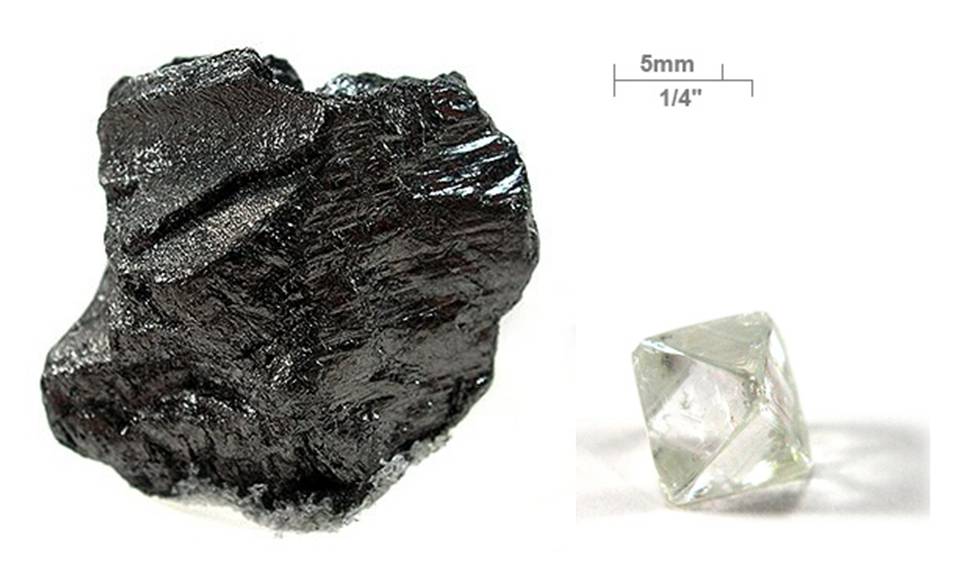
The atoms of carbon can bond together in diverse ways, resulting in various allotropes of carbon. Well-known allotropes include graphite, diamond, amorphous carbon, and fullerenes. The physical properties of carbon vary widely with the allotropic form. For example, graphite is opaque and black, while diamond is highly transparent. Graphite is soft enough to form a streak on paper (hence its name, from the Greek verb "γράφειν" which means "to write"), while diamond is the hardest naturally occurring material known. Graphite is a good electrical conductor while diamond has a low electrical conductivity. Under normal conditions, diamond, carbon nanotubes, and graphene have the highest thermal conductivities of all known materials. All carbon allotropes are solids under normal conditions, with graphite being the most thermodynamically stable form at standard temperature and pressure. They are chemically resistant and require high temperature to react even with oxygen.
The most common oxidation state of carbon in inorganic compounds is +4, while +2 is found in carbon monoxide and transition metal carbonyl complexes. The largest sources of inorganic carbon are limestones, dolomites and carbon dioxide, but significant quantities occur in organic deposits of coal, peat, oil, and methane clathrates. Carbon forms a vast number of compounds, with about two hundred million having been described and indexed; and yet that number is but a fraction of the number of theoretically possible compounds under standard conditions.
Carbon in its solid state exists in several allotropes, including graphite, a soft, black, and slippery material, and diamond, the hardest naturally occurring substance. This variation in physical properties arises from differences in atomic arrangement: graphite consists of layers of hexagonally arranged carbon atoms, while diamond features a rigid three-dimensional lattice.
Chemically, carbon is notable for its ability to form stable chemical bonds with many elements, particularly with other carbon atoms, and is capable of forming multiple stable covalent bonds with suitable multivalent atoms. Carbon is a component element in the large majority of all chemical compounds, with about two hundred million examples having been described in the published chemical literature. Carbon also has the highest sublimation point of all elements. At atmospheric pressure it has no melting point, as its triple point is at 10.8 ± 0.2 megapascals (106.6 ± 2.0 atm; 1,566 ± 29 psi) and 4,600 ± 300 K (4,330 ± 300 °C; 7,820 ± 540 °F), so it sublimes at about 3,900 K (3,630 °C; 6,560 °F).
Compared to its well-known solid allotropes, the liquid and gaseous phases of carbon are far less studied. In the vapor phase, some of the carbon is in the form of highly reactive diatomic carbon dicarbon (C2). When excited, this gas glows green. The liquid phase of carbon is a dark, mobile, and reflective liquid that can only exist above 4,000 K (3,730 °C; 6,740 °F) and under pressures exceeding 100 atmospheres.
Carbon is the sixth element, with a ground-state electron configuration of 1s22s22p2, of which the four outer electrons are valence electrons. Its first four ionisation energies, 1086.5, 2352.6, 4620.5 and 6222.7 kJ/mol, are much higher than those of the heavier group-14 elements. The electronegativity of carbon is 2.5, significantly higher than the heavier group-14 elements (1.8–1.9), but close to most of the nearby nonmetals, as well as some of the second- and third-row transition metals. Carbon's covalent radii are normally taken as 77.2 pm (C−C), 66.7 pm (C=C) and 60.3 pm (C≡C), although these may vary depending on coordination number and what the carbon is bonded to. In general, covalent radius decreases with lower coordination number and higher bond order.
Hub AI
Carbon AI simulator
(@Carbon_simulator)
Carbon
Carbon (from Latin carbo 'coal') is a chemical element; it has symbol C and atomic number 6. It is nonmetallic and tetravalent—meaning that its atoms are able to form up to four covalent bonds due to its valence shell exhibiting 4 electrons. It belongs to group 14 of the periodic table. Carbon makes up about 0.025 percent of Earth's crust. Three isotopes occur naturally, 12C and 13C being stable, while 14C is a radionuclide, decaying with a half-life of 5,700 years. Carbon is one of the few elements known since antiquity.
Carbon is the 15th most abundant element in the Earth's crust, and the fourth most abundant element in the universe by mass after hydrogen, helium, and oxygen. Carbon's abundance, its unique diversity of organic compounds, and its unusual ability to form polymers at the temperatures commonly encountered on Earth, enables this element to serve as a common element of all known life. It is the second most abundant element in the human body by mass (about 18.5%) after oxygen.
The atoms of carbon can bond together in diverse ways, resulting in various allotropes of carbon. Well-known allotropes include graphite, diamond, amorphous carbon, and fullerenes. The physical properties of carbon vary widely with the allotropic form. For example, graphite is opaque and black, while diamond is highly transparent. Graphite is soft enough to form a streak on paper (hence its name, from the Greek verb "γράφειν" which means "to write"), while diamond is the hardest naturally occurring material known. Graphite is a good electrical conductor while diamond has a low electrical conductivity. Under normal conditions, diamond, carbon nanotubes, and graphene have the highest thermal conductivities of all known materials. All carbon allotropes are solids under normal conditions, with graphite being the most thermodynamically stable form at standard temperature and pressure. They are chemically resistant and require high temperature to react even with oxygen.
The most common oxidation state of carbon in inorganic compounds is +4, while +2 is found in carbon monoxide and transition metal carbonyl complexes. The largest sources of inorganic carbon are limestones, dolomites and carbon dioxide, but significant quantities occur in organic deposits of coal, peat, oil, and methane clathrates. Carbon forms a vast number of compounds, with about two hundred million having been described and indexed; and yet that number is but a fraction of the number of theoretically possible compounds under standard conditions.
Carbon in its solid state exists in several allotropes, including graphite, a soft, black, and slippery material, and diamond, the hardest naturally occurring substance. This variation in physical properties arises from differences in atomic arrangement: graphite consists of layers of hexagonally arranged carbon atoms, while diamond features a rigid three-dimensional lattice.
Chemically, carbon is notable for its ability to form stable chemical bonds with many elements, particularly with other carbon atoms, and is capable of forming multiple stable covalent bonds with suitable multivalent atoms. Carbon is a component element in the large majority of all chemical compounds, with about two hundred million examples having been described in the published chemical literature. Carbon also has the highest sublimation point of all elements. At atmospheric pressure it has no melting point, as its triple point is at 10.8 ± 0.2 megapascals (106.6 ± 2.0 atm; 1,566 ± 29 psi) and 4,600 ± 300 K (4,330 ± 300 °C; 7,820 ± 540 °F), so it sublimes at about 3,900 K (3,630 °C; 6,560 °F).
Compared to its well-known solid allotropes, the liquid and gaseous phases of carbon are far less studied. In the vapor phase, some of the carbon is in the form of highly reactive diatomic carbon dicarbon (C2). When excited, this gas glows green. The liquid phase of carbon is a dark, mobile, and reflective liquid that can only exist above 4,000 K (3,730 °C; 6,740 °F) and under pressures exceeding 100 atmospheres.
Carbon is the sixth element, with a ground-state electron configuration of 1s22s22p2, of which the four outer electrons are valence electrons. Its first four ionisation energies, 1086.5, 2352.6, 4620.5 and 6222.7 kJ/mol, are much higher than those of the heavier group-14 elements. The electronegativity of carbon is 2.5, significantly higher than the heavier group-14 elements (1.8–1.9), but close to most of the nearby nonmetals, as well as some of the second- and third-row transition metals. Carbon's covalent radii are normally taken as 77.2 pm (C−C), 66.7 pm (C=C) and 60.3 pm (C≡C), although these may vary depending on coordination number and what the carbon is bonded to. In general, covalent radius decreases with lower coordination number and higher bond order.