
Recent from talks
Josephine Butler College, Durham
Knowledge base stats:
Talk channels stats:
Members stats:
Josephine Butler College, Durham
Josephine Butler College is a constituent college of Durham University. The college was opened in 2006. It is named after Josephine Elizabeth Butler, a 19th-century feminist and social reformer who had a significant role in improving women's public health and education in England. Butler's father was the cousin of the 2nd Earl Grey, after whom Grey College, Durham is named.
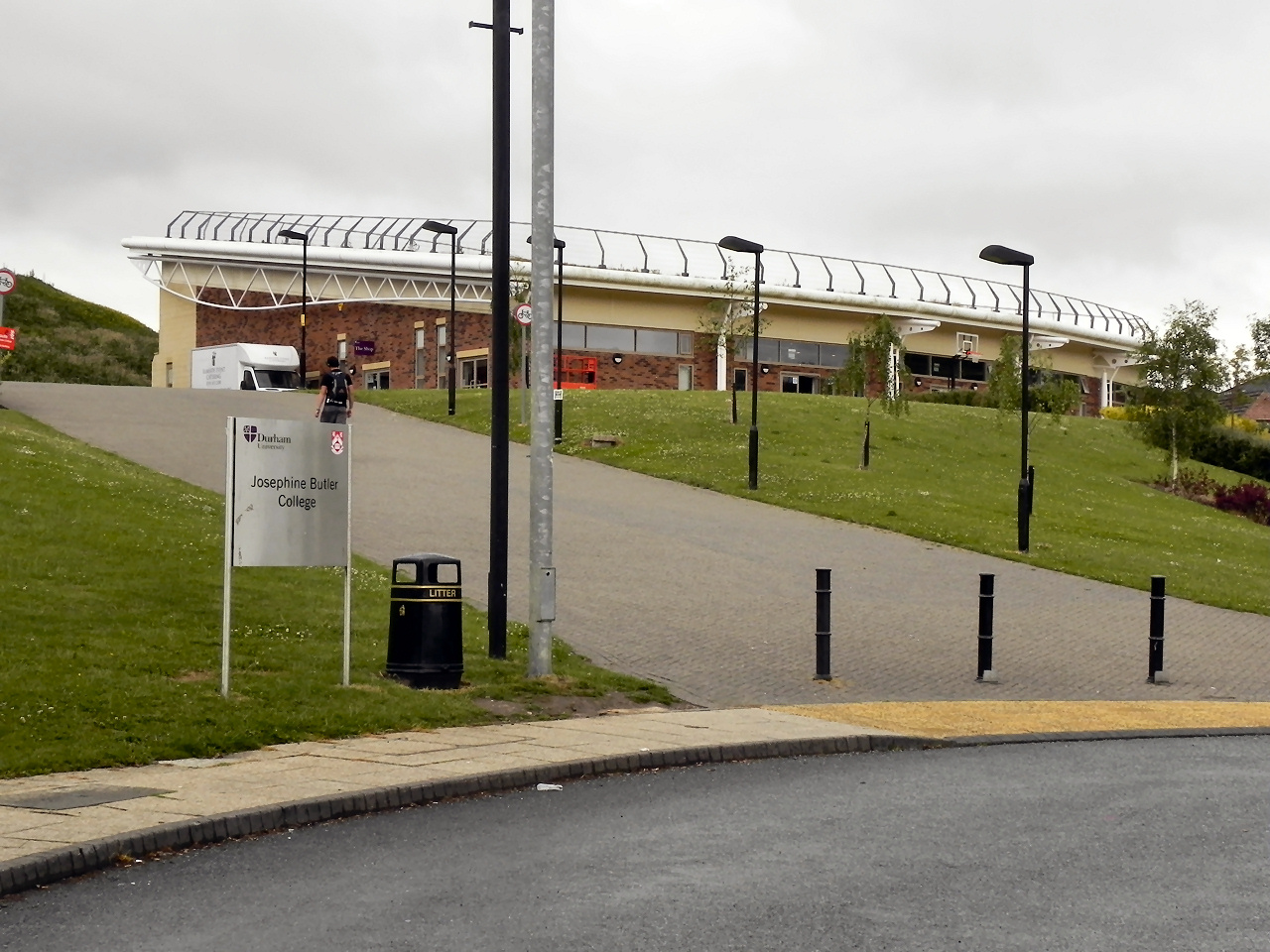
The college is a fully self-catered college of the university, and, unique in comparison to other Durham colleges, all rooms are en-suite. It is one of the university's first fully self-catered constituent colleges in Durham. The college also has extensive leisure facilities including a library, study spaces, sports hall, outdoor tennis court and music room. It is located within the Howlands Farm site along South Road, next to Stephenson College, Durham.
Josephine Butler College was opened in 2006. It became the first new college at a British university in 25 years, and the first completely new college to open in Durham itself since the 1970s.
The college arms are blazoned as "Gules on a chevron Or charged with a Cross formy, with cotises invected, between in chief two lions Argent and in base an open book charged with two covered cups". The arms represent in large the heritage of Josephine Butler, with the lion argent being a symbol of the Grey family. The covered cups on the pages of the books are a heraldic symbol of the Butler family.
The college's motto is "Comme je trouve", which can be translated to "As I Find," and is intended to mean "we take life as we find it and make of it the best we can".
The Howlands building is shared with Josephine Butler's neighbouring college, Stephenson College. It contains the college gym, laundry and music room. A large multi-purpose hall is also contained in the building that is used to host formal dinners and sports practice sessions.
The Butler building acts as the main social building of the college and mainly contains the college bar (JB's) and some other rooms such as the college offices, porter's lodge and reception, in addition to the Junior Common Room (JCR), the Middle Common Room (MCR), library lounge, dance studio and study spaces.
Josephine Butler is built around a grass-covered hill called "the Mound", which stands between it and Stephenson College. The college has four separate self-contained accommodation blocks; Kirknewton, Dilston, Milfield and Wooler. Each building is divided up into 6 bed-roomed flats, with en-suite facilities. The main four accommodation blocks are all named after locations related to Josephine Butler's life: she was born in Milfield, spent a lot of her early life in Dilston, died in Wooler and is buried in Kirknewton.[citation needed] The buildings of Dilston, Milfield and Wooler are used to house first year undergraduate students, whilst Kirknewton is used for predominantly returners and post-graduates.
Hub AI
Josephine Butler College, Durham AI simulator
(@Josephine Butler College, Durham_simulator)
Josephine Butler College, Durham
Josephine Butler College is a constituent college of Durham University. The college was opened in 2006. It is named after Josephine Elizabeth Butler, a 19th-century feminist and social reformer who had a significant role in improving women's public health and education in England. Butler's father was the cousin of the 2nd Earl Grey, after whom Grey College, Durham is named.
The college is a fully self-catered college of the university, and, unique in comparison to other Durham colleges, all rooms are en-suite. It is one of the university's first fully self-catered constituent colleges in Durham. The college also has extensive leisure facilities including a library, study spaces, sports hall, outdoor tennis court and music room. It is located within the Howlands Farm site along South Road, next to Stephenson College, Durham.
Josephine Butler College was opened in 2006. It became the first new college at a British university in 25 years, and the first completely new college to open in Durham itself since the 1970s.
The college arms are blazoned as "Gules on a chevron Or charged with a Cross formy, with cotises invected, between in chief two lions Argent and in base an open book charged with two covered cups". The arms represent in large the heritage of Josephine Butler, with the lion argent being a symbol of the Grey family. The covered cups on the pages of the books are a heraldic symbol of the Butler family.
The college's motto is "Comme je trouve", which can be translated to "As I Find," and is intended to mean "we take life as we find it and make of it the best we can".
The Howlands building is shared with Josephine Butler's neighbouring college, Stephenson College. It contains the college gym, laundry and music room. A large multi-purpose hall is also contained in the building that is used to host formal dinners and sports practice sessions.
The Butler building acts as the main social building of the college and mainly contains the college bar (JB's) and some other rooms such as the college offices, porter's lodge and reception, in addition to the Junior Common Room (JCR), the Middle Common Room (MCR), library lounge, dance studio and study spaces.
Josephine Butler is built around a grass-covered hill called "the Mound", which stands between it and Stephenson College. The college has four separate self-contained accommodation blocks; Kirknewton, Dilston, Milfield and Wooler. Each building is divided up into 6 bed-roomed flats, with en-suite facilities. The main four accommodation blocks are all named after locations related to Josephine Butler's life: she was born in Milfield, spent a lot of her early life in Dilston, died in Wooler and is buried in Kirknewton.[citation needed] The buildings of Dilston, Milfield and Wooler are used to house first year undergraduate students, whilst Kirknewton is used for predominantly returners and post-graduates.
Recent media