


Community hub
Recent from talks
Contribute something
Nothing was collected or created yet.
Motto
View on Wikipedia

A motto (derived from the Latin muttum, 'mutter', by way of Italian motto, 'word' or 'sentence')[1][2][3][4] is a sentence or phrase expressing a belief or purpose,[1] or the general motivation or intention of an individual, family, social group, or organization.[2][4] Mottos (or mottoes)[1] are usually found predominantly in written form (unlike slogans, which may also be expressed orally), and may stem from long traditions of social foundations, or from significant events, such as a civil war or a revolution. One's motto may be in any language, but Latin has been widely used, especially in the Western world.
Language
[edit]Latin has been very common for mottos in the Western World, but for nation states, their official national language is generally chosen. Examples of using other historical languages in motto language include:
- County of Somerset in England: Sumorsǣte ealle (All the men of Somerset), Old English.[5][6]
- South Cambridgeshire in the English Fens: Niet Zonder Arbyt (Nothing without work), Dutch, originally the motto of Dutchman Cornelius Vermuyden, who drained The Fens in the 17th century.[7][8]
- South Africa: ǃke e: ǀxarra ǁke (Unity in diversity), ǀXam.
- Shire of Shetland: Með lögum skal land byggja (By law shall the land be built up), Old Norse.[9]
A canting motto is one that contains word play.[10] For example, the motto of the Earl of Onslow is Festina lente (literally 'make haste slowly'), punningly interpreting 'on slow'.[11] Similarly, the motto of the Burgh of Tayport, Te oportet alte ferri (It is incumbent on you to carry yourself high), is a cant on 'Tayport at auld Tay Ferry', also alluding to the local lighthouse.[12] The motto of the U.S. Federal Bureau of Investigation, Fidelity, Bravery, Integrity, is a backronym of the letters F.B.I.
List of examples
[edit]
- United in diversity, the motto of the European Union (EU)
- In God We Trust, the motto of the United States (US)
- Je Maintiendrai Châlons (French for "I will maintain Châlons"), often abbreviated as Je maintiendrai (French for "I will maintain"), the motto of the Netherlands
- Dieu et mon droit (French for "God and my right"), is the motto of the monarch of the United Kingdom. It appears on a scroll beneath the shield of the version of the coat of arms of the United Kingdom.
- Unus pro omnibus, omnes pro uno (Latin for "One for all, all for one"), unofficial motto of Switzerland
- Post tenebras lux (Latin for "Light After Darkness"), motto of University of Geneva
- United we stand, divided we fall[clarification needed]
Mottos in heraldry
[edit]| Part of a series on |
| Heraldic achievement |
|---|
| External devices in addition to the central coat of arms |
 Heraldry portal Heraldry portal |

In heraldry, a motto is often found below the shield in a banderole in the compartment. This placement stems from the Middle Ages, in which the vast majority of nobles possessed a coat of arms complete with a motto. In the case of Scottish heraldry, it is mandated to appear above the crest[13] and is called slogan (see: Slogan (heraldry)). The word 'slogan' is an Anglicisation of the Scottish Gaelic sluagh-ghairm (sluagh "army, host" + gairm "cry").[14] There are several notable slogans which are thought to originate from a battle or war cries. In heraldic literature, the terms 'rallying cry' respectively 'battle banner' are also common.[citation needed] Spanish coats of arms may display a motto in the bordure of the shield.[15]
In English heraldry, mottos are not granted with armorial bearings, and may be adopted and changed at will. In Scottish heraldry, mottos can only be changed by re-matriculation, with the Lord Lyon King of Arms.[16] Although unusual in England, and perhaps outside English heraldic practice, there are some examples, such as in Belgium, of the particular appearance of the motto scroll and letters thereon being blazoned;[17] a prominent example is the obverse of the Great Seal of the United States (which is a coat of arms and follows heraldic conventions), the blazon for which specifies that the motto scroll is held in the beak of the bald eagle serving as the escutcheon's supporter.
-
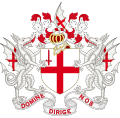 Motto "Domine dirige nos" (Latin for 'Lord, guide us') below the Coat of arms of the City of London
 -
![Motto Deus protector noster (Latin for 'God is our protector') below the arms of Pori[18]](//upload.wikimedia.org/wikipedia/commons/thumb/c/cb/Porin_vaakuna.svg/120px-Porin_vaakuna.svg.png)
-
 Above the crest is the slogan (see: Slogan (heraldry), most traditional in Scottish heraldry) or the war cry, Arms of Brady Brim-DeForest, Baron of Balvaird

![Motto Deus protector noster (Latin for 'God is our protector') below the arms of Pori[18]](https://en.wikipedia.org/wiki/File:Porin_vaakuna.svg)

Ships and submarines in the Royal Navy (RN) each have a badge and motto, as do units of the Royal Air Force (RAF).[19][ISBN missing]
Mottos in literature
[edit]In literature, a motto is a sentence, phrase, poem, or word; prefixed to an essay, chapter, novel, or the like, suggestive of its subject matter. It is a short, suggestive expression of a guiding principle for the written material that follows.[4]
For example, Robert Louis Stevenson's Travels with a Donkey in the Cévennes uses mottos at the start of each section.[20]
See also
[edit]

References
[edit]- ^ a b c motto – Cambridge Dictionary. Cambridge, England: Cambridge University Press. 2022. Retrieved 1 November 2022.
{{cite encyclopedia}}:|website=ignored (help) - ^ a b "motto – Oxford Dictionaries". OxfordDictionaries.com. Oxford, England: Oxford University Press. Archived from the original on 18 August 2016. Retrieved 31 January 2011.
- ^ motto – Merriam-Webster. Merriam-Webster, Incorporated. 2022. Retrieved 1 November 2022.
{{cite encyclopedia}}:|website=ignored (help) - ^ a b c "Webster's Revised Unabridged Dictionary (1913)". The ARTFL Project. The University of Chicago. Archived from the original on 6 December 2013. Retrieved 20 December 2013. [failed verification]
- ^ "The Danish Invasions". Somerset.gov.uk. Somerset County Council archives. Archived from the original on 24 December 2013. Retrieved 26 June 2015.
- ^ "Somerset - Coat of arms (crest) of Somerset". Heraldry-Wiki.com. Heraldry of the World. 19 March 2019. Retrieved 1 November 2022.
- ^ "Civic Heraldry of England and Wales – East Anglia and Essex area". CivicHeraldry.co.uk. Archived from the original on 28 August 2009. Retrieved 8 November 2009.
- ^ "South Cambridgeshire". rsnonline.org.uk. Rural Services Network. Archived from the original on 24 December 2013. Retrieved 21 December 2013.
- ^ "Shetland Islands - Coat of arms (crest) of Shetland Islands". Heraldry-Wiki.com. Heraldry of the World. 13 October 2020. Archived from the original on 26 May 2021. Retrieved 1 November 2022.
- ^ The Manual of Heraldry : being a concise description of the several terms used, and containing a dictionary of every designation in the science. Illustrated by four hundred engravings on wood (5th ed.). London, England: Arthur Hall, Virtue & Co. 1800. p. 132. OCLC 1049649069. OL 24349702M. Retrieved 1 November 2022.
- ^ Mark Antony Lower (October 1860). "Onslow". Patronymica Britannica: A Dictionary of the Family Names of the United Kingdom. London, England: John Russell Smith. ISBN 9780788404566.
{{cite book}}: ISBN / Date incompatibility (help) - ^ "Tayport - Coat of arms (crest) of Tayport". Heraldry-Wiki.com. Heraldry of the World. 13 October 2020. Retrieved 1 November 2022.
- ^ von Volborth, Carl Alexander (March 1980). Heraldry of the World. Blandford Press. p. 192. ISBN 9780806999609. OL 7944413M.
- ^ "slogan". Merriam-Webster. 2003. p. 1174.
- ^ von Volborth, Carl Alexander (March 1980). Heraldry of the World. Blandford Press. p. 211. ISBN 9780806999609. OL 7944413M.
- ^ Innes-Smith, Robert (1990). An Outline of Heraldry in England and Scotland. Derby, England: Pilgrim Press. p. 14, col 1. ISBN 0-900594-82-9. OCLC 1036776100. Retrieved 1 November 2022.
Mottos are not necessarily hereditary, and can be adopted and changed at will.
- ^ "USS Winston S. Churchill (DDG-81)". The Institute of Heraldry. Archived from the original on 21 February 2024. Retrieved 21 February 2024.
- ^ "Juhana Herttuan patsas - Pori, Finland – Statues of historic figures". Waymarking.com. Groundspeak, Inc. 2022. Retrieved 1 November 2022.
- ^ Cassells, Vic (2000). The capital ships: Their battles and their badges. Kangaroo Press. p. 190.
- ^ Stevenson, Robert Louis (1907). Travels with a Donkey in the Cevennes. London, England: Chatto & Windus.
| Types | |||||||||||||||
|---|---|---|---|---|---|---|---|---|---|---|---|---|---|---|---|
| Topics | |||||||||||||||
| Achievement | |||||||||||||||
| Charges | |||||||||||||||
| Tinctures |
| ||||||||||||||
| Applications | |||||||||||||||
| Related | |||||||||||||||
| |||||||||||||||


| International | |
|---|---|
| National | |
| Other | |

Motto
View on GrokipediaA motto is a sentence, phrase, or word inscribed on something as appropriate to or indicative of its character or use.[1] Frequently pithy and expressive of a principle or aspiration, it serves as a maxim guiding conduct or encapsulating a core belief.[2] The term originates from the Italian motto, meaning "word" or "saying," derived from the Late Latin muttum, a mutter or grunt.[2] Mottos have long been integral to heraldry, where they appear on coats of arms—typically scrolled below the escutcheon or above the crest—as later additions to heraldic achievements, often evolving from ancient war cries or battle slogans.[3][4] In this context, they convey familial, institutional, or personal values, sometimes in Latin for universality and conciseness. Beyond heraldry, mottos are adopted by nations to symbolize unity or faith, as seen in the United States' official national motto "In God We Trust," established by Congress in 1956,[5] and "E Pluribus Unum" ("Out of many, one") on the Great Seal, denoting the federation of states.[6] Organizations, such as the Boy Scouts with "Be Prepared," and individuals alike employ mottos to articulate enduring principles.[1] While mottos can inspire adherence to ideals, their effectiveness depends on alignment with empirical realities rather than mere rhetoric, as unsubstantiated phrases risk becoming hollow platitudes. Notable examples include state mottos mapping diverse regional identities across the U.S., reflecting historical contexts from religious invocations to calls for liberty. Controversies occasionally arise over their wording or implications, particularly in secularizing societies debating religious references in public symbols.[7]
Definition and Etymology
Core Definition
A motto is a concise sentence, phrase, or word that encapsulates a guiding principle, belief, ideal, or purpose associated with an individual, family, organization, institution, or entity.[1][8][9] It serves to express the spirit or character of its subject, often inscribed on emblems, seals, crests, badges, banners, or buildings to indicate its intended ethos or rule of conduct.[1][9] In practice, mottos function as declarative statements of motivation or intention, distinguishing them from mere slogans by their emphasis on enduring principles rather than transient advertising.[10] Within heraldry, a motto typically appears as a short phrase or sentence positioned below the escutcheon (shield) on a scroll or banderole, originating from medieval traditions where it encapsulated the bearer's faith, advice, or resolve.[10][11] Not all coats of arms include a motto, as its addition is optional and governed by heraldic conventions rather than strict requirement, with content ranging from serious exhortations to punning references tied to the bearer's name or armorial bearings.[12] Heraldic mottos are commonly rendered in Latin for universality and gravitas, though vernacular languages appear in modern instances, reflecting their role in affirming identity without altering the core blazon.[10][11] Mottos differ from related concepts like proverbs or adages by their specific adoption for emblematic or institutional use, rather than general wisdom, and from battle cries or slogans by their static, inspirational nature unbound to immediate contexts.[1][8] This definitional precision underscores their utility in fostering cohesion or self-reminder, as evidenced in applications from personal creeds to state emblems, where the phrasing prioritizes brevity and memorability for maximal impact.[9][10]Etymology and Historical Roots
The English word motto derives from the Italian motto, signifying "a word" or "saying," which entered the language around the 1580s to denote a pithy maxim or phrase inscribed on an emblem.[2] This Italian term traces back to Late Latin muttum, meaning a "mutter," "grunt," or uttered word, stemming from the verb muttīre, "to mutter."[2] The concept aligns with earlier Romance language roots emphasizing concise verbal expressions, evolving from mere utterance to formalized inspirational or guiding phrases by the Renaissance period.[13] Historically, mottos emerged prominently within European heraldry during the High Middle Ages, coinciding with the development of coats of arms in the mid-12th century for knightly identification in tournaments and battle.[4] These short phrases, often in Latin, Old French, or vernacular tongues, were appended to escutcheons to encapsulate familial virtues, battle cries, or personal aspirations, with examples appearing in armorial records by the 13th century.[14] In Scottish heraldry, mottos held elevated status akin to ancient war cries, registered alongside arms to evoke martial heritage and clan identity.[15] While antecedents exist in classical antiquity—such as Roman sententiae (moral maxims) or Greek gnomic sayings—the structured motto as an integral heraldic element crystallized in medieval chivalric culture rather than ancient traditions.[16] Early instances, like those in 12th-century Norman rolls, frequently originated as exhortative shouts or cris de guerre, transitioning into emblazoned inscriptions by the 14th century.[17]Historical Development
Ancient and Classical Periods
In ancient civilizations, precursors to modern mottos appeared as inscribed maxims and proverbial sayings intended to convey ethical, practical, or communal guidance, often linked to religious or civic contexts rather than personal emblems. In Egypt, wisdom literature from the Old Kingdom, such as the Instructions of Ptahhotep dating to approximately 2350 BCE, compiled aphoristic precepts like "Be industrious, let thine eyes be open, lest you become a beggar," emphasizing self-reliance and vigilance as moral imperatives for social order.[18] These texts, preserved on papyrus and tomb inscriptions, functioned to instruct elites on virtuous conduct, mirroring the didactic role later assumed by mottos, though lacking the concise, heraldic format of subsequent eras. Similarly, Mesopotamian cuneiform tablets from the third millennium BCE contained proverbial wisdom, but evidence of formalized, repeatable phrases for institutional use remains sparse compared to later Greco-Roman examples.[19] The most prominent ancient analogs emerged in Archaic Greece around the sixth century BCE at the Delphic Oracle, where the Temple of Apollo bore inscriptions of ethical maxims attributed to the god or the Seven Sages. A core set of three—gnōthi seauton ("Know thyself"), mēden agan ("Nothing in excess"), and engua mē didou ("Give surety and harm attends")—were carved at the temple entrance, serving as universal admonitions for moderation, self-awareness, and caution in oaths, influencing philosophers like Socrates and Plato.[20] [21] Expanded lists of up to 147 maxims, compiled in Hellenistic sources like Stobaeus' Anthology (fifth century CE), covered virtues such as "Control anger" and "Honor the gods," functioning as mnemonic guides for personal and civic ethics rather than battle cries or crests.[22] These Delphic precepts prefigured mottos by distilling complex principles into terse, memorable phrases for enduring application, with archaeological evidence from Delphi confirming their inscription by the fourth century BCE.[23] In the classical Roman period, institutional phrases akin to mottos appeared on public monuments and military standards, symbolizing collective authority and resilience. The acronym SPQR (Senatus Populusque Romanus, "The Senate and People of Rome") originated in the Roman Republic by the late fourth century BCE, though earliest epigraphic evidence dates to coins from 80 BCE; it adorned eagles, shields, and arches, encapsulating republican governance and imperial expansion as a declarative emblem of unity and sovereignty.[24] [25] Unlike personal maxims, SPQR served a proto-national function, stamped on triumphal arches like the Arch of Titus (81 CE) and enduring through the Empire, evoking Roman exceptionalism without explicit moral exhortation.[26] Other Latin sayings, such as Julius Caesar's veni, vidi, vici ("I came, I saw, I conquered") reported in 47 BCE, functioned as triumphant reports rather than fixed mottos, highlighting how Roman usage prioritized declarative brevity for propaganda over introspective wisdom.[27] These early forms laid groundwork for mottos' evolution, shifting from oracular ethics to civic symbolism amid expanding polities.Medieval and Heraldic Traditions
Heraldry, the systematic use of inherited armorial bearings, emerged in northern Europe during the mid-12th century primarily to identify knights in battle and tournaments amid the obscuring effects of armor and dust.[4] Mottos, concise phrases encapsulating familial virtues, aspirations, or battle cries, constituted a later adjunct to these heraldic achievements, with evidence of their inscription on personal seals appearing by the 13th century.[14] For instance, Sir John de Byron employed the seal motto Crede Beronti ("Trust Byron") around this period, illustrating early personalization of heraldic elements beyond mere visual symbols.[14] Two principal theories explain the genesis of heraldic mottos: one posits their evolution from battlefield war cries, particularly evident in Scottish and Highland traditions where such exclamations were positioned above the crest as slogans or cries to rally troops; the other suggests origins in personal or household badges, serving non-combat identificatory or declarative functions.[3][28] By the Late Middle Ages, mottos had integrated into the full armorial achievement—encompassing shield, helmet, crest, mantling, and motto—often rendered in Latin or Old French to evoke classical authority and brevity, and placed either below the escutcheon or above the crest depending on regional conventions.[4] This development coincided with heraldry's maturation in the 13th century, when armorial rolls and seals proliferated, standardizing noble lineages and chivalric display across England, France, and the Holy Roman Empire.[29] In practice, medieval mottos reinforced identity and moral imperatives amid feudal warfare and tournaments, with noble houses adopting phrases that perpetuated ancestral legacies or commemorated exploits, such as the Pilkington family's enigmatic Now Thus! Now Thus!, possibly alluding to resolute action.[3] Unlike charges or tinctures, mottos remained optional and unregulated in early patents, allowing bearers flexibility in expression while heralds oversaw overall coherence to prevent conflicts.[3] Their proliferation by the 14th and 15th centuries extended to ecclesiastical and civic arms, adapting chivalric forms for institutional continuity, though core usage persisted among the aristocracy to signify unyielding fidelity or divine favor.[4]Modern and Contemporary Evolution
In the 19th and early 20th centuries, the proliferation of nation-states and subnational entities led to widespread adoption of official mottos as emblems of collective identity and governance principles. In the United States, while some states like Connecticut traced informal mottos to the mid-17th century, most formalized theirs through legislative action between the late 1800s and 1920s, reflecting historical legacies, natural resources, or aspirational virtues; for example, Colorado's "Nil sine numine" (Nothing without providence) was adopted in 1861, and Alaska's emerged post-statehood in 1959 as the most recent.[30] This trend paralleled global patterns where emerging republics and monarchies codified mottos during unification or independence movements to encapsulate civic ideals.[31] The United States national motto underwent a significant shift in the mid-20th century, with "In God We Trust"—first appearing on coins in 1864—formally enacted by Congress on July 30, 1956, under President Dwight D. Eisenhower, supplanting the longstanding unofficial "E pluribus unum" amid Cold War ideological contrasts with atheistic communism.[32] [33] This change underscored a pivot toward explicit religious affirmation in public symbolism, driven by domestic political pressures rather than heraldic tradition. Nationally, mottos increasingly served propagandistic or unifying roles, as seen in military contexts like the U.S. Army's adoption of phrases emphasizing duty and resilience, evolving from historical battle cries to institutional ethos.[34] Heraldic practices adapted in the modern era, with mottos retaining flexibility as non-essential elements that could be altered to reflect contemporary values without compromising armorial integrity. In jurisdictions like the United Kingdom, while private grants of arms diminished after the 19th century, corporate and institutional heraldry flourished, incorporating mottos to convey mission statements; for instance, mottos in new grants often drew from vernacular languages over Latin, prioritizing accessibility.[35] This evolution mirrored broader shifts from feudal symbolism to democratic and commercial applications, where mottos distilled organizational principles akin to branding but rooted in tradition.[36] In the contemporary period since the late 20th century, mottos have extended into international events and corporate identity, blending historical gravitas with modern messaging. The Olympic Games, formalized in 1896, introduced mottos progressively, such as the 2006 Turin Winter Olympics' "Passion lives here" and the 2022 Beijing edition's "Together for a Shared Future," emphasizing transient themes of unity over perpetual tenets.[37] Organizations increasingly employ mottos to foster internal culture and external differentiation, distinguishing them from ephemeral slogans by their aspirational permanence, though empirical studies on their efficacy remain limited compared to marketing metrics for advertising phrases.[38] This adaptation reflects causal pressures from globalization and secularism, favoring concise, multilingual expressions of core values amid declining ritualistic heraldry.Purposes and Functions
Personal and Motivational Uses
Personal mottos consist of succinct phrases that individuals select to encapsulate guiding principles, values, or aspirations, serving as internal reminders to direct decision-making and sustain effort toward long-term objectives.[39] These differ from institutional mottos by their individualized nature, often derived from personal reflection, literature, or life experiences, and function motivationally by providing cognitive anchors during challenges, such as habit formation or overcoming setbacks.[40] Psychologically, personal mottos enhance self-regulation by countering destructive thought patterns and bolstering willpower; for instance, phrases like "Health first" can reinforce commitments to lifestyle changes by linking actions to identity and priorities.[40] They promote persistence through inspirational reframing, such as "Slow and steady wins the race," which encourages sustained productivity amid distractions, and foster emotional resilience via calming reminders like "This too shall pass," reducing acute stress responses.[40] Empirical interventions demonstrate that developing "motto-goals"—personal affirmations framed as metaphorical commitments—increases anticipated incentives for goal pursuit and elevates feelings of vitality, as shown in experimental studies where participants reported heightened energy and motivation after adopting such phrases.[41] In coaching contexts, motto-based affirmations yield measurable improvements in emotion regulation ability, with participants in structured sessions showing significant gains (p = .009) in managing affective responses compared to goal-focused or indulgent controls, alongside boosts in extraversion as a marker of adaptive personality traits.[42] Historical figures have exemplified this use; Theodore Roosevelt adopted "Speak softly and carry a big stick" as a personal creed for measured yet resolute action in diplomacy and life, reflecting a balance of restraint and strength that motivated his policy decisions and personal conduct from the early 1900s onward.[43] Similarly, Benjamin Franklin's maxim "Early to bed and early to rise makes a man healthy, wealthy, and wise," drawn from his 1735 almanac, served as a self-imposed rule for discipline, contributing to his productivity across science, invention, and statesmanship until his death in 1790.[44] Critically, while anecdotal reports and small-scale studies suggest mottos aid self-improvement by clarifying motivations, larger longitudinal data remains limited, with effects potentially varying by individual adherence and phrasing specificity; overly generic mottos may dilute impact without personalized resonance.[45] Nonetheless, their low-cost accessibility positions them as practical tools for everyday motivation, often integrated into journaling or daily routines to align behaviors with enduring values.[40]Organizational and Institutional Roles
Mottos serve organizations by encapsulating core values and guiding principles, thereby reinforcing internal culture and motivating members toward shared objectives.[46] In corporate settings, they define identity and mission, aiding in employee alignment and behavioral guidance. For instance, mottos in business organizations often promote ethical conduct and social responsibility, as seen in analyses of internet-based firms where they signal commitments beyond profit.[47] In military institutions, mottos embody enduring missions and instill discipline and resolve among personnel. The United States Army's motto, "This We'll Defend," adopted since the Revolutionary War, underscores the commitment to national defense and protection of citizens, serving as a constant reminder of operational purpose.[48][49] Similarly, the U.S. Army Special Forces' "De Oppresso Liber" (To Free the Oppressed) highlights liberation objectives, enhancing unit cohesion and mission focus.[50] Air Force mottos, when formalized, reinforce service values and national commitment, aiding recruitment and public perception of readiness.[51] Universities employ mottos to construct institutional identity, linking historical traditions with contemporary goals. Princeton University's "In the Nation's Service and the Service of Humanity," inscribed since 1896, emphasizes public service and global engagement, shaping alumni contributions and institutional ethos.[52] Wake Forest University's "Pro Humanitate" (For Humanity) prompts community reflection on human concerns, integrating ethical inquiry into academic life.[53] Such mottos in higher education often derive from heraldic or foundational elements, fostering pride and differentiation in competitive environments.[54] Civic and governmental bodies use mottos to symbolize authority and communal aspirations, as exemplified by the City of London's "Domine Dirige Nos" (Lord, Guide Us), which has guided municipal governance since the 17th century, promoting stewardship and moral direction in policy. In non-profits and public agencies, mottos align operations with societal roles, such as the U.S. Department of Veterans Affairs' adaptation of Lincoln's pledge to care for veterans, ensuring mission fidelity amid evolving mandates.[55] Overall, these roles extend to crisis response organizations, where mottos like those in fire departments build operational identity and resilience.[56]National and Political Applications
National mottos encapsulate core values, historical ethos, and aspirations of sovereignty, often inscribed on state seals, currency, and public monuments to reinforce collective identity and legitimacy of governance. These phrases function politically by promoting internal cohesion and external projection of unity, particularly in diverse or post-colonial states where they counter fragmentation risks. For example, Indonesia's "Bhinneka Tunggal Ika" (Unity in Diversity), derived from an 8th-century Sanskrit poem and formalized as the national motto in 1945, underscores harmonious coexistence amid ethnic, linguistic, and religious pluralism, aiding nation-building after independence from Dutch rule.[57] Similarly, Haiti's "L'Union fait la force" (Unity Makes Strength), adopted post-1804 independence, symbolizes collective resilience against division, appearing on the coat of arms to evoke revolutionary solidarity.[58] In Western contexts, mottos often blend religious or Enlightenment principles with political stability. The United States formalized "In God We Trust" as its national motto on July 30, 1956, through Public Law 84-851 signed by President Eisenhower, supplanting the de facto "E Pluribus Unum" amid Cold War contrasts with atheistic communism; it first appeared on coins in 1864 during Civil War exigencies.[59] France's "Liberté, égalité, fraternité," originating in a 1790 speech by revolutionary leader Maximilien Robespierre and officially adopted by the Second Republic in 1848, was inscribed on public buildings from July 14, 1880, and enshrined in the 1958 Constitution's Article 2, embodying republican ideals of individual rights and civic bonds forged through upheaval.[60][61] These mottos politically legitimize state authority by invoking transcendent or historical imperatives, though their efficacy in sustaining unity varies with enforcement of underlying policies rather than mere recitation. Politically, mottos extend to subnational entities and parties, where they articulate ideological commitments or rally adherents. U.S. states employ mottos on seals to signify regional character and governance priorities, such as Texas's "Friendship" (from 1831, reflecting alliances in independence struggles) or California's "Eureka" (adopted 1849 amid Gold Rush optimism), tying local identity to federal union.[30] Historical political movements have adopted enduring mottos for mobilization; the French Revolution's triad not only nationalized but inspired radical clubs and later socialist groupings, while ancient Roman "SPQR" (Senatus Populusque Romanus) denoted republican governance from circa 509 BCE, symbolizing elite-popular partnership in imperial expansion. In contemporary politics, party mottos like the UK's Labour Party's historical "Let Us Face the Future" (1945 manifesto) serve analogous roles, though shorter-lived than national variants, emphasizing programmatic visions over perpetual symbolism. Such applications underscore mottos' utility in framing political narratives, yet their impact hinges on alignment with material realities rather than rhetorical flourish alone.Linguistic and Structural Aspects
Language Selection and Multilingualism
Latin has historically dominated motto selection in Western contexts due to its association with classical antiquity, ecclesiastical authority, and scholarly prestige, qualities that impart a sense of timelessness and gravitas to the phrase.[62] This preference arose during the medieval period when Latin served as Europe's lingua franca for legal, religious, and academic discourse, allowing mottos to transcend vernacular shifts and appeal to educated elites.[63] Renaissance humanists further reinforced this by reviving ancient phrases to link contemporary institutions with Roman and Greek heritage, as seen in university and heraldic mottos adopted from the 15th century onward.[63] Selection criteria emphasize linguistic precision, where dead languages like Latin avoid ambiguities from evolving slang or dialects, ensuring enduring interpretability. Conciseness is another factor, as Latin's inflected structure permits compact expressions of complex ideas, ideal for emblems or seals. In contrast, vernacular languages gained traction from the 18th century amid nationalist movements, prioritizing accessibility and cultural resonance over classical allure; for example, France's "Liberté, égalité, fraternité" was formalized in French during the Revolution to embody republican ideals directly.[64] Among U.S. states as of 2024, Latin remains prevalent with 20 mottoes, reflecting inherited European traditions, while 21 use English and others incorporate French, Spanish, or indigenous tongues like Hawaiian to mirror regional identities.[65] Globally, national mottos favor the official language in about 70% of cases to foster unity and sovereignty, per compilations of sovereign states' declarations, though Latin persists in former colonies or federations valuing historical continuity.[64] Multilingual mottos are rare owing to the format's demand for succinctness, which monolingual phrasing best satisfies for visual and mnemonic impact; bilingual variants occasionally appear in polyglot entities, such as Swiss cantonal arms pairing German and French, but these function as parallel translations rather than integrated texts.[62] In corporate or international settings, English has emerged since the 20th century as a neutral multilingual proxy, selected for its global intelligibility without evoking specific national biases.[62]Rhetorical and Stylistic Elements
Mottos leverage rhetorical brevity to distill complex ideals into memorable phrases, typically comprising three to seven words for ease of recall and repetition in ceremonial or motivational contexts. This conciseness aligns with classical rhetorical principles of puritas (purity and clarity) and brevitas (economy of expression), as articulated in ancient treatises on style, enabling mottos to function as epigrammatic summaries of ethos or pathos without extraneous elaboration. For instance, the phrase "E pluribus unum," adopted by the U.S. Congress on January 30, 1782, for the Great Seal, exemplifies this through its terse metaphor of unity from diversity, avoiding verbose exposition to prioritize symbolic potency.[66] Stylistically, mottos often employ parallelism or tricolon structures to create rhythmic balance and reinforce thematic unity, as in France's "Liberté, égalité, fraternité," decreed by the National Convention on February 20, 1793, which lists virtues in ascending order of abstraction for cumulative persuasive effect. Alliteration and assonance further enhance phonetic memorability, such as the repeated 'l' sounds in "Loyalty, Liberty, Law" variants found in institutional mottos, drawing on auditory devices to facilitate oral dissemination in speeches or chants. These elements promote cognitive anchoring, where simple, patterned language aids long-term retention over complex prose.[67][68] ![Motto "Domine dirige nos" (Latin for 'Lord, guide us') below the Coat of arms of the City of London.][float-right] The imperative mood predominates in many mottos to evoke direct calls to action or divine invocation, fostering a sense of agency or supplication, as in London's "Domine dirige nos" (Lord, guide us), inscribed since the 17th century on civic heraldry to rhetorically align governance with providential oversight. Classical languages like Latin amplify stylistic gravitas through archaism and universality, insulating the motto from vernacular flux and evoking authoritative precedent, a tactic rooted in Renaissance humanism's revival of Ciceronian eloquence. Conversely, vernacular mottos prioritize accessibility, though they risk temporal dilution absent the timeless veneer of dead languages.[69] Empirical analyses of slogan-like phrases, analogous to mottos, indicate that effective formulations favor content-heavy words (nouns, verbs, adjectives) over function words, correlating with higher recall rates in psychological recall tests involving 20-30 participants per condition. Rhetorical appeals lean toward logos via declarative assertions of principle or pathos through aspirational imagery, rarely pathos-dominant emotionalism to maintain dignified restraint. Such devices, while potent for cohesion, can veer into propaganda when ideologically loaded, as critiqued in literary examinations of mottos in dystopian narratives where succinctness enables manipulative distillation of ruling dogmas.[68][66]Examples and Case Studies
National and State Mottos
National mottos consist of succinct phrases officially designated by sovereign states to embody their foundational principles, unity, or guiding ethos, frequently inscribed on seals, flags, coins, and public buildings to reinforce collective identity.[70] These declarations often emerge from pivotal historical moments, such as revolutions or foundings, and prioritize aspirational or declarative language to inspire citizens and signal values to the world. State mottos, employed by federated or subnational divisions like U.S. states or Canadian provinces, mirror this function on a regional scale, highlighting local heritage, resources, or self-determination while aligning with broader national themes. In the United States, "In God We Trust" became the official national motto through Public Law 84-851, enacted by Congress and signed by President Dwight D. Eisenhower on July 30, 1956, as a response to Cold War ideological contrasts with state atheism.[7] This replaced the longstanding de facto motto "E Pluribus Unum" ("Out of many, one"), proposed for the Great Seal in 1776 and adopted by Congress in 1782 to signify unity from diverse colonies.[71] Canada's motto, "A mari usque ad mare" ("From sea to sea"), drawn from Psalm 72:8, was added to the coat of arms in 1868, post-Confederation, to evoke the nation's vast oceanic boundaries and manifest destiny across the continent.[72] France's "Liberté, égalité, fraternité" ("Liberty, equality, fraternity") first appeared in revolutionary decrees of 1790 and was enshrined as the republican motto in 1848, encapsulating Enlightenment ideals central to the Third Republic's identity.[64] U.S. state mottos, totaling one per state plus the District of Columbia, vary in language and origin, with many in Latin reflecting classical influences during the founding era.[73] Virginia's "Sic semper tyrannis" ("Thus always to tyrants"), adopted in 1776, underscores resistance to oppression, famously linked to John Wilkes Booth's assassination of Abraham Lincoln.[73] New Hampshire's "Live Free or Die," from Revolutionary War general John Stark's 1809 toast, emphasizes individual liberty as paramount.[73] Others invoke divine favor or natural endowments, such as Colorado's "Nil sine numine" ("Nothing without providence," 1861) or Montana's "Oro y Plata" ("Gold and silver," referencing mining booms).[73] Florida uniquely shares the national motto, while Alaska's "North to the Future" (1967) nods to post-statehood optimism.[73] These mottos, often legislated during statehood conventions or later reforms, endure on seals and license plates, promoting regional pride without supplanting federal symbolism.[31]| State | Motto | Translation/Notes |
|---|---|---|
| Alabama | Audemus jura nostra defendere | "We dare defend our rights" – Adopted 1923 |
| California | Eureka | "I have found it" – References 1849 Gold Rush |
| Kansas | Ad astra per aspera | "To the stars through difficulties" – Adopted 1861 |
| Missouri | Salus populi suprema lex esto | "Let the welfare of the people be the supreme law" – From Cicero |
| West Virginia | Montani semper liberi | "Mountaineers are always free" – Adopted 1863 |