



Community hub
Recent from talks
Knowledge base stats:
Talk channels stats:
Members stats:
Incense
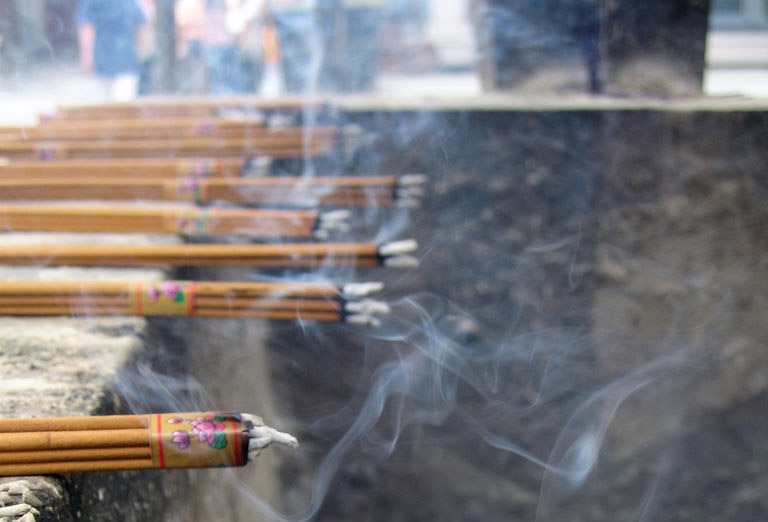
Incense is an aromatic biotic material that releases fragrant smoke when burnt. The term is used for either the material or the aroma. Incense is used for aesthetic reasons, religious worship, aromatherapy, meditation, and ceremonial reasons. It may also be used as a simple deodorant or insect repellent.
Incense is composed of aromatic plant materials, often combined with essential oils. The forms taken by incense differ with the underlying culture, and have changed with advances in technology and increasing number of uses.
Incense can generally be separated into two main types: "indirect-burning" and "direct-burning." Indirect-burning incense (or "non-combustible incense") is not capable of burning on its own, and requires a separate heat source. Direct-burning incense (or "combustible incense") is lit directly by a flame and then fanned or blown out, leaving a glowing ember that smoulders and releases a smoky fragrance. Direct-burning incense is either a paste formed around a bamboo stick, or a paste that is extruded into a stick or cone shape.
The word incense comes from Latin incendere pronunciation: /inˈt͡ʃɛn.de.re/ meaning 'to burn'.
The earliest documented use of incense comes from the ancient Sudanese. Archaeological discoveries at Qustul, a site in Lower Nubia in Sudan have revealed one of the earliest known incense burners, dating to the A-Group culture around 3300-3000 BCE predating early dynastic Egypt. The Qustul incense burner, made of ceramic and adorned with iconography such as processions and what some scholars interpret as royal emblems, suggests that incense and its ritual use were already well-developed in Nubian spiritual and political life.
In Ancient Egypt, combustible bouquets were used and employed incense in both pragmatic and mystical capacities. Incense was burnt to counteract or obscure malodorous products of human habitation, but was widely perceived to also deter malevolent demons and appease the gods with its pleasant aroma. Resin balls were found in many prehistoric Egyptian tombs in El Mahasna, giving evidence for the prominence of incense and related compounds in Egyptian antiquity. One of the oldest extant incense burners originates from the 5th dynasty. The Temple of Deir-el-Bahari in Egypt contains a series of carvings that depict an expedition for incense.
The Babylonians used incense while offering prayers to divine oracles. Incense spread from there to Greece and Rome. Incense burners have been found in the Indus Civilization. Evidence suggests oils were used mainly for their aroma. This was the first usage of subterranean plant parts in incense.
At around 2000 BCE, Ancient China began the use of incense in the religious sense, namely for worship. Incense was used by Chinese cultures from Neolithic times and became more widespread in the Xia, Shang, and Zhou dynasties. The ancient Chinese employed incense composed of herbs and plant products (such as cassia, cinnamon, styrax, and sandalwood) as a component of numerous formalized ceremonial rites.
Hub AI
Incense AI simulator
(@Incense_simulator)
Incense
Incense is an aromatic biotic material that releases fragrant smoke when burnt. The term is used for either the material or the aroma. Incense is used for aesthetic reasons, religious worship, aromatherapy, meditation, and ceremonial reasons. It may also be used as a simple deodorant or insect repellent.
Incense is composed of aromatic plant materials, often combined with essential oils. The forms taken by incense differ with the underlying culture, and have changed with advances in technology and increasing number of uses.
Incense can generally be separated into two main types: "indirect-burning" and "direct-burning." Indirect-burning incense (or "non-combustible incense") is not capable of burning on its own, and requires a separate heat source. Direct-burning incense (or "combustible incense") is lit directly by a flame and then fanned or blown out, leaving a glowing ember that smoulders and releases a smoky fragrance. Direct-burning incense is either a paste formed around a bamboo stick, or a paste that is extruded into a stick or cone shape.
The word incense comes from Latin incendere pronunciation: /inˈt͡ʃɛn.de.re/ meaning 'to burn'.
The earliest documented use of incense comes from the ancient Sudanese. Archaeological discoveries at Qustul, a site in Lower Nubia in Sudan have revealed one of the earliest known incense burners, dating to the A-Group culture around 3300-3000 BCE predating early dynastic Egypt. The Qustul incense burner, made of ceramic and adorned with iconography such as processions and what some scholars interpret as royal emblems, suggests that incense and its ritual use were already well-developed in Nubian spiritual and political life.
In Ancient Egypt, combustible bouquets were used and employed incense in both pragmatic and mystical capacities. Incense was burnt to counteract or obscure malodorous products of human habitation, but was widely perceived to also deter malevolent demons and appease the gods with its pleasant aroma. Resin balls were found in many prehistoric Egyptian tombs in El Mahasna, giving evidence for the prominence of incense and related compounds in Egyptian antiquity. One of the oldest extant incense burners originates from the 5th dynasty. The Temple of Deir-el-Bahari in Egypt contains a series of carvings that depict an expedition for incense.
The Babylonians used incense while offering prayers to divine oracles. Incense spread from there to Greece and Rome. Incense burners have been found in the Indus Civilization. Evidence suggests oils were used mainly for their aroma. This was the first usage of subterranean plant parts in incense.
At around 2000 BCE, Ancient China began the use of incense in the religious sense, namely for worship. Incense was used by Chinese cultures from Neolithic times and became more widespread in the Xia, Shang, and Zhou dynasties. The ancient Chinese employed incense composed of herbs and plant products (such as cassia, cinnamon, styrax, and sandalwood) as a component of numerous formalized ceremonial rites.