Hubbry Logo
EmberEmberMain
Open search
Ember
Community hub
Ember
logo
8 pages, 0 posts
0 subscribers
Be the first to start a discussion here.
Ember
Ember
from Wikipedia
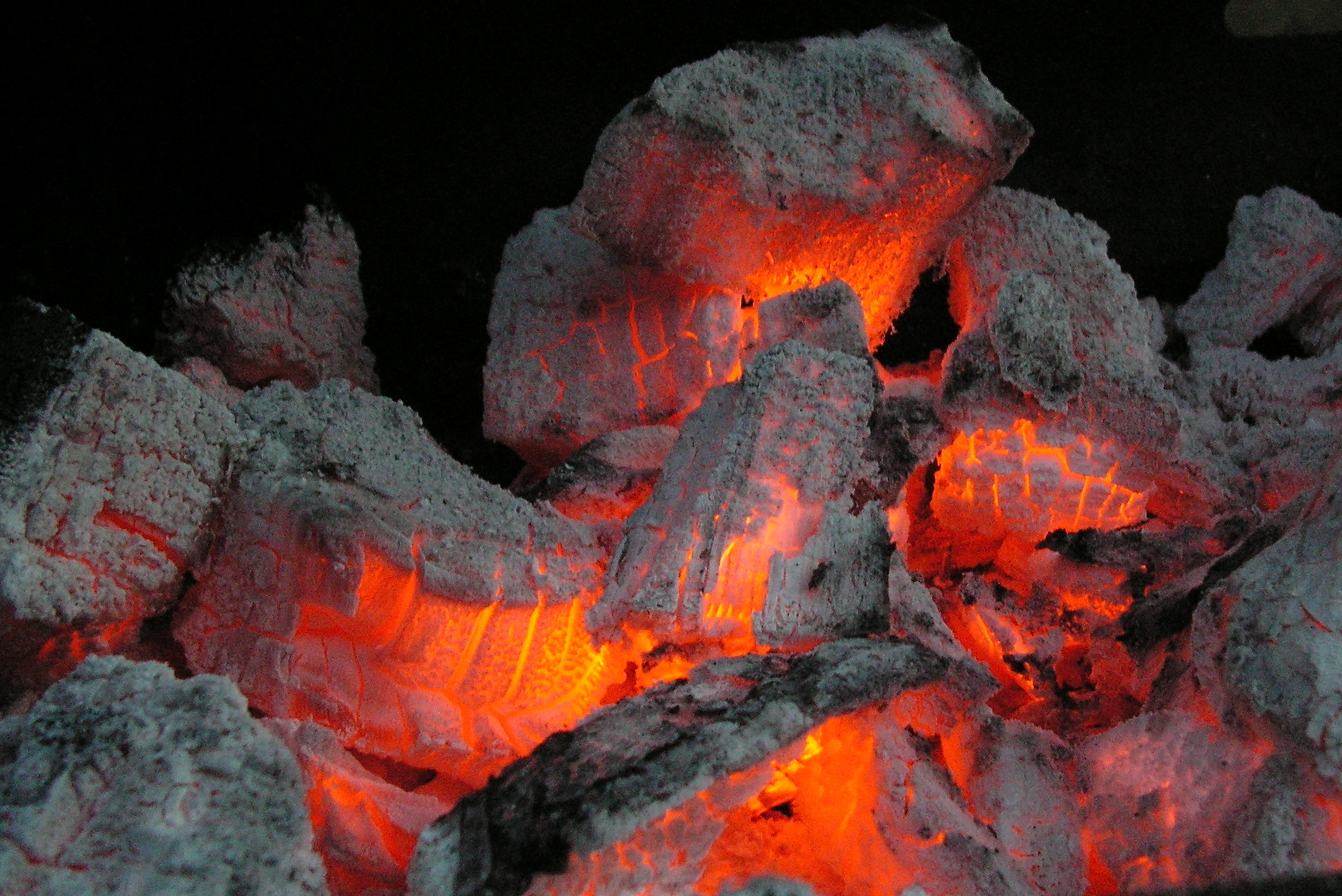
Embers of coal
A bonfire in rural Australia, with a large number of sparks being blown by the wind; sparks are akin to embers in a similar way that dust is to stone.
Embers of firewood used in sauna stove

An ember, also called a hot coal, is a hot lump of smouldering solid fuel, typically glowing, composed of greatly heated wood, coal, or other carbon-based material. Embers (hot coals) can exist within, remain after, or sometimes precede, a fire. Embers are, in some cases, as hot as the fire which created them. They radiate a substantial amount of heat long after the fire has been extinguished, and if not taken care of properly can rekindle a fire that is thought to be completely extinguished and can pose a fire hazard. In order to avoid the danger of accidentally spreading a fire, many campers pour water on the embers or cover them in dirt. Alternatively, embers can be used to relight a fire after it has gone out without the need to rebuild the fire – in a conventional fireplace, a fire can easily be relit up to 12 hours after it goes out, provided that there is enough space for air to circulate between the embers and the introduced fuel.

They are often used for cooking, such as in charcoal barbecues. This is because embers radiate a more consistent form of heat, as opposed to an open fire, which is constantly changing along with the heat it radiates.

An ember is formed when a fire has only partially burnt a piece of fuel, and there is still usable chemical energy in that piece of fuel. This happens because the usable chemical energy is so deep into the center that air (specifically oxygen) does not reach it, and it therefore does not combust (carbon-based fuel + O2 → CO2 + H2O + C + other chemicals involved). It continues to stay hot and does not lose its thermal energy quickly because combustion is still happening at a low level. The small yellow, orange and red lights often seen among the embers are actually combustion; the combustion is just not happening at a fast enough rate to create a flame. Once the embers are completely 'burned through', the remains are oxidized minerals like carbon, calcium and phosphorus. At that point they are called ashes.

Embers play a large role in forest fires, wildland fires or wildland–urban interface fires. Because embers are typically burnt leaves and thus small and lightweight, they can easily become airborne. During a large fire, with the right conditions, embers can be blown far ahead of the fire front, starting spot fires several kilometres/miles away.[1] A number of practical measures can be undertaken by homeowners to reduce the consequences of such an "ember attack" that bombards especially wooden structures and starts property fires.[2]

References

[edit]
[edit]
Revisions and contributorsEdit on WikipediaRead on Wikipedia
from Grokipedia
An ember is a small, glowing piece of wood, , or other that remains hot and smoldering after a has mostly burned out. Embers typically lack visible flames but continue to produce heat through oxidation, and they play a key role in fire propagation, as airborne embers can ignite new fires.

Etymology and Definition

Etymology

The word "ember" originates from Old English ǣmerge or æmerge, denoting "that which, by smoldering, changes to gray ash" or a glowing remnant of fire. This term evolved in Middle English as emer or eymere, with the letter "b" inserted in the 16th century, possibly for euphonic reasons or by analogy with other words. The Old English form derives from Proto-Germanic *aimuzjǭ or *aim-uzjon-, a compound of *aima- ("ashes" or "embers") and *uz- ("to burn"), reflecting its association with low-intensity burning material. Cognates appear in other Germanic languages, such as Old Norse eimyrja ("embers"), Old High German eimuria ("pyre" or "ashes"), Danish emmer, and Swedish mörja ("embers"), all sharing the Proto-Germanic root related to glowing or combusting residues. It is distantly akin to Latin urere ("to burn"), underscoring an Indo-European connection to fire and heat. In contemporary usage, major dictionaries define "ember" as a small, live piece of , , or similar material that continues to glow after a has mostly died out, preserving the ancient of smoldering persistence. This linguistic lineage highlights the term's enduring link to the observable remnants of .

Definition

An ember is a hot lump of smoldering , typically glowing, composed of greatly heated , , or other carbon-based material that retains heat after the visible have subsided. This glowing remnant represents a stage of where the fuel continues to oxidize slowly without producing significant , maintaining temperatures sufficient to ignite nearby materials under the right conditions. Unlike , which are the visible, gaseous part of resulting from rapid exothermic chemical reactions in a thin zone of combusting vapors, embers involve the sustained low-level burning of solid residues. Embers differ from , which are the fully oxidized, powdery inorganic remnants left after complete combustion of the fuel, no longer capable of glowing or sustaining heat. Embers can be categorized by their source material, such as embers formed from partially charred logs in a , which often appear as irregular, fragmented pieces with a bright orange glow, or embers, which are denser and more uniform, deriving from bituminous or and providing prolonged, even heat. A common example is glowing , produced from through and used in barbecues for its steady radiant heat.

Formation and Combustion

Formation Process

The formation of an ember initiates during the ignition of , such as wood, where external heat sources raise the to approximately 250–325°C, triggering . In this initial stage, the wood undergoes , releasing volatile gases—including , , , and organic compounds—that mix with surrounding air and ignite, producing visible flames while the underlying structure chars. This charring process leaves a porous, carbon-rich residue comprising 20–30% of the original wood mass, which acts as a insulator protecting the unpyrolyzed interior. As flaming progresses, the volatile content diminishes, and the becomes partially consumed; simultaneously, if the oxygen supply is restricted—such as in denser packs or sheltered conditions—the rapid gas-phase burning slows, transitioning to heterogeneous surface reactions on the char layer. This shift results in glowing , where oxygen directly reacts with the solid carbon at the char's surface, producing and without sustained flames, thereby creating the characteristic ember. The process is exothermic, sustaining the reaction as long as sufficient carbon and oxygen are available. Environmental factors significantly influence ember formation and persistence. Airflow plays a critical role by delivering oxygen to the char surface; adequate flow promotes efficient oxidation, while limited can prolong the transition by reducing reaction rates and leading to incomplete . Fuel density affects ember longevity, with dense hardwoods like forming more stable, longer-lasting embers due to slower char consumption compared to less dense softwoods like , which burn more rapidly and produce shorter-lived residues. Sustained glowing typically requires temperatures above 500°C, with ember cores often reaching 600–800°C to maintain visible incandescence and heat output.

Combustion Mechanics

The combustion of an ember primarily involves a process known as smoldering or glowing , characterized by slow, heterogeneous oxidation at the surface of the carbon-rich char material. In this reaction, carbon atoms in the char react with molecular oxygen from the surrounding air, producing and releasing without the volatile release and rapid gas-phase reactions associated with flaming combustion. This surface-limited process sustains the ember's heat by maintaining a localized high-temperature zone, where the is governed by the availability of oxygen at the char-oxygen interface rather than bulk fuel consumption. The fundamental driving this oxidation can be represented as: \mathrm{C_{(s)} + O_2_{(g)} \rightarrow CO_{2(g)} + \Delta H} where ΔH\Delta H denotes the exothermic release, approximately 394 kJ/mol under standard conditions. This reaction occurs predominantly at the solid-gas boundary, making it diffusion-controlled; the rate depends on the transport of oxygen molecules to the reactive sites via or . Factors such as the of the char structure play a critical role, as higher facilitates greater oxygen ingress into the material's internal pores, enhancing and thereby accelerating the oxidation rate and generation. Conversely, denser or less porous char impedes oxygen access, prolonging the smoldering phase. The characteristic glow of an ember arises from thermal incandescence, where the elevated temperature of the carbon particles causes them to emit visible light as . This phenomenon becomes perceptible in the at surface temperatures typically ranging from 700°C to 900°C, with peak emission in the orange-red wavelengths corresponding to the ember's observed hue. The incandescence is sustained by the continuous heat feedback from the oxidation reaction, which keeps the particles above the threshold for radiative emission without progressing to flaming.

Physical and Thermal Properties

Physical Characteristics

Embers display a characteristic glowing orange-red hue, arising from as the carbon material is heated during . This incandescence makes them visually distinct from surrounding or unburned . In terms of size and shape, embers vary widely but typically measure from 1 mm to 10 cm in diameter, with larger specimens often observed in campfires or structural fires and smaller ones in wildfires; their forms are irregular, resulting from the fragmentation of burning wood or other . Embers form as remnants of this burning process, where portions of the fuel detach while still partially oxidized. The texture of embers features a highly porous structure, composed primarily of a lightweight carbon matrix that incorporates trapped minerals and ash residues from the original biomass. This porosity contributes to their low bulk density, generally ranging from 0.1 to 0.3 g/cm³ for wood-derived embers (varying by fuel type such as hardwood or softwood), enhancing their buoyancy and longevity in air. Embers exhibit considerable durability, often persisting intact for several hours—and in some cases up to 12 hours or more—before fully oxidizing and crumbling into fine ash.

Thermal Behavior

Embers exhibit notable heat retention due to the low thermal conductivity of their carbon-based structure, which minimizes rapid dissipation of internal . This property allows embers to maintain elevated temperatures for extended periods, with hot coals retaining sufficient to pose ignition risks for up to 12 hours after apparent extinguishment in insulated conditions (varying by fuel type). The coarse, porous composition of in embers further contributes to this insulation effect, as the material's thermal conductivity is significantly lower than that of metals or dense solids, limiting conductive loss to the surrounding environment. The primary mechanism of heat transfer from embers is , predominantly in the spectrum, owing to their glowing temperatures typically ranging from 750°C to 1050°C (varying by type). This radiative emission follows the Stefan-Boltzmann law, where the power radiated PP is given by P=σAT4P = \sigma A T^4 with σ=5.67×10⁸\sigma = 5.67 \times 10^{-8} W/m²K⁴ as the Stefan-Boltzmann constant, AA the surface area, and TT the absolute temperature in ; for embers, this results in radiative heat fluxes dominating over other modes, accounting for 80% to 86% of total transfer in experimental setups. Convection and conduction play minor roles in ember due to their isolated, particulate nature, which reduces direct contact and bulk fluid movement. However, external airflow can influence these processes by enhancing convective cooling or, conversely, promoting reignition through increased oxygen supply and altered distribution.

Historical and Cultural Aspects

Historical Uses

Archaeological evidence indicates that early hominins in utilized controlled , including embers for sustaining , as early as one million years ago. At in the province of , microstratigraphic analysis of sediments from the layers revealed burning of , plants, and bones deep within the cave, suggesting repeated use of for warmth, cooking, and possibly light in enclosed spaces where embers would have been essential to maintain flames without constant tending. This practice represents one of the earliest documented instances of habitual fire management, enabling prolonged occupation of cave environments. In ancient Roman , embers played a key role in the system, an innovative technology employed in public baths, villas, and military structures from the 1st century BCE onward. The system involved a central furnace (praefurnium) fueled by wood or , where burning produced hot gases and embers that circulated through hollow floors and walls, providing radiant without direct smoke exposure in living areas. Experimental reconstructions and archaeometric studies confirm that furnace temperatures reached 300–500°C, sustained by raking embers to regulate airflow and distribution, demonstrating the practical of ember-based heating for comfort in temperate climates. During the medieval period in , blacksmiths relied on embers to maintain precise forge temperatures for , a central to tool production, weaponry, and from the 5th to 15th centuries. In workshops described in contemporary treatises, a bed of glowing charcoal embers—often started with wood and fanned by —was used to achieve even, controlled heating around 800–1200°C, allowing smiths to hammer and shape iron without overheating or uneven cooling. The 12th-century manual On Divers Arts by Theophilus Presbyter details the smithy setup, emphasizing the fire's management with tools like pokers and rakes to concentrate embers for tasks such as bells and ornaments, underscoring embers' indispensability in pre-industrial . The transition to the , beginning in the late with the , marked a decline in everyday ember use as coal, oil, and eventually supplanted wood fires in urban and industrial settings, reducing the need for manual fire preservation. However, in rural communities, traditions like banking campfires—covering embers with ash to smolder overnight for easy rekindling—persisted into the 20th century, particularly among farmers and campers in regions like and , where access to matches or lighters remained limited until widespread .

Cultural Significance

Embers have long served as powerful symbols in , representing both dying passion and latent potential. In William Shakespeare's , the imagery of warm embers dying evokes a soft autumnal melancholy and detachment, mirroring the play's themes of emotional resolution and fading intensity after conflict. This underscores the remnants of fervor that can either extinguish or hold the promise of rekindling, a duality central to Prospero's renunciation of magic and return to . In Japanese culture, frequently evoke the aesthetic of —a poignant awareness of impermanence and transience. Haiku poets like those in the tradition of use imagery to capture the ephemeral beauty of life akin to cherry blossoms or autumn leaves. This reflects broader Buddhist influences on , where the dying light parallels the inevitable passage of moments. Folklore across cultures further enriches embers' symbolic depth. In Native American traditions, such as those of tribes, embers are derived from sacred fires guarded by spiritual entities, embodying the enduring spirit of fire that sustains communities and connects the living to ancestral forces. Similarly, European myths draw analogies between embers and rebirth, particularly through the , where the bird constructs a and rises renewed from its glowing embers, signifying and cyclical renewal in Greco-Roman and medieval lore. In modern media, embers continue as motifs for resilience amid obscurity. The 2008 film , adapted from Jeanne DuPrau's novel, portrays an underground city named for its ember-like lights that pierce perpetual darkness, symbolizing hidden hope and enlightenment against ignorance and decay. This narrative uses the faint, persistent glow of embers to represent the latent potential for escape and renewal in a world on the brink of collapse.

Practical Applications

In Cooking and Heating

Embers have been utilized in cooking for centuries, particularly through techniques like ember roasting, where food is buried directly in hot coals for even, low-heat cooking. This method allows for slow cooking that infuses flavors from the smoke and ash while minimizing direct flame exposure. For instance, potatoes wrapped in foil are commonly nestled into embers, where they roast for 45 minutes to 1 hour until tender, achieving a charred exterior and fluffy interior without the risk of scorching. Charcoal grills, which rely on embers from compressed briquettes for barbecues, emerged in the late , revolutionizing by providing a controlled, portable source. The first for charcoal briquettes was granted to Ellsworth B.A. Zwoyer in 1897, enabling consistent ember production for meats and . By the , by companies like Kingsford, tied to Henry Ford's operations, made these grills accessible for home use, with innovations like the 1952 kettle design by George Stephen enhancing airflow and even heating. In heating applications, embers offer practical benefits in traditional fireplaces, where "banking" involves covering glowing coals with to restrict and retain overnight for easy relighting in the morning. This technique, common in energy-scarce environments, conserves by maintaining a steady, low-level warmth compared to continuously burning open flames, with wood stoves using banked embers achieving up to 50-80% versus 10-20% for unbanked fireplaces. The advantages of embers in both cooking and heating stem from their consistent temperatures, typically ranging from 500–800 °C, which provide radiant heat that cooks food evenly and prevents burning while their heat retention properties sustain warmth longer than flames. In global cuisines, this is exemplified by the South American , where hardwood is burned to embers for grilling beef cuts like vacio on a parrilla, yielding tender results through indirect, smoky heat.

In Fire Management

In fire management, embers play a key role in controlled practices aimed at preserving heat sources and facilitating safe ignition. One common technique for fire preservation involves banking embers by covering them with or , which insulates the heat and allows the fire to be rekindled after periods of inactivity, sometimes lasting up to several days. This method has been employed by indigenous groups for land stewardship and by modern campers to maintain fires overnight without additional fuel, reducing the need for constant monitoring while minimizing risk. In agricultural contexts like slash-and-burn farming, embers from initial ignitions contribute to the spread of fire across cleared , helping to uniformly fields and return nutrients to the soil through ash deposition. This practice, historically used in tropical regions, clears land for cultivation while the embers ensure complete of . Contemporary employs controlled s to reduce fuel loads and prevent catastrophic wildfires, where embers generated during the burn can be managed to ignite targeted areas safely, promoting and . As of 2025, there is increased integration of indigenous fire knowledge in prescribed burns, such as those by the Yurok Tribe, to enhance resilience against climate-driven wildfires. Tools such as or fans are utilized to oxygenate banked embers, facilitating quick relighting by increasing airflow to reignite . Historically, have been essential in various cultures for this purpose, from blacksmithing to domestic , enabling efficient management. Archaeological and experimental indicate that embers in pit fires can retain sufficient heat for relighting up to 24 hours, depending on insulation and type, informing traditional and modern preservation strategies.

Safety and Hazards

Fire Risks

Embers can smolder for hours or even days after the primary fire front has passed, retaining heat that allows them to reignite when disturbed by , foot , or other factors, thereby posing a significant of starting new fires in structures long after the main blaze appears extinguished. This rekindling potential is particularly dangerous in contexts, where embers are estimated to ignite up to 90% of homes destroyed, often through entry into vents, roofs, or decks. In wildfire scenarios, airborne serve as a primary mechanism for rapid fire spread, traveling distances of several kilometers ahead of the flame front to ignite spot fires in unburned vegetation or structures. For instance, during the 2018 Camp Fire in —one of the deadliest in state history—strong winds carried embers long distances, contributing to the ignition of thousands of spot fires and the destruction of over 18,000 buildings. Beyond structural threats, embers release fine particulate matter (PM2.5) and other pollutants during incomplete , which, when inhaled, can trigger or worsen respiratory issues including exacerbations, , and acute symptoms like coughing, wheezing, and . Additionally, smoldering embers produce elevated levels of through low-oxygen processes, increasing the risk of poisoning that can lead to headaches, , and potentially fatal outcomes in confined or poorly ventilated areas.

Prevention Methods

Preventing the ignition or spread of embers requires targeted techniques to deprive them of oxygen, fuel, or heat while minimizing the risk of further dispersal. The primary method for extinguishing embers involves smothering them to cut off oxygen supply, using water as the preferred agent where available. According to guidelines from the U.S. Forest Service via Smokey Bear, the recommended "Drown, Stir, Feel" process entails pouring water over the embers to soak them thoroughly, then stirring the ashes with a shovel to expose and wet any hidden hot spots, and finally feeling the area with the back of the hand to ensure no residual heat remains. If water is unavailable, dry sand or dirt can be used to smother embers by scooping it over the area and stirring to ensure coverage, though this method is less effective alone and should be combined with stirring to prevent heat trapping. Blowing on embers to extinguish them is strongly discouraged, as it introduces additional oxygen and can scatter burning particles, exacerbating spread rather than containing the fire. In bushfire-prone regions, structural modifications to homes play a critical role in preventing ember entry and ignition. Ember-resistant vents and screens, designed with fine mesh to block small airborne embers while allowing ventilation, are a standard recommendation in high-risk areas. Following the 2009 in , which highlighted embers as the cause of up to 85% of home ignitions, the updated Australian Standard AS 3959-2009 mandated stricter construction requirements, including ember-resistant screening for vents, subfloor areas, and windows with apertures no larger than 2 mm to prevent ember intrusion. These standards, further refined in AS 3959-2018, emphasize non-combustible materials and sealed gaps in building envelopes for properties in designated bushfire attack levels (BAL), significantly reducing vulnerability in regions like Victoria and . Detecting and addressing hidden embers in or post-fire environments is essential to prevent re-ignition, and thermal imaging tools provide a reliable means for this purpose. Handheld or drone-mounted thermal imaging cameras detect heat signatures from smoldering embers that may not be visible to the , allowing firefighters to identify and extinguish them before they flare up. The USDA Forest Service's Fire Imaging Technologies User Guide outlines the use of mid-wave and long-wave (MWIR/LWIR) systems for wildland operations, including hotspot detection in debris piles and scars, to support safe mop-up procedures and reduce the risk of escaped fires. These guidelines recommend integrating thermal imaging with ground patrols for comprehensive monitoring, particularly in forested or urban-interface areas where embers can persist for days after the main has passed.

References

Add your contribution
Related Hubs
User Avatar
No comments yet.