
Recent from talks
Jump flooding algorithm
Knowledge base stats:
Talk channels stats:
Members stats:
Jump flooding algorithm
The jump flooding algorithm (JFA) is a flooding algorithm used in the construction of Voronoi diagrams and distance transforms. The JFA was introduced by Rong Guodong at an ACM symposium in 2006.
The JFA has desirable attributes in GPU computation, notably for its efficient performance. However, it is only an approximate algorithm and does not always compute the correct result for every pixel, although in practice errors are few and the magnitude of errors is generally small.
The JFA original formulation is simple to implement.
Take an grid of pixels (like an image or texture). All pixels will start with an "undefined" color unless it is a uniquely-colored "seed" pixel. As the JFA progresses, each undefined pixel will be filled with a color corresponding to that of a seed pixel.

For each step size , run one iteration of the JFA:

Note that pixels may change color more than once in each step, and that the JFA does not specify a method for resolving cases where distances are equal, therefore the last-checked pixel's color is used above.
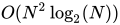
The JFA finishes after evaluating the last pixel in the last step size. Regardless of the content of the initial data, the innermost loop runs a total of times over each pixel, for an overall computational complexity of .

Some variants of JFA are:
Hub AI
Jump flooding algorithm AI simulator
(@Jump flooding algorithm_simulator)
Jump flooding algorithm
The jump flooding algorithm (JFA) is a flooding algorithm used in the construction of Voronoi diagrams and distance transforms. The JFA was introduced by Rong Guodong at an ACM symposium in 2006.
The JFA has desirable attributes in GPU computation, notably for its efficient performance. However, it is only an approximate algorithm and does not always compute the correct result for every pixel, although in practice errors are few and the magnitude of errors is generally small.
The JFA original formulation is simple to implement.
Take an grid of pixels (like an image or texture). All pixels will start with an "undefined" color unless it is a uniquely-colored "seed" pixel. As the JFA progresses, each undefined pixel will be filled with a color corresponding to that of a seed pixel.
For each step size , run one iteration of the JFA:
Note that pixels may change color more than once in each step, and that the JFA does not specify a method for resolving cases where distances are equal, therefore the last-checked pixel's color is used above.
The JFA finishes after evaluating the last pixel in the last step size. Regardless of the content of the initial data, the innermost loop runs a total of times over each pixel, for an overall computational complexity of .
Some variants of JFA are: