
Recent from talks
Junkers G 24
Knowledge base stats:
Talk channels stats:
Members stats:
Junkers G 24
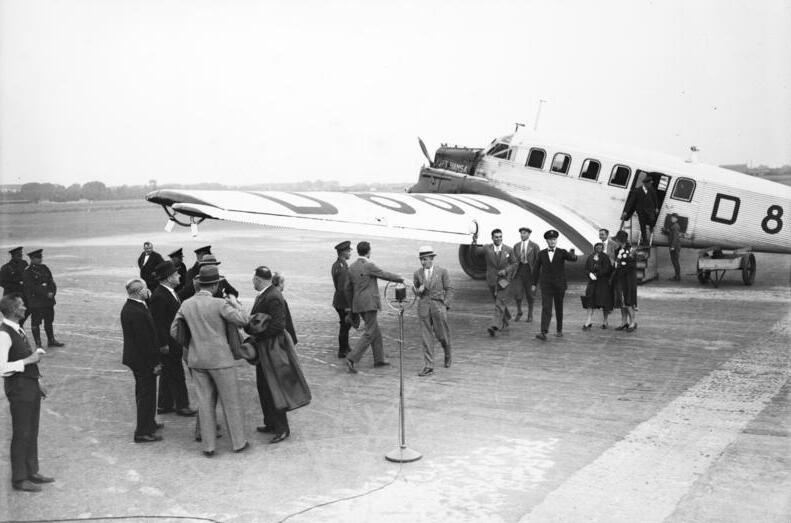
The Junkers G 24 was a German three-engine, all-metal low-wing monoplane passenger aircraft manufactured by Junkers from 1925. Junkers F 24 was the designation for single-engine versions of the same aircraft.
The increased German air traffic in the 1920s led to a requirement for a larger passenger transport aircraft. The G 24 was an enlarged development of the F 13. It was originally designed by Ernst Zindel as a single-engine aircraft. Under the restrictions imposed on aircraft in Germany by the Treaty of Versailles, only low powered engines were allowed. So the Junkers company designed their large G 24 airliner to be single-engined, but built it as a tri-motor. With three low powered engines the G 24 could fly, but was not a viable airliner. The plan was to sell the tri-motors to airlines outside of Germany, who would then install a single, high-powered engine (e.g. 450 hp Napier Lion) on the nose, and simply remove the wing center-section plugs that carried the other two engines. However the Military Inter-Allied Commission of Control declared the G 24 design to be a military type aircraft, and outlawed it.
Junkers then resubmitted what was essentially the same design, but under a new designation: Junkers G23. The Allied Commission ultimately allowed Junkers to build the G23, even in the single engined version, because it was clearly an airline type. The plane was always marketed under the G 24 designation.
Junkers continued to build the G 24/G 23 as a tri-motor, because the ruse to circumvent the Allied restrictions also had the benefit that the plane could fly, and even climb, with one engine out. In 1925 most airliners were single-engined, since one big engine will usually be more efficient than several small ones. Twin-engine types could not maintain altitude with an engine out, unless they were so overpowered that the airlines could not afford to operate them (similarly to how twinjets were impractical on long-range routes before the 1980s, and how trijets were used instead). A tri-motor did not have to be so grossly overpowered, to be able to fly with one engine out.
On 1 May 1926, the newly formed German airline Deutsche Luft Hansa started flying passengers on the route Berlin – Königsberg at night using its G 24 fleet. This was the first time any airline, anywhere in the world, flew passengers at night. Previously airlines had flown only mail and freight after dark. If an engine failed, the pilot bailed out by parachute, since a forced landing in the dark was then considered to be too dangerous. The G 24 could carry passengers, since there would not be any forced landings. The G 24s operated by Luft Hansa also had blind flying instruments and radio navigation (with the radio operator sitting in the passenger cabin, as there was no room in the open two seat cockpit.
The aircraft was manufactured in three main batches, with different engine alternatives. Between 1925 and 1929, at least 72 aircraft were manufactured, 26 of which went to Luft Hansa. The G 24 managed to set a number of aviation records involving pay loads. Fritz Horn flew 2,020 km (1,256 mi) with a payload of 1,000 kg (2,200 lb) on 14 h 23 min, having an average speed of 140 km/h (90 mph), setting a new world record.
On 24 July 1926, two G 24s became famous after having flown the 20,000 km (12,400 mi) route between Berlin and Peking in just 10 stops. This flight ended on 8 September. It was initially meant that they would fly all the way to Shanghai, but they were prevented by military conflicts. On 26 September 1926, the two aircraft landed again in Berlin. Later during the year, a trans-Euro-Asiatic line was created.
The Soviet-German aircraft cooperation during the 1920s included a Soviet request for a new bomber aircraft. In response, Junkers prepared the Ju 25 twin-engine bomber. However, the development of this aircraft was deemed to be too expensive by Junkers, especially in light of several difficulties with his Russian partners. Accordingly, Junkers instructed his lead designers – Ernst Zindel and Hermann Pohlmann – to design a military derivate of the G 24. By November 1924, the new aircraft was ready; receiving the designation G3S1 24, it was a direct modification of the G 24ba. The aircraft was stated to be an air ambulance. Junkers followed up this design with several reconnaissance designs, such as the G1Sa 24, which was a modified G 24 with only a single engine. The next design, the G2sB 24 was also a bomber, directly derived from the G 24he. This aircraft had a new center wing section and a new nose section, to allow an open shooting area to the forward areas. Junkers decided to produce this design as the general military version of the G 24 and gave it the designation K 30 in 1926.
Hub AI
Junkers G 24 AI simulator
(@Junkers G 24_simulator)
Junkers G 24
The Junkers G 24 was a German three-engine, all-metal low-wing monoplane passenger aircraft manufactured by Junkers from 1925. Junkers F 24 was the designation for single-engine versions of the same aircraft.
The increased German air traffic in the 1920s led to a requirement for a larger passenger transport aircraft. The G 24 was an enlarged development of the F 13. It was originally designed by Ernst Zindel as a single-engine aircraft. Under the restrictions imposed on aircraft in Germany by the Treaty of Versailles, only low powered engines were allowed. So the Junkers company designed their large G 24 airliner to be single-engined, but built it as a tri-motor. With three low powered engines the G 24 could fly, but was not a viable airliner. The plan was to sell the tri-motors to airlines outside of Germany, who would then install a single, high-powered engine (e.g. 450 hp Napier Lion) on the nose, and simply remove the wing center-section plugs that carried the other two engines. However the Military Inter-Allied Commission of Control declared the G 24 design to be a military type aircraft, and outlawed it.
Junkers then resubmitted what was essentially the same design, but under a new designation: Junkers G23. The Allied Commission ultimately allowed Junkers to build the G23, even in the single engined version, because it was clearly an airline type. The plane was always marketed under the G 24 designation.
Junkers continued to build the G 24/G 23 as a tri-motor, because the ruse to circumvent the Allied restrictions also had the benefit that the plane could fly, and even climb, with one engine out. In 1925 most airliners were single-engined, since one big engine will usually be more efficient than several small ones. Twin-engine types could not maintain altitude with an engine out, unless they were so overpowered that the airlines could not afford to operate them (similarly to how twinjets were impractical on long-range routes before the 1980s, and how trijets were used instead). A tri-motor did not have to be so grossly overpowered, to be able to fly with one engine out.
On 1 May 1926, the newly formed German airline Deutsche Luft Hansa started flying passengers on the route Berlin – Königsberg at night using its G 24 fleet. This was the first time any airline, anywhere in the world, flew passengers at night. Previously airlines had flown only mail and freight after dark. If an engine failed, the pilot bailed out by parachute, since a forced landing in the dark was then considered to be too dangerous. The G 24 could carry passengers, since there would not be any forced landings. The G 24s operated by Luft Hansa also had blind flying instruments and radio navigation (with the radio operator sitting in the passenger cabin, as there was no room in the open two seat cockpit.
The aircraft was manufactured in three main batches, with different engine alternatives. Between 1925 and 1929, at least 72 aircraft were manufactured, 26 of which went to Luft Hansa. The G 24 managed to set a number of aviation records involving pay loads. Fritz Horn flew 2,020 km (1,256 mi) with a payload of 1,000 kg (2,200 lb) on 14 h 23 min, having an average speed of 140 km/h (90 mph), setting a new world record.
On 24 July 1926, two G 24s became famous after having flown the 20,000 km (12,400 mi) route between Berlin and Peking in just 10 stops. This flight ended on 8 September. It was initially meant that they would fly all the way to Shanghai, but they were prevented by military conflicts. On 26 September 1926, the two aircraft landed again in Berlin. Later during the year, a trans-Euro-Asiatic line was created.
The Soviet-German aircraft cooperation during the 1920s included a Soviet request for a new bomber aircraft. In response, Junkers prepared the Ju 25 twin-engine bomber. However, the development of this aircraft was deemed to be too expensive by Junkers, especially in light of several difficulties with his Russian partners. Accordingly, Junkers instructed his lead designers – Ernst Zindel and Hermann Pohlmann – to design a military derivate of the G 24. By November 1924, the new aircraft was ready; receiving the designation G3S1 24, it was a direct modification of the G 24ba. The aircraft was stated to be an air ambulance. Junkers followed up this design with several reconnaissance designs, such as the G1Sa 24, which was a modified G 24 with only a single engine. The next design, the G2sB 24 was also a bomber, directly derived from the G 24he. This aircraft had a new center wing section and a new nose section, to allow an open shooting area to the forward areas. Junkers decided to produce this design as the general military version of the G 24 and gave it the designation K 30 in 1926.
Recent media