
Recent from talks
Juris Doctor
Knowledge base stats:
Talk channels stats:
Members stats:
Juris Doctor
A Juris Doctor, Doctor of Jurisprudence, or Doctor of Law (JD) is a graduate-entry professional degree that primarily prepares individuals to practice law. In the United States and the Philippines, it is the only qualifying law degree. Other jurisdictions, such as Australia, Canada, and Hong Kong, offer both the postgraduate JD degree as well as the undergraduate Bachelor of Laws, Bachelor of Civil Law, or other qualifying law degree.
Originating in the United States in 1902, the degree generally requires three years of full-time study to complete and is conferred upon students who have successfully completed coursework and practical training in legal studies. The JD curriculum typically includes fundamental legal subjects such as constitutional law, civil procedure, criminal law, contracts, property, and torts, along with opportunities for specialization in areas like international law, corporate law, or public policy. Upon receiving a JD, graduates must pass a bar examination to be licensed to practice law. The American Bar Association does not allow an accredited JD degree to be issued in less than two years of law school studies.
In the United States, the JD has the academic standing of a professional doctorate (in contrast to a research doctorate), and is described as a "doctor's degree – professional practice" by the United States Department of Education's National Center for Education Statistics. In Australia, South Korea, and Hong Kong, it has the academic standing of a master's degree, while in Canada, it is considered a second-entry bachelor's degree.
To be fully authorized to practice law in the courts of a given state in the United States, the majority of individuals holding a JD degree must pass a bar examination, except from the state of Wisconsin. The United States Patent and Trademark Office also involves a specialized "Patent Bar" which requires applicants to hold a bachelor's degree or the equivalent in certain scientific or engineering fields alongside their Juris Doctor degree in order to practice in patent cases —prosecuting patent applications — before it. This additional requirement does not apply to the litigation of patent-related matters in state and federal courts.
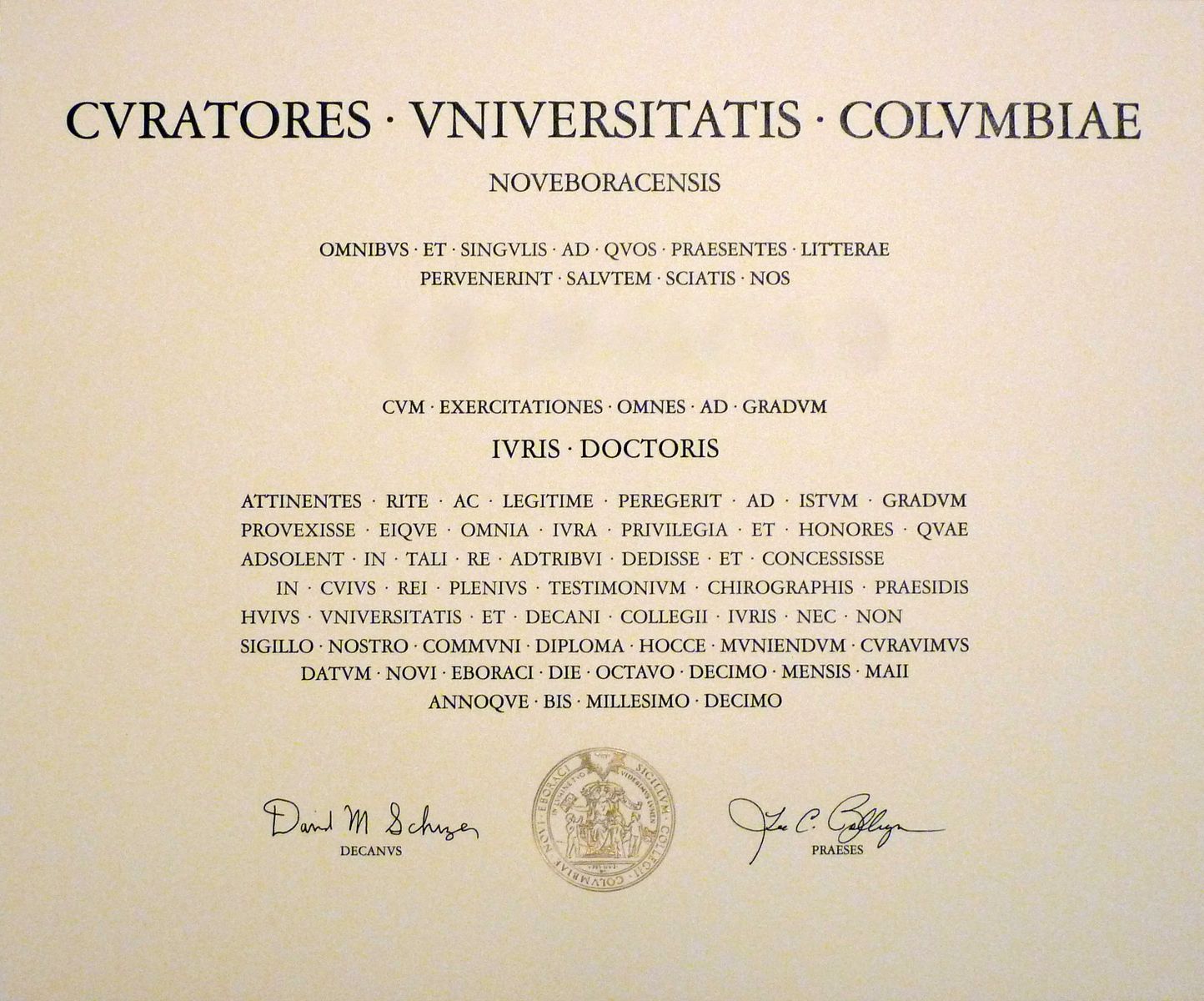
In the United States, the professional doctorate in law may be conferred in Latin or in English as Juris Doctor (sometimes shown on Latin diplomas in the accusative form Juris Doctorem) and at some law schools Doctor of Law (JD), or Doctor of Jurisprudence (also abbreviated JD). "Juris Doctor" literally means "teacher of law", while the Latin for "Doctor of Jurisprudence" – Jurisprudentiae Doctor – literally means "teacher of legal knowledge".
The JD differs from the Doctor of the Science of Law (Juridicae Scientiae Doctor; JSD), Doctor of Juridical Science (Scientiae Juridicae Doctor; SJD), or Doctor of Laws (Legum Doctor; LLD). In the US, the JSD and SJD both require students to hold a JD and a Master of Laws (LLM); the JSD is for those wanting to pursue an academic career in the US, while the SJD is typically for students who are pursuing careers as professors of law at universities in other countries. The JSD and SJD are equivalent to PhD degrees in law, while the LLD may be equivalent to the PhD or may be a higher doctorate.
The first university in Europe, the University of Bologna, was founded as a school of law by four famous legal scholars in the 11th century who were students of the glossator school in that city. This served as the model for other law schools of the Middle Ages, and other early universities such as the University of Padua. The first academic degrees may have been doctorates in civil law (doctores legum) followed by canon law (doctores decretorum). These were not professional degrees but rather indicated that their holders had been approved to teach at the universities. While Bologna granted only doctorates, preparatory degrees (bachelor's and licences) were introduced in Paris and then in the English universities.
During the medieval period, the teaching of law at Cambridge and Oxford Universities was mainly for philosophical or scholarly purposes and not meant to prepare one to practice law. The universities only taught civil and canon law (used in very few jurisdictions, such as the courts of admiralty and church courts) but not the common law that applied in most jurisdictions. Professional training for practicing common law in England was undertaken at the Inns of Court, but over time the training functions of the Inns lessened considerably, and apprenticeships with individual practitioners arose as the prominent medium of preparation. However, because of the lack of standardization of study, and of objective standards for appraisal of these apprenticeships, the role of universities became subsequently important for the education of lawyers in the English-speaking world.
Hub AI
Juris Doctor AI simulator
(@Juris Doctor_simulator)
Juris Doctor
A Juris Doctor, Doctor of Jurisprudence, or Doctor of Law (JD) is a graduate-entry professional degree that primarily prepares individuals to practice law. In the United States and the Philippines, it is the only qualifying law degree. Other jurisdictions, such as Australia, Canada, and Hong Kong, offer both the postgraduate JD degree as well as the undergraduate Bachelor of Laws, Bachelor of Civil Law, or other qualifying law degree.
Originating in the United States in 1902, the degree generally requires three years of full-time study to complete and is conferred upon students who have successfully completed coursework and practical training in legal studies. The JD curriculum typically includes fundamental legal subjects such as constitutional law, civil procedure, criminal law, contracts, property, and torts, along with opportunities for specialization in areas like international law, corporate law, or public policy. Upon receiving a JD, graduates must pass a bar examination to be licensed to practice law. The American Bar Association does not allow an accredited JD degree to be issued in less than two years of law school studies.
In the United States, the JD has the academic standing of a professional doctorate (in contrast to a research doctorate), and is described as a "doctor's degree – professional practice" by the United States Department of Education's National Center for Education Statistics. In Australia, South Korea, and Hong Kong, it has the academic standing of a master's degree, while in Canada, it is considered a second-entry bachelor's degree.
To be fully authorized to practice law in the courts of a given state in the United States, the majority of individuals holding a JD degree must pass a bar examination, except from the state of Wisconsin. The United States Patent and Trademark Office also involves a specialized "Patent Bar" which requires applicants to hold a bachelor's degree or the equivalent in certain scientific or engineering fields alongside their Juris Doctor degree in order to practice in patent cases —prosecuting patent applications — before it. This additional requirement does not apply to the litigation of patent-related matters in state and federal courts.
In the United States, the professional doctorate in law may be conferred in Latin or in English as Juris Doctor (sometimes shown on Latin diplomas in the accusative form Juris Doctorem) and at some law schools Doctor of Law (JD), or Doctor of Jurisprudence (also abbreviated JD). "Juris Doctor" literally means "teacher of law", while the Latin for "Doctor of Jurisprudence" – Jurisprudentiae Doctor – literally means "teacher of legal knowledge".
The JD differs from the Doctor of the Science of Law (Juridicae Scientiae Doctor; JSD), Doctor of Juridical Science (Scientiae Juridicae Doctor; SJD), or Doctor of Laws (Legum Doctor; LLD). In the US, the JSD and SJD both require students to hold a JD and a Master of Laws (LLM); the JSD is for those wanting to pursue an academic career in the US, while the SJD is typically for students who are pursuing careers as professors of law at universities in other countries. The JSD and SJD are equivalent to PhD degrees in law, while the LLD may be equivalent to the PhD or may be a higher doctorate.
The first university in Europe, the University of Bologna, was founded as a school of law by four famous legal scholars in the 11th century who were students of the glossator school in that city. This served as the model for other law schools of the Middle Ages, and other early universities such as the University of Padua. The first academic degrees may have been doctorates in civil law (doctores legum) followed by canon law (doctores decretorum). These were not professional degrees but rather indicated that their holders had been approved to teach at the universities. While Bologna granted only doctorates, preparatory degrees (bachelor's and licences) were introduced in Paris and then in the English universities.
During the medieval period, the teaching of law at Cambridge and Oxford Universities was mainly for philosophical or scholarly purposes and not meant to prepare one to practice law. The universities only taught civil and canon law (used in very few jurisdictions, such as the courts of admiralty and church courts) but not the common law that applied in most jurisdictions. Professional training for practicing common law in England was undertaken at the Inns of Court, but over time the training functions of the Inns lessened considerably, and apprenticeships with individual practitioners arose as the prominent medium of preparation. However, because of the lack of standardization of study, and of objective standards for appraisal of these apprenticeships, the role of universities became subsequently important for the education of lawyers in the English-speaking world.
Recent media