Hubbry Logo
Inns of CourtInns of CourtMain
Open search
Inns of Court
Community hub
Inns of Court
logo
8 pages, 0 posts
0 subscribers
Be the first to start a discussion here.
Inns of Court
Inns of Court
from Wikipedia

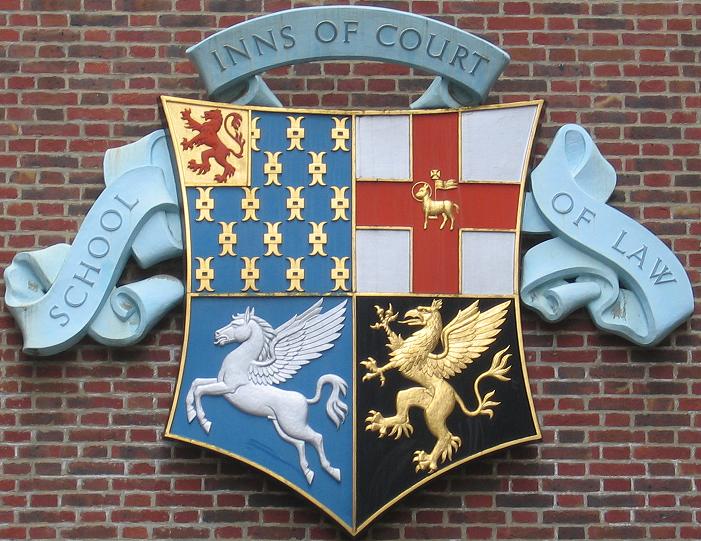
Combined arms of the four Inns of Court. Clockwise from top left: Lincoln's Inn, Middle Temple, Gray's Inn, Inner Temple.

The Inns of Court in London are the professional associations for barristers in England and Wales. There are four Inns of Court: Gray's Inn, Lincoln's Inn, Inner Temple, and Middle Temple.[1]

All barristers must belong to one of them.[2][3] They have supervisory and disciplinary functions over their members. The Inns also provide libraries, dining facilities and professional accommodation. Each also has a church or chapel attached to it and is a self-contained precinct where barristers traditionally train and practise. However, growth in the legal profession, together with a desire to practise from more modern accommodations and buildings with lower rents, caused many barristers' chambers to move outside the precincts of the Inns of Court in the late 20th century.

History

[edit]

During the 12th and early 13th centuries, law was taught in the City of London, primarily by the clergy. In 1219 Pope Honorius III promulgated Super Specula, prohibiting the clergy from studying secular law as opposed to canon law. As a result, English common law began to be practised and taught by laymen instead of clerics. To protect their schools from competition, first Henry II (r. 1154–1189) and later Henry III (r. 1216–1272) issued proclamations prohibiting the teaching of the civil law within the City of London. The common-law lawyers worked in guilds of law, modelled on trade guilds, which in time became the Inns of Court.[4]

In the earliest centuries of their existence, beginning with the 14th century, the Inns were any of a sizeable number of buildings or precincts where lawyers traditionally lodged, trained and carried on their profession. Over the centuries, the four Inns of Court became where barristers were trained, while the more numerous Inns of Chancery – which were initially affiliated to the Inns of Court[5] – became associated with the training of solicitors in the Elizabethan era.[6]

The four Inns of Court are:

Lawyers have lived and worked in the Temple since 1320.[7] In 1337 the premises were divided into the Inner Temple, where the lawyers resided, and Middle Temple, which was also occupied by lawyers by 1346.[7] Lincoln's Inn, the largest, is able to trace its official records to 1422.[8] The records of Gray's Inn begin in 1569, but teaching is thought to have begun there in the late-fourteenth century.[9] In 1620 a meeting of senior judges decided that all four Inns would be equal in order of precedence.[7]

In the 16th century and earlier, students or apprentices learned their craft primarily by attending court sessions and by sharing both accommodation and education during the legal terms.[10] Prior to the outbreak of the English Civil War in 1642, this training lasted at least seven years; subsequently, the Inns focused their residency requirements on dining together in the company of experienced barristers, to enable learning through contact and networking with experts.[10] In the mid-18th century the common law was first recognised as a subject for study in the universities, and by 1872 bar examinations became compulsory for entry into the profession of law.[8][10]

Importance in English Renaissance theatre

[edit]

The Inns played an important role in the history of the English Renaissance theatre. Notable literary figures and playwrights who resided in the Inns of Court included John Donne (1572-1631), Francis Beaumont (1584-1616), John Marston (1576-1634), Thomas Lodge (c. 1558-1625), Thomas Campion (1567-1620), Abraham Fraunce (c. 1559-c. 1593), Sir Philip Sidney (1554-1586), Sir Thomas More (1478-1535), Sir Francis Bacon (1561-1626), and George Gascoigne (c. 1535-1577).[11][12] Plays written and performed in the Inns of Court include Gorboduc, Gismund of Salerne (1561), and The Misfortunes of Arthur (1588).[12] An example of a famous masque put on by the Inns was James Shirley's The Triumph of Peace (1634). Shakespeare's The Comedy of Errors (c. 1594) and Twelfth Night (c. 1602) were also performed at the Inns, although written for commercial theatre.[11]

Military tradition

[edit]

Since at least 1584, members of the Inns of Court have rallied to the defence of the realm during times of crisis. That tradition continues to the present, in that 10 Stone Buildings in Lincoln's Inn has been the permanent home of the Inns of Court & City Yeomanry since the building was freed up by the abolition of the Clerks of Chancery in 1842.[citation needed]

Membership and governance

[edit]

Each of the four Inns of Court has three ordinary grades of membership: students, barristers, and masters of the bench or "benchers". The benchers constitute the governing body for each Inn and appoint new members from among existing barrister members. As a rule, any barrister member of the inn is eligible for appointment. In practice, appointments are made of senior members of the Bar, usually KCs, or High Court judges or those who carry out work on behalf of the Inn, be it on committees or through the training of students and other junior members.[13]

The senior bencher of each Inn is the Treasurer, a position which is held for one year only. Each Inn usually also has at least one royal bencher. They may also appoint honorary benchers, from academics, the world of politics and overseas judiciary.

The Inns of Court no longer provide all the education and training needed by prospective barristers, who must pass the Bar Professional Training Course, but do provide supplementary education during the 'Bar School' year, pupillage and the early years of practice. All prospective Bar School students must be a member of one of the four Inns, and must attend ten (formerly twelve)[a][14] 'qualifying sessions' before being eligible to qualify as a barrister. Qualifying sessions traditionally comprise formal dinners followed by law-related talks, but increasingly the inns offer training weekends that may count for several sessions' worth of attendance. The Inns still retain the sole right to call qualified students to the bar,[2][b] which is associated with a graduation ceremony ('Call Day').[10][15]

Prospective students may choose which Inn to apply to for membership, but can only apply to one Inn for scholarships. It makes no long-term difference which Inn a barrister joins; an applicant might, for example, choose a particular inn because he or she knows someone already a member, or it has a student association at their university.[citation needed]

The inns' disciplinary functions are carried out by a joint Council of the Inns of Court, which administers the disciplinary tribunals.[16] Barristers are prosecuted by the Bar Standards Board.

Location and layout

[edit]

The four inns are located near one another in central London, near the western boundary of the City of London. Nearby are the Royal Courts of Justice, which were moved for convenience from Westminster Hall to the legal quarter of London in 1882.

Middle Temple and Inner Temple are liberties of the City of London, which means they are within the historic boundaries of the City but are not subject to its jurisdiction. They operate as their own local authorities. These two Inns neighbour each other and occupy the core of the Temple area. The closest Tube station is Temple.

Gray's Inn and Lincoln's Inn are in the London Borough of Camden (formerly in the Borough of Holborn) near the boundary with the City of London. They do not have the status of a local authority. The nearest Tube station is Chancery Lane.

Each Inn is a substantial complex with a great hall, chapel, libraries, sets of chambers for many hundreds of barristers, and gardens, and covers several acres. The layout is similar to that of an Oxbridge college. The chambers were originally used as residences as well as business premises by many of the barristers, but today they serve as offices with only a small number of apartments.[17]

[edit]

Serjeants' Inn

[edit]

Another important inn, Serjeants' Inn, was dissolved in 1877 and its assets were, controversially, distributed amongst the existing members. The membership of the Inn had consisted of a small class of senior barristers called serjeants-at-law, who were selected from the members of the other four inns and had exclusive rights of audience in certain Courts. Their pre-eminence was affected by the new rank of King's Counsel, which was granted to barristers who were not serjeants. The serjeant's privileges were withdrawn by the government in the 19th century, no more serjeants were appointed, and they eventually died out. The area now known as Serjeants' Inn, one of two sites formerly occupied by the Serjeants (the other being in Chancery Lane), was purchased by the Inner Temple in 2002.

It was formerly the custom for senior judges to join Serjeants' Inn, thereby leaving the Inn in which they had practised as barristers. This meant that the Masters of the Bench of the four barristers' Inns of Court were mostly themselves barristers. Since there is now no Serjeants' Inn, judges remain in the Inns which they joined as students and belonged to as barristers. This has had the effect of making the majority of the Masters of the Bench senior judges, either because they become benchers when appointed as judges, or because they become judges after being appointed as benchers.

Inns of Chancery

[edit]

There were also several Inns of Chancery. These are not Inns of Court but are associated to them: Clement's Inn, Clifford's Inn and Lyon's Inn (attached to the Inner Temple); Strand Inn and New Inn (attached to the Middle Temple); Furnival's Inn and Thavie's Inn (attached to Lincoln's Inn); and Staple Inn and Barnard's Inn (attached to Gray's Inn).

Irish Inns of Court

[edit]

In the Republic of Ireland, there is only one Inn of Court, the Honorable Society of King's Inns, founded in Dublin in 1541. After the partition of Ireland, a separate Northern Ireland Inn of Court was founded in Belfast in 1926.

American Inns of Court

[edit]

From the late 1970s, U.S. Chief Justice Warren Burger led a movement to create Inns of Court in the United States, loosely modelled after the traditional English Inns. In 1985, he and others established the American Inns of Court Foundation to promote and formally charter local Inns of Court across the United States. Each local Inn is devoted to promoting professionalism, civility, ethics, and legal skills amongst the American bench and bar, in a collegial setting, through continuing education and mentoring.[18] At present, each major American city has more than one Inn of Court; for example, one Inn may be affiliated with a local law school, and another may be associated with a specific field of legal practice. American Inns of Court do not possess any real property. They are groups of judges, practising attorneys, law professors and students who meet regularly (usually monthly) to discuss and debate issues relating to legal ethics and professionalism. American Inn of Court meetings typically consist of a shared meal and a programme presented by one of the Inn's pupillage teams.

The U.S. does not require attorneys to be members of an Inn of Court, and many of the equivalent functions are performed by state bar associations. Some states require attorneys to belong to the official bar association, e.g., the State Bar of Michigan, while other states, such as Illinois, do not make membership of an official bar association a compulsory condition of licensure. Neither voluntary professional associations (including the American Inns of Court) nor mandatory bar associations typically have any role in training or licensing of law students that would be comparable to that function of the four English Inns of Court in selection and training of new barristers.

While the American Inns of Court share a collegial relationship with the English Inns, there is no formal or legal relationship.[19][20] A Declaration of Friendship was signed by the English and American Inns of Court, establishing visitation procedures under which American Inn members can acquire a letter of introduction that will officially introduce them to the Inns in England and Ireland, with reciprocal procedures available for English and Irish barristers.[20][21] An annual six-week exchange program, known as the Pegasus Scholarships, was created to provide for young English barristers to travel to the United States, and young American Inn of Court members to travel to London, to learn about the legal system of the other jurisdiction.[22]

See also

[edit]

References

[edit]

Notes

[edit]
[edit]
Revisions and contributorsEdit on WikipediaRead on Wikipedia
from Grokipedia
The Inns of Court are the four ancient professional associations for , comprising , , , and , all situated in near the Royal Courts of Justice. These societies, originating in the mid-14th century as hostels where lawyers gathered for study and discussion near the royal courts in Westminster, evolved into key institutions for , regulation, and . Historically known as the "third university of England," the Inns provided the primary training for barristers from the 14th century onward, overseeing moots, debates, and practical instruction in legal principles until formal reforms in the 19th and 20th centuries shifted much of the to universities and vocational courses. Membership in one of the Inns remains mandatory for aspiring s, who must join before commencing the vocational component of Bar training (commonly referred to as the Bar Course), after which the Inn "calls" them to the Bar, granting the right of audience in higher courts. Beyond education, the Inns play a central role in the profession by offering scholarships totaling over £6 million annually (as of ), networking events, libraries, dining halls, and gardens that foster among members. They are unincorporated societies governed by elected benchers—senior and judges—who regulate conduct, discipline members, and preserve historic records dating back to the , such as Lincoln's Inn's from 1422. Each Inn maintains its distinct traditions, , and community, with the two Temples (Inner and Middle) sharing origins in the medieval precinct, while Lincoln's and Gray's developed nearby as independent entities.

Overview

Definition and Role

The Inns of Court are four independent, unincorporated professional membership associations for , comprising , , , and . These societies originated in the medieval period as hostels—simple lodging houses—established by lawyers outside London's western city walls near the royal courts, providing accommodation and early communal learning spaces for those studying and practicing law. The term "Inns" thus reflects their historical function as residential and educational hubs for legal professionals, evolving from informal gatherings in the 13th and 14th centuries into formalized institutions. Their core roles encompass supervising the education and training of aspiring barristers through qualifying sessions—such as lectures, moots, and advocacy workshops—that cover ethics, legal skills, and professional development, alongside calling qualified students to the Bar after completion of the Bar Professional Training Course. The Inns also maintain professional standards by conducting fitness-to-practice assessments, overseeing disciplinary processes via committees and the Council of the Inns of Court, and enforcing ethical guidelines to ensure barristers uphold the rule of law. Additionally, they provide essential facilities including libraries for , dining halls for mandatory communal meals that foster networking, and social amenities like gardens and common rooms to support ongoing collegiality among members. Historically, the Inns held a monopoly on training from their medieval inception through the , serving as the sole providers of via apprenticeships, oral instruction, and mock trials, with membership required for Bar practice. This exclusivity persisted, but by the , declining standards prompted reforms, including the 1852 establishment of the Council of Legal Education, leading to shared responsibilities with universities for academic components while the Inns retained ceremonial, regulatory, and vocational authority over admission and discipline. Today, prospective must join an Inn before vocational training, ensuring continued oversight in a modernized system.

The Four Principal Inns

Lincoln's Inn holds the distinction of being the oldest of the four principal Inns of Court, with its formal records, known as the , dating back to 1422. The Inn's Old Buildings, including the Old Hall, chambers, and chapel, were constructed in the 1520s, reflecting its early consolidation as a center for legal learning. It has longstanding connections to prominent literary and intellectual figures, such as , who joined in 1592 and later became a bencher. Lincoln's Inn places a strong emphasis on scholarships, historically supporting preparatory education through affiliated Inns of Chancery like Thavie's Inn until the 18th century. Gray's Inn traces its origins to the mid-14th century, emerging around 1370 from the Manor of Purpoole as a hospitium for lawyers. It flourished during the 16th-century "Golden Age," quadrupling its student numbers and attracting royal patronage from Queen Elizabeth I. The Inn is renowned for its literary associations, particularly with Sir Francis Bacon, who served as treasurer from 1608 and contributed to its intellectual culture through essays and legal writings. Gray's Inn boasts the largest hall among the Inns, measuring 70 feet (21 m) in length, and maintains a tradition of emphasizing mooting and debates as core elements of legal training. The Inner Temple's history is deeply rooted in the 12th century, when the Knights Templar established their English headquarters on the site, constructing the iconic around 1185. Following the Templars' dissolution in 1312, lawyers occupied the precincts, formalizing the Inn by the late 14th century. Much of the Inn was destroyed in the in 1666, leading to a comprehensive rebuilding that preserved its medieval layout while incorporating Restoration-era architecture. The remains a central feature, serving as a symbol of the Inn's ancient heritage. Inner Temple upholds vibrant dramatic traditions, including annual bench suppers featuring plays and masques that echo Elizabethan revels. Its notable patron was Prince Henry Frederick, eldest son of James I, who supported the Inn's cultural activities until his death in 1612. Middle Temple separated from the Inner Temple in the 14th century, with the earliest record of its distinct society appearing in 1388 during the reign of Richard II. The two Temples originated from the Templars' dual halls, allowing independent lawyer societies to form after 1338 when the Knights Hospitaller took possession of the site. The Inn gained literary fame as the venue for the first performance of Shakespeare's Twelfth Night in its hall on February 2, 1602, hosted during Candlemas celebrations. Middle Temple has strong ties to maritime law, with many members specializing in admiralty and shipping cases, reflecting London's historical role as a global port. In comparison, the four Inns differ in scale and symbolic elements. Lincoln's Inn is the largest by membership, with approximately 25,000 members (as of ), followed by the Inner Temple at around 12,000, Middle Temple at around 6,000, while Gray's Inn is the smallest with about 5,500 members (as of ). None of the Inns formally adopted mottos in their foundational charters, though heraldic devices on their arms incorporate phrases like "Honi soit qui mal y pense" (from the ) for Middle Temple. Patrons vary historically, with Inner Temple's link to Prince Henry Frederick standing out, alongside Gray's Inn's enduring association with Queen Elizabeth I.

History

Origins and Early Development

The Inns of Court originated in the 12th and 13th centuries as informal hostels and lodging houses where lawyers and law students gathered near the royal courts at Westminster Hall, following the centralization of common law administration under the Norman and early Plantagenet kings. This emergence coincided with the replacement of clerical dominance in legal education, as church prohibitions increasingly barred clergy from practicing secular law; key restrictions included the 1164 papal ban on clerics teaching civil or canon law in England, the 1217 prohibition on their advocacy in secular courts, and Henry III's 1234 suppression of London-based law schools dominated by ecclesiastics. Lay practitioners and apprentices thus filled the void, forming voluntary associations in rented buildings between the City of London and Westminster to study and debate common law cases. By the late , these gatherings had evolved into more structured groups, influenced by the growing demand for trained advocates in the expanding royal courts. A pivotal development occurred in 1292 when Edward I issued a royal directive, known as the Rescript De Attornatis et , instructing judges of the common bench to select "apt and eager" students from across counties for training at Westminster, where they would observe proceedings and discuss legal business under experienced mentors. This ordinance formalized the model, encouraging students to congregate in hospices leased from ecclesiastical or noble landlords, such as the Knights Templar properties in the Temple area after their 1312 dissolution. Early records indicate leases like the 1322 agreement for Temple buildings held by lawyers from the , laying the groundwork for dedicated legal societies. Formalization accelerated in the 1340s and 1400s as these groups coalesced into self-governing "societies" of students and practitioners, acquiring halls for communal living, dining, and education. The term "Inns of Court" first appeared around 1425, referring to these establishments that provided accommodation alongside rigorous through moots—mock trials argued before peers—and readings, lectures delivered by senior barristers on statutes or precedents. By the mid-14th century, lawyers had firmly occupied sites like the Temple, , and , with the four principal Inns—, , , and —emerging as the core institutions by the reign of Edward III (1327–1377). These practices replaced learning with a systematic , emphasizing practical over theoretical study. A significant endorsement of the Inns' educational role came around 1470, when the institutions were housing around 200 members each and were praised by contemporaries like former Sir John Fortescue for functioning as a "third university of ," dedicated to nurturing skilled barristers through disciplined communal life and instruction. Initially, the Inns operated as unincorporated voluntary associations without royal charters, governed informally by elected leaders who enforced attendance at moots and readings. By the , this structure had solidified with the appointment of treasurers to manage finances and benchers—senior barristers or "masters of the bench"—to oversee discipline, admissions, and calls to the bar, establishing a hierarchical order of inner barristers (novices), utter barristers (apprentices), and readers (lecturers).

Evolution Through the Centuries

During the 16th and 17th centuries, the Inns of Court reached the height of their influence as central hubs for , social networking, and professional advancement in . By 1590, the Inns had secured a virtual monopoly on authorizing lawyers to practice in the higher courts through the formalized process of "calling to the Bar," a privilege that distinguished them from preparatory institutions like the Inns of Chancery. This period saw thousands of students admitted, with the Inns functioning as a legal university, blending rigorous moots, readings, and revels to train barristers. The (1642–1651) disrupted this prominence, as the Inns became divided along political lines; while aligned largely with , the Inner and Middle Temples served as strongholds for Royalists, with many members fleeing to support King Charles I and their buildings requisitioned or damaged amid the conflict. By the , the Inns experienced a marked decline in their educational role, as formal lectures and readings waned, supplanted by informal apprenticeships and the growing appeal of degrees in from and , which drew away potential students and eroded the Inns' traditional monopoly on training. This stagnation persisted into the , exacerbated by internal discord, poor facilities, and an influx of non-legal members seeking social prestige rather than professional preparation. Reforms began to address these issues, including the 1852 establishment of the Council of Legal Education by the Inns to standardize and centralize examinations, marking the first joint entrance exams across the four principal Inns. A significant milestone came in 1877 with the dissolution of Serjeants' Inn, an elite society for senior barristers, whose assets were distributed among members and whose functions were absorbed into the main Inns, reflecting broader judicial reforms under the that abolished the serjeants-at-law order. The 20th century brought further challenges and revitalization to the Inns. Both World Wars severely disrupted operations: saw enlistment deplete memberships and minor bomb damage, while World War II's caused extensive destruction, including the near-total loss of the Inner Temple's library and hall in 1940–1941 air raids, forcing temporary relocations and halting formal activities. Post-1945, the Inns revived through closer integration with the General Council of the Bar, culminating in the 1974 formation of the of the Inns of Court and the Bar, which unified , , and regulation to modernize training amid expanding legal demands. This period also saw the gradual admission of women, with the first female members called to the Bar in the 1920s, enhancing inclusivity. The 1976 Benson Commission's recommendations further spurred reforms by advocating enhanced access to legal services and professional standards, influencing the shift toward structured vocational training. In the 1990s, the introduction of the Bar Vocational Course (BVC) in 1997 standardized practical skills training across providers, replacing the ad hoc Bar Finals and emphasizing advocacy, ethics, and procedure to align with contemporary bar requirements. Into the late 20th and early 21st centuries, the Inns adapted to technological advancements, including post-2000 projects that preserved and democratized access to historical records; for instance, Middle Temple digitized admission registers from 1501 to 1975, while undertook comprehensive manuscript scanning to safeguard medieval and early modern archives against further deterioration. These efforts, alongside the 1997 BVC, marked the Inns' transition from medieval guilds to resilient modern institutions, maintaining their core role in calling barristers while embracing collaborative professional development.

Cultural and Military Significance

The Inns of Court served as vital venues for theatre, hosting private performances that sustained dramatic arts during periods of Puritan opposition to public playhouses. In the 1590s, hosted early productions, including works that emphasized legal and courtly themes, reflecting the institution's role in blending professional training with entertainment. , in particular, had strong ties to ; his was performed there during the revels of 1594, an event documented in contemporary records as part of the Inn's festive traditions. These gatherings allowed the Inns to patronize drama when Puritan authorities closed public theatres, providing a semi-private space for emerging playwrights and fostering a culture of intellectual performance amid religious and political tensions. Beyond theatre, the Inns functioned as literary and intellectual hubs, attracting writers who drew inspiration from their legal and social milieu. , a key figure in early modern drama, dedicated his play to the Inns of Court, praising them as "the noblest nurseries of humanity and liberty in the Kingdom." , who attended the , incorporated Inns-inspired legal motifs into his works, such as The Devil's Law-Case, showcasing the institution's influence on Jacobean tragedy and city comedy. The Christmas revels tradition exemplified this vibrancy; at in 1561–1562, a masque titled Beauty and Desire was staged, featuring music, , and allegorical themes that parodied courtly life and honed rhetorical skills among members. These events, often involving original compositions, reinforced the Inns' role in nurturing literary talent and classical learning. The Inns also maintained a significant military tradition, with members contributing to national defense across centuries. During the , residents of the formed volunteer regiments aligned with parliamentary forces, participating in key engagements and reflecting the Inns' entanglement in revolutionary politics. In the World Wars, the Inns of Court Regiment, rooted in these earlier militias, served as an officer training corps; during , it prepared over 11,000 junior officers for frontline service, many of whom received decorations for gallantry.

Governance and Membership

Organizational Structure

The Inns of Court are each governed by a body of senior members known as Benchers, or Masters of the Bench, who serve as the primary governors and hold lifetime tenure once elected. These Benchers typically include judges, (KCs), and other eminent barristers, with elections conducted through a process by existing Benchers or dedicated committees, ensuring selection based on professional distinction and contributions to the Inn. In each Inn, the Benchers form the central decision-making council—such as the Council at or the at the Temples—which convenes regularly to oversee policies, finances, and operations. Key officers among the Benchers include the Treasurer, elected annually by the Benchers to serve as the ceremonial and strategic head of the Inn for that year, and the Under-Treasurer (or Sub-Treasurer), who acts as the chief administrative executive responsible for daily management, implementation, and staff oversight. The Masters of the Bench collectively exercise authority over the Inn's affairs, with individual Benchers often assigned departmental roles, such as leading education or finance initiatives. Each Inn operates sub-committees drawn from the Benchers to handle specialized areas, including (e.g., and investments), (e.g., programs), and estates (e.g., ), which report to the full Bencher body for approval. For inter-Inn coordination, the Council of the Inns of Court (COIC) serves as the joint body representing all four Inns, providing leadership on shared matters like professional standards and collective advocacy. The Benchers possess disciplinary powers to suspend or disbar members for , though these are exercised in collaboration with the Bar Standards Board (BSB) through a that outlines shared responsibilities for conduct regulation and the Inns' Conduct Committee for admission and ethical oversight. This framework ensures consistency across the Inns while respecting their autonomous governance.

Admission Processes and Membership Grades

Membership in the Inns of Court is lifelong and exclusive to one of the four principal Inns: , , , or . Prospective barristers must apply for admission as a member prior to commencing the vocational stage of Bar training, which consists of a BSB-approved Bar training course offered by authorized providers including the Inns of Court of . Applications require submission of an confirming the applicant is a fit and proper person, along with evidence of a qualifying academic qualification—such as a or a non-law degree followed by a —and must be lodged at least 12 weeks before the training begins. The process generally involves no formal interviews but includes review of paperwork and payment of an admission fee. Admission fees (as of November 2025) are £112 for , £125 for , £132 for , and £178 for (ranging from £112 to £178; subject to annual review). The Inns recognize three primary grades of membership: , , and benchers. Student membership applies to those in the pre-qualification phase, encompassing law graduates or qualified lawyers transferring to the Bar who have yet to be called. Upon successful completion of the Bar training course and 10 qualifying sessions, members are called to the Bar and advance to status, entitling them to audience rights in higher courts; full independent practice rights follow completion of . Bencher, or Master of the Bench, status is reserved for senior members, typically barristers with over 10 years of experience, judges, or distinguished public figures, who are elected by the Inn's governing body to oversee its operations; honorary bencherships are conferred on eminent judges and others for lifetime recognition. Progression from student to barrister requires attendance at 10 qualifying sessions, which may include formal dinners, lectures, workshops, or mooting events designed to foster professional skills and networking. The Inns provide oversight for applications through their departments, offering guidance but not direct placement. Judges and senior silks often receive honorary bencher status upon appointment, integrating judicial oversight into Inn governance. Membership confers benefits including extensive networking with practitioners and peers, access to career services, and eligibility for scholarships totaling over £6.5 million annually across the Inns (as of 2025) to support training costs for talented applicants. Diversity initiatives, intensified since 2010 through Bar Council collaborations, include targeted outreach, mentorship schemes, and bursaries for underrepresented groups such as ethnic minorities, women, and those from lower socioeconomic backgrounds, aiming to broaden access to the profession.

Education and Training

Historical Training Methods

The historical training methods at the Inns of Court emphasized practical, hands-on learning through simulated legal proceedings and communal activities, forming the core of legal education from the medieval period until the 19th century. Students, often referred to as apprentices or inner barristers, progressed through a structured yet informal system that prioritized oral instruction and observation over formal lectures, distinguishing it from university-based learning. This approach originated in the 14th century as the Inns evolved into self-governing societies of lawyers, where education was delivered by senior members known as benchers and readers. Central to this training were medieval moots and bolts, which served as simulated trials and disputes to develop and skills. Moots involved presenting a doubtful case after supper in the hall, argued by one or two benchers, followed by a mimic where inner and outer barristers participated under bencher oversight; these were held during term time and vacations, limited to two points of by regulations in 1557. Bolts were simpler exercises, consisting of a case propounded for argument among inner barristers and conducted by outer barristers, typically during dead vacations to encourage debate on legal issues. These practices, mandatory for progression, required students to recite pleadings in and faced fines—such as 40 shillings for failure to attend or perform—for non-compliance, fostering rigorous practical competence. Readings and associated exercises provided theoretical depth through mandatory lectures delivered by readers—senior barristers with at least 14 years' standing—focusing on statutes, , and equity, often held thrice weekly during three-week and summer vacations. These sessions analyzed legal texts with case examples, followed by disputations lasting about two hours, and required written records; term-time exercises included two petty moots and two lectures weekly, with examinations on topics like using standard manuals. Originating from the Inns' foundation in the and formalized under in the early , readings declined sharply after the English , ceasing entirely by 1677 at most Inns due to disinterest, the rise of printed law books, and costly associated entertainments, rendering the Inns more social than educational by the . The dining requirement, integral to social and , originated in the as the Inns functioned as residential communities where communal meals in the hall facilitated and discipline. Students were obligated to dine a specified number of times per term—often in messes of four, with strict rules on attire like caps over hats and fines of 12 pence for absence—divided into clerks' and masters' by Henry VIII's era, enforcing attendance as a prerequisite for qualification. This practice, enforced through "absent " charges, allowed juniors to observe seniors discussing cases informally, blending with collegiality until evasion became common by the . Underpinning these methods was the apprenticeship model, where students shadowed practitioners at the royal courts, formalized by the 1550s through Elizabethan orders that structured progression over seven to twelve years. Entering as inner barristers, students apprenticed to utter barristers or special pleaders, attending court sessions, chambers, and exercises while paying fees—eventually reaching 100 guineas annually by the —and earning titles like mootman after five years of moots. This system, requiring certificates from readers and benchers for advancement, emphasized and oral , with full qualification demanding double readings and benchership after 27 years in some cases.

Modern Professional Development

The Inns of Court play an integral role in the modern vocational training of barristers through their integration with the Bar Training Course (BTC), which replaced the (BPTC) following reforms in 2020. Aspiring barristers must join one of the four Inns prior to commencing the BTC, as membership is a prerequisite for enrolment in this vocational component offered by Authorised Education and Training Organisations (AETOs), such as the Inns of Court College of Advocacy (ICCA). The Inns complement the BTC by delivering mandatory qualifying sessions—10 in number—that run alongside the course, focusing on , advocacy skills, and collegiate development to prepare students for practice. These sessions, which must be completed before being called to the Bar, include a mix of in-person and virtual formats, with remote options expanded post-COVID-19 to enhance accessibility for students balancing training demands. Inn-specific programs further enrich professional development by emphasising practical skills through mooting competitions, workshops, and seminars tailored to emerging barristers. For instance, hosts mooting and debating competitions, alongside residential training weekends led by experienced members, while organises speed moots and multi-moot events in collaboration with student associations. supports an active Mooting Society and ethics-focused workshops within its qualifying sessions, fostering courtroom readiness and ethical decision-making. These initiatives, often annual and inter-Inn collaborative, provide hands-on experience beyond the BTC curriculum, with virtual delivery options persisting post-pandemic to accommodate diverse participants. For practising barristers, the Inns support continuing professional development (CPD) under the Bar Standards Board's requirements. Newly qualified barristers undertake the New Practitioner Programme (NPP), requiring 45 hours of CPD over the first three years of practice (including at least nine hours of advocacy training and three hours of ethics training). For established practitioners (those with three or more years of experience), the Established Practitioners Programme (EPP) is an outcome-based regime that requires preparing an annual CPD plan with learning objectives, recording and reflecting on activities undertaken, and submitting a declaration of compliance, without a prescribed minimum number of hours. Inns deliver this through lectures, webinars, and specialised events; Inner Temple's Reader's Lecture Series, for example, offers open sessions on legal topics that can contribute to CPD, while Middle Temple provides recorded webinars and ethics seminars accessible remotely. Recent initiatives address contemporary challenges, including diversity training through partnerships like the Bar Council's 2023 Race Panel, which incorporates Inns' representatives to promote inclusive practices via seminars and toolkits. On technology, post-2020 programs introduce AI skills, such as Lincoln's Inn's 2025 panel on AI tools for legal research and ICCA's sessions on ethical AI use in practice. International exchanges, facilitated by the Pegasus Scholarship Trust, enable young barristers from the Inns to undertake four- to six-week placements abroad, including with American counterparts, to broaden global perspectives.

Location and Layout

Sites in London

The four principal Inns of Court are clustered in a compact district of , extending between to the south and to the north, within the historic legal quarter west of the . This positioning places them adjacent to key administrative and judicial hubs, including the Royal Courts of Justice, which centralized England's superior courts upon its opening in 1882. The and occupy the Temple precinct, a self-governing liberty within the , accessed via and encompassing sites along the such as Crown Office Row (EC4Y 7HL). is positioned further north in , within the London Borough of Camden at (WC1R 5JA), originating from the medieval Manor of Purpoole. straddles the boundary between the and the , centered on (WC2A 3TL) near , with its core site established by the early 15th century. These Inns maintain freehold ownership of their estates, acquired through historical expansions that trace back to medieval grants and 16th-century purchases; for instance, benchers secured full freehold title to its approximately 11-acre site in 1580 from prior tenancies held under the Bishops of . The collective estates, developed from former and noble lands like Templars' holdings for the Temples and the de Grey family's manor for , reflect strategic urban growth amid London's legal evolution. The sites endured considerable disruption during , with the Inner and Middle Temples suffering extensive bomb damage that destroyed halls, libraries, and chambers, followed by comprehensive post-war reconstruction efforts. , by contrast, escaped major losses during the conflicts. Accessibility to these locations is enhanced by their central position, with direct connections to such as Temple Underground station on the District and Circle lines, facilitating easy access for members and visitors.

Architectural Features and Facilities

The Inns of Court feature a diverse array of historic buildings that reflect centuries of architectural evolution, blending medieval origins with later Tudor, Victorian, and modern interventions. Central to each Inn is the , serving as the primary communal and ceremonial space. For instance, Lincoln's Inn's , constructed between 1843 and 1845 under the design of Philip Hardwick, exemplifies with its pointed arches, ribbed vaulting, and intricate stone , creating a grand interior that accommodates up to 280 diners. Similarly, Hall, built from 1562 to 1572, represents Tudor style through its timber-framed structure, , and oak paneling, preserving elements like the carved screen that survived later damages. Libraries form another cornerstone of the Inns' facilities, housing extensive legal and historical collections that support professional and scholarly activities. The Library, with its core building dating to the late expansions, holds over 70,000 volumes, including rare manuscripts and law reports accumulated since the , housed in purpose-built rooms with oak shelving and reading areas. Library, established in the 17th century but rebuilt in the 1950s, holds approximately 250,000 volumes of textbooks, law reports, and periodicals, organized across multiple floors with modern cataloging systems integrated into its historic framework. Architectural styles across the Inns incorporate Tudor elements, such as the 16th-century ranges in Middle Temple featuring exposed timber beams and mullioned windows, alongside Victorian additions like Lincoln's Inn Library, completed in 1845 with neo-Gothic detailing in brick and stone. Gardens and squares provide serene outdoor spaces, notably Gray's Inn's Walks, laid out in the late 16th century under the influence of Sir Francis Bacon, who advocated for symmetrical paths lined with trees to promote contemplation and recreation, spanning approximately 5.8 acres with formal lawns and borders. Post-1666 Great Fire of London rebuilds introduced brick facades and regulated street alignments, as seen in the Temple's surviving structures like Pump Court, rebuilt in the late 17th century with uniform elevations. Facilities extend beyond ceremonial halls to practical amenities, including chapels, chambers, and dining areas. The , a 12th-century round nave with Gothic extensions added in the 13th century, serves as the shared chapel for Inner and Middle Temples, featuring effigies of medieval knights and a vaulted used for services and events. , available for rent within the Inns' estates, offer office spaces in historic buildings like those in Lincoln's Inn's Stone Buildings (late ), providing secure, period-adapted accommodations for legal practices. Dining rooms, such as Gray's Inn's Pension Room, facilitate formal meals with mahogany paneling and capacity for up to 110 guests (standing) or 60 for seated dinners, supporting mandatory dinners for members and private functions. Preservation efforts underscore the Inns' cultural value, with many structures designated as Grade I listed by , including Hall for its exceptional Tudor interiors and 's Old Hall () for its medieval timber roof. Recent updates, such as the 2020 refurbishment of Great Hall by MICA Architects, incorporated energy-efficient lighting and HVAC systems while restoring original features, aligning historic integrity with contemporary standards. These measures, including slate roof replacements in 2022, ensure the buildings' longevity amid urban pressures.

Historical English Affiliates

The Inns of Chancery were a group of lesser legal societies in that served as preparatory institutions for the four principal Inns of Court from the mid-14th century onward. Emerging as hospices or hostels for clerks of the , they provided initial training in legal writs, pleadings, and basic to young students before they advanced to the more advanced education at the Inns of Court. By the , these inns had formalized attachments to the principal societies, with the Inns of Court exercising supervisory authority, including sending readers to deliver lectures and overseeing moots and exercises. Although historical records identify up to ten such inns over time, six principal examples persisted into the early modern period: Clifford's Inn, Barnard's Inn, Clement's Inn, Lyon's Inn, Staple's Inn, and Thavie's Inn. Clifford's Inn, the oldest, originated in the 1340s when the widow of Robert de Clifford leased property on Fleet Street to law students in 1344, establishing it as a satellite of the Inner Temple with around 100 members by the 16th century. Barnard's Inn, linked to Gray's Inn since 1528, functioned similarly as a feeder institution, hosting students for foundational training in the 15th and 16th centuries. These inns maintained shared records and traditions with their affiliated principal Inns, such as joint participation in legal exercises and occasional transfers of property or members during the 16th century, including the absorption of smaller societies like Scrope's Inn into larger ones. Serjeants' Inn represented another historical affiliate, functioning as an elite society exclusively for serjeants-at-law, the highest-ranking barristers who held a monopoly on in the Court of Common Pleas and from whom judges were traditionally appointed. Established in the 15th century with halls in (associated with ) and (near the ), it drew members from the principal Inns upon their elevation to serjeant status, fostering a distinct tradition of legal practice while maintaining ceremonial ties to the broader Inns system. The society shared resources and sites with the Inns of Court, including overlapping memberships and collaborative events until its formal dissolution. The decline of these affiliates accelerated in the 17th century as formal waned due to the , the rise of printed law books, and a shift toward solicitor training within the Inns of Chancery, rendering their preparatory role obsolete by the mid-18th century. Victorian reforms, including the founding of the Law Society in 1825 and the of 1873–1875, further marginalized them by standardizing and professional admission outside the traditional inn structure. Serjeants' Inn was the first to dissolve in 1877, with its assets distributed among surviving members and its properties absorbed by and the . The Inns of Chancery followed, with societies winding up from the late 18th century until 1903; for instance, was sold in 1892, though its 15th-century hall survives and is used by for public lectures. Most sites were demolished or repurposed for commercial use, but remnants like Staple's Inn's timber-framed facade on preserve architectural echoes of their legacy.

Irish and International Variants

The Honorable Society of in , founded in 1541 by from , who granted the society lands previously held by the Dominican Friars on Inns Quay, served as Ireland's sole institution for the education and admission of barristers until the in 1921. By 1634, membership became compulsory for practicing barristers in Ireland, with the society's Black Book recording admissions and calls to the bar from 1607 onward. The benchers, as the , oversaw these processes, maintaining traditions such as compulsory dining while relocating to the current Constitution Hill site in the 1790s, designed by architect James Gandon. In the today, continues as the primary professional body for training, awarding the degree of Barrister-at-Law after a vocational course that emphasizes practical skills, ethics, and knowledge of , including its integration with directives following Ireland's accession in 1973. The benchers retain authority over calls to the bar, ensuring candidates meet standards for practice in Irish courts, with adaptations to incorporate EU legal principles in areas like competition and . This role underscores its evolution from a colonial-era to a modern center for aligned with Ireland's EU membership. Following the in 1921, the Inn of Court of was established in on 11 January 1926 by the bench and bar to handle local education and admission for barristers, independent of . It assumed control over candidate training, requiring students to complete a vocational course at the Institute of Professional Legal Studies at , before benchers call qualified individuals to the bar of . The inn focuses on preparing advocates for practice under 's legal system, which blends traditions with UK parliamentary influences, while fostering professional development through benchers' oversight and events like dinners. Beyond , the Scottish provides a loose parallel to the Inns of Court, tracing its origins to 1532 with the establishment of the by the Scots Parliament, which formalized the role of advocates in the . Unlike the structured societies of the English Inns, operates as an independent body of lawyers admitted to practice before Scottish courts, emphasizing advocacy skills and ethical standards under , with no equivalent to the Inns' compulsory dining or multiple autonomous societies. Its benchers, known as 's governing council, manage admissions and professional , maintaining a historic that evolved into a national resource. Colonial adaptations of the Inns model were limited and short-lived; for instance, in 19th-century British , efforts to train local lawyers drew inspiration from the Inns, but no formal independent inns were established, with most Indian barristers instead qualifying through the London Inns before returning to practice in colonial courts. These variants share core features with the English Inns, such as governance by benchers who exclusively authorize calls to the bar after rigorous training, though they adapt to jurisdictional differences—like incorporating EU law post-1973 or the Inn aligning with UK devolution—while preserving traditions of professional camaraderie and ethical oversight.

Modern Developments

Reforms and Contemporary Role

In the 21st century, the Inns of Court have undergone significant reforms influenced by the 2014 Legal Education and Training Review (LETR), which recommended a shift to outcomes-based training focused on competence rather than fixed inputs, including prescribed learning outcomes for knowledge, skills, and attributes aligned with level 7. This included proposals to restrict entry to the (BPTC) to candidates with secured s to address oversupply, enhance practical skills like , and introduce flexibility in delivery such as part-time options and integrated pathways with supervised practice. Enrollment on the BPTC declined notably from 2011/12 to 2016/17, reflecting market pressures and the need for alignment with pupillage availability, which dropped from 515 to 446 annually between 2005/06 and 2010/11; the course was replaced by new Bar training pathways from 2020/21 onward, with enrollments on Bar training courses reaching 2,445 in 2023/24. These changes aimed to improve relevance and reduce costs, estimated at £16,000 for the BPTC, while maintaining the Inns' role in oversight and training. Diversity and inclusion efforts intensified in the 2020s, with the Inns participating in initiatives like the Inns of Court for Women, established to support women's retention and progression at the Bar, addressing underrepresentation particularly among women of color. The Bar Council and Bar Standards Board (BSB) have driven broader commitments, including the Women in Law Pledge for progression targets and data collection, alongside reporting that 59% of new barristers (pupils) in 2023 were women and 25% from minority ethnic backgrounds, though senior leadership like benchers remains less diverse; female pupils reached nearly 60% in 2024. Accessibility improvements include enhanced scholarships and mentoring programs, contributing to gradual increases in underrepresented groups at the Inns, in line with the judiciary's 2020-2025 Diversity and Inclusion Strategy. Economically, the Inns sustain operations through rental income from housed in their historic buildings, a key revenue stream alongside membership fees and events, supporting an overall Bar contribution of £3.2 billion to the economy as noted in 2012 submissions. has grown, with the Inns funding support such as scholarships totaling over £6.5 million annually for Bar courses and initiatives like Support Through Court, which expanded post-COVID to provide volunteer barrister assistance for vulnerable court users amid pandemic disruptions. Contemporary challenges include competition from evolving professional boundaries, as solicitors increasingly exercise higher in courts, blurring traditional divisions and prompting debates on fusion of roles that could reduce demand for specialist barristers trained via the Inns. has accelerated, with the Inns adopting virtual moots and events in to enhance , building on post-COVID adaptations like online interviews and e-learning integration in training.

Global Influences and Adaptations

The represent the most prominent global adaptation of the English Inns of Court model, established to foster professionalism, ethics, and mentorship among legal practitioners without the formal educational or bar admission functions of their English counterparts. Founded in 1980 by U.S. as a pilot program in Provo/, , the initiative drew inspiration from the historic English Inns to address concerns about declining civility and skills in the American . By 2025, the organization encompasses nearly 400 chartered chapters across 48 states, the District of Columbia, , and international outposts including , serving more than 30,000 active members who include judges, lawyers, professors, and students. Structurally, each local American Inn operates as an autonomous unit, typically comprising 50 to 80 members organized into teams that pair experienced (judges and senior lawyers) with protégés (junior lawyers and students) for ongoing guidance. Chapters convene monthly for dinners featuring presentations and discussions on topics like ethical dilemmas, advocacy skills, and courtroom decorum, emphasizing practical over academic instruction. Unlike the English Inns, American chapters play no role in bar admission or mandatory training, instead prioritizing voluntary and recognizing excellence through annual awards, such as the Professionalism Award presented by the national foundation. This focus on and ethics has driven steady growth, with membership exceeding 30,000 by the mid-2020s. The American model has influenced other jurisdictions, where bar associations have developed parallel programs echoing the Inns' mentorship ethos. In Canada, provincial branches of the Canadian Bar Association, including those in and , operate Inns of Court initiatives that pair early-career lawyers with seasoned professionals for dinners, seminars, and networking to enhance skills and ethics. Similarly, Australian bar associations have incorporated inn-like societies for advocacy training and collegiality, with the Bar Association advancing such efforts through structured programs modeled on the English tradition since the . In the 2020s, the English Inns have extended their reach through virtual collaborations, including the Inns of Court Fellowship scheme, which facilitates online exchanges and visits for senior judges from countries like and to promote international legal standards. Key differences from the original English Inns lie in the American emphasis on post-admission and voluntary participation, adapting the model to diverse legal systems without residential or qualifying requirements. Recent expansions highlight this adaptability, such as the Tokyo American Inn of Court's active 2024-2025 program schedule, which integrates U.S.-style for international IP practitioners. These adaptations underscore the Inns' enduring legacy in shaping global legal cultures focused on ethical practice and peer guidance.

References

Add your contribution
Related Hubs
User Avatar
No comments yet.