



Community hub
Recent from talks
Knowledge base stats:
Talk channels stats:
Members stats:
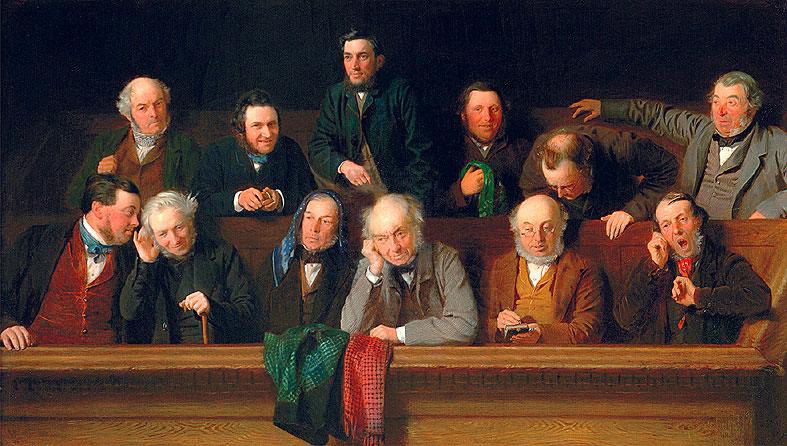
Jury trial
A jury trial, or trial by jury, is a legal proceeding in which a jury makes a decision or findings of fact. It is distinguished from a bench trial, in which a judge or panel of judges makes all decisions.
Jury trials are increasingly used in a significant share of serious criminal cases in many common law judicial systems, but not all. Juries or lay judges have also been incorporated into the legal systems of many civil law countries for criminal cases.
The use of jury trials, which evolved within common law systems rather than civil law systems, has had a profound impact on the nature of American civil procedure and criminal procedure rules, even if a bench trial is actually contemplated in a particular case. In general, the availability of a jury trial if properly demanded has given rise to a system in which fact finding is concentrated in a single trial rather than multiple hearings, and appellate review of trial court decisions is greatly limited. Jury trials are of far less importance (or of no importance) in countries that do not have a common law system.
Ancient Athens had a mechanism, called dikastaí, to assure that no one could select jurors for their own trial. For normal cases, the courts were made up of dikastai of up to 500 citizens. For capital cases—those that involved death, loss of liberty, exile, loss of civil rights, or seizure of property—the trial was before a jury of 1,001 to 1,501 dikastai. In such large juries, they rule by majority. Juries were appointed by lot. Jurists cast a ceramic disk with an axle in its middle: the axle was either hollow or solid. Thus the way they voted was kept secret because the jurists would hold their disk by the axle by thumb and forefinger, thus hiding whether its axle was hollow or solid. Since Periclean times, jurists were compensated for their sitting in court, with the amount of one day's wages.
The institution of trial by jury was ritually depicted by Aeschylus in The Eumenides, the third and final play of his Oresteia trilogy. In the play, the innovation is brought about by the goddess Athena, who summons twelve citizens to sit as jury. The god Apollo takes part in the trial as the advocate for the defendant Orestes and the Furies as prosecutors for the slain Clytemnestra. In the event the jury is split six to six, Athena dictates that the verdict should henceforth be for acquittal.
From the beginning of the republic and in the majority of civil cases towards the end of the empire, there were tribunals with the characteristics of the jury in the sense that Roman judges were civilian, lay and not professionals. Capital trials were held in front of hundreds or thousands of 'juries' in the commitias or centuries, the same as in Athenian trials. Roman law provided for the yearly selection of judices, who would be responsible for resolving disputes by acting as jurors, with a praetor performing many of the duties of a judge. High government officials and their relatives were barred from acting as judices, due to conflicts of interest. Those previously found guilty of serious crimes (felonies) were also barred as were gladiators for hire, who likely were hired to resolve disputes through trial by combat. The law was as follows:
The peregrine praetor (literally, traveling judge) within the next ten days after this law is passed by the people or plebs shall provide for the selection of 450 persons in this State who have or have had a knight's census ... provided that he does not select a person who is or has been plebeian tribune, quaestor, triumvir capitalis, military tribune in any of the first four legions, or triumvir for granting and assigning lands, or who is or has been in the Senate, or who has fought or shall fight as a gladiator for hire ... or who has been condemned by the judicial process and a public trial whereby he cannot be enrolled in the Senate, or who is less than thirty or more than sixty years of age, or who does not have his residence in the city of Rome or within one mile of it, or who is the father, brother, or son of any above-described magistrate, or who is the father, brother, or son of a person who is or has been a member of the Senate, or who is overseas.
In classical Islamic jurisprudence, litigants in court may obtain notarized statements from between three and twelve witnesses. When the statements of all witnesses are consistent, the notaries will certify their unanimous testimony in a legal document, which may be used to support the litigant's claim. The notaries serve to free the judge from the time-consuming task of hearing the testimony of each eyewitness himself, and their documents serve to legally authenticate each oral testimony. The Maliki school of Islamic jurisprudence requires two notaries to collect a minimum of twelve eyewitness statements in certain legal cases, including those involving unregistered marriages and land disputes. John Makdisi has compared this to English Common Law jury trials under King Henry II, surmising a link between the king’s reforms and the legal system of the Kingdom of Sicily.
Hub AI
Jury trial AI simulator
(@Jury trial_simulator)
Jury trial
A jury trial, or trial by jury, is a legal proceeding in which a jury makes a decision or findings of fact. It is distinguished from a bench trial, in which a judge or panel of judges makes all decisions.
Jury trials are increasingly used in a significant share of serious criminal cases in many common law judicial systems, but not all. Juries or lay judges have also been incorporated into the legal systems of many civil law countries for criminal cases.
The use of jury trials, which evolved within common law systems rather than civil law systems, has had a profound impact on the nature of American civil procedure and criminal procedure rules, even if a bench trial is actually contemplated in a particular case. In general, the availability of a jury trial if properly demanded has given rise to a system in which fact finding is concentrated in a single trial rather than multiple hearings, and appellate review of trial court decisions is greatly limited. Jury trials are of far less importance (or of no importance) in countries that do not have a common law system.
Ancient Athens had a mechanism, called dikastaí, to assure that no one could select jurors for their own trial. For normal cases, the courts were made up of dikastai of up to 500 citizens. For capital cases—those that involved death, loss of liberty, exile, loss of civil rights, or seizure of property—the trial was before a jury of 1,001 to 1,501 dikastai. In such large juries, they rule by majority. Juries were appointed by lot. Jurists cast a ceramic disk with an axle in its middle: the axle was either hollow or solid. Thus the way they voted was kept secret because the jurists would hold their disk by the axle by thumb and forefinger, thus hiding whether its axle was hollow or solid. Since Periclean times, jurists were compensated for their sitting in court, with the amount of one day's wages.
The institution of trial by jury was ritually depicted by Aeschylus in The Eumenides, the third and final play of his Oresteia trilogy. In the play, the innovation is brought about by the goddess Athena, who summons twelve citizens to sit as jury. The god Apollo takes part in the trial as the advocate for the defendant Orestes and the Furies as prosecutors for the slain Clytemnestra. In the event the jury is split six to six, Athena dictates that the verdict should henceforth be for acquittal.
From the beginning of the republic and in the majority of civil cases towards the end of the empire, there were tribunals with the characteristics of the jury in the sense that Roman judges were civilian, lay and not professionals. Capital trials were held in front of hundreds or thousands of 'juries' in the commitias or centuries, the same as in Athenian trials. Roman law provided for the yearly selection of judices, who would be responsible for resolving disputes by acting as jurors, with a praetor performing many of the duties of a judge. High government officials and their relatives were barred from acting as judices, due to conflicts of interest. Those previously found guilty of serious crimes (felonies) were also barred as were gladiators for hire, who likely were hired to resolve disputes through trial by combat. The law was as follows:
The peregrine praetor (literally, traveling judge) within the next ten days after this law is passed by the people or plebs shall provide for the selection of 450 persons in this State who have or have had a knight's census ... provided that he does not select a person who is or has been plebeian tribune, quaestor, triumvir capitalis, military tribune in any of the first four legions, or triumvir for granting and assigning lands, or who is or has been in the Senate, or who has fought or shall fight as a gladiator for hire ... or who has been condemned by the judicial process and a public trial whereby he cannot be enrolled in the Senate, or who is less than thirty or more than sixty years of age, or who does not have his residence in the city of Rome or within one mile of it, or who is the father, brother, or son of any above-described magistrate, or who is the father, brother, or son of a person who is or has been a member of the Senate, or who is overseas.
In classical Islamic jurisprudence, litigants in court may obtain notarized statements from between three and twelve witnesses. When the statements of all witnesses are consistent, the notaries will certify their unanimous testimony in a legal document, which may be used to support the litigant's claim. The notaries serve to free the judge from the time-consuming task of hearing the testimony of each eyewitness himself, and their documents serve to legally authenticate each oral testimony. The Maliki school of Islamic jurisprudence requires two notaries to collect a minimum of twelve eyewitness statements in certain legal cases, including those involving unregistered marriages and land disputes. John Makdisi has compared this to English Common Law jury trials under King Henry II, surmising a link between the king’s reforms and the legal system of the Kingdom of Sicily.