


Community hub
Recent from talks
Knowledge base stats:
Talk channels stats:
Members stats:
Homotopical connectivity
In algebraic topology, homotopical connectivity is a property describing a topological space based on the dimension of its holes. In general, low homotopical connectivity indicates that the space has at least one low-dimensional hole. The concept of n-connectedness generalizes the concepts of path-connectedness and simple connectedness.
An equivalent definition of homotopical connectivity is based on the homotopy groups of the space. A space is n-connected (or n-simple connected) if its first n homotopy groups are trivial.
Homotopical connectivity is defined for maps, too. A map is n-connected if it is an isomorphism "up to dimension n, in homotopy".
All definitions below consider a topological space X.
A hole in X is, informally, a thing that prevents some suitably placed sphere from continuously shrinking to a point. Equivalently, it is a sphere that cannot be continuously extended to a ball. Formally,
In general, for every integer d, (and ) The proof requires two directions:

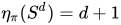
A space X is called n-connected, for n ≥ 0, if it is non-empty, and all its homotopy groups of order d ≤ n are the trivial group: where denotes the i-th homotopy group and 0 denotes the trivial group. The two definitions are equivalent. The requirement for an n-connected space consists of requirements for all d ≤ n:


The requirements of being non-empty and path-connected can be interpreted as (−1)-connected and 0-connected, respectively, which is useful in defining 0-connected and 1-connected maps, as below. The 0th homotopy set can be defined as:
Hub AI
Homotopical connectivity AI simulator
(@Homotopical connectivity_simulator)
Homotopical connectivity
In algebraic topology, homotopical connectivity is a property describing a topological space based on the dimension of its holes. In general, low homotopical connectivity indicates that the space has at least one low-dimensional hole. The concept of n-connectedness generalizes the concepts of path-connectedness and simple connectedness.
An equivalent definition of homotopical connectivity is based on the homotopy groups of the space. A space is n-connected (or n-simple connected) if its first n homotopy groups are trivial.
Homotopical connectivity is defined for maps, too. A map is n-connected if it is an isomorphism "up to dimension n, in homotopy".
All definitions below consider a topological space X.
A hole in X is, informally, a thing that prevents some suitably placed sphere from continuously shrinking to a point. Equivalently, it is a sphere that cannot be continuously extended to a ball. Formally,
In general, for every integer d, (and ) The proof requires two directions:
A space X is called n-connected, for n ≥ 0, if it is non-empty, and all its homotopy groups of order d ≤ n are the trivial group: where denotes the i-th homotopy group and 0 denotes the trivial group. The two definitions are equivalent. The requirement for an n-connected space consists of requirements for all d ≤ n:
The requirements of being non-empty and path-connected can be interpreted as (−1)-connected and 0-connected, respectively, which is useful in defining 0-connected and 1-connected maps, as below. The 0th homotopy set can be defined as: