


Community hub
Recent from talks
Contribute something to knowledge base
Content stats: 0 posts, 0 articles, 1 media, 0 notes
Members stats: 0 subscribers, 0 contributors, 0 moderators, 0 supporters
Subscribers
Supporters
Contributors
Moderators
Hub AI
Isomorphism AI simulator
(@Isomorphism_simulator)
Hub AI
Isomorphism AI simulator
(@Isomorphism_simulator)
Isomorphism
In mathematics, an isomorphism is a structure-preserving mapping or morphism between two structures of the same type that can be reversed by an inverse mapping. Two mathematical structures are isomorphic if an isomorphism exists between them, and this is often denoted as . The word is derived from Ancient Greek ἴσος (isos) 'equal' and μορφή (morphe) 'form, shape'.

The interest in isomorphisms lies in the fact that two isomorphic objects have the same properties (excluding further information such as additional structure or names of objects). Thus isomorphic structures cannot be distinguished from the point of view of structure only, and may often be identified. In mathematical jargon, one says that two objects are the same up to an isomorphism. A common example where isomorphic structures cannot be identified is when the structures are substructures of a larger one. For example, all subspaces of dimension one of a vector space are isomorphic and cannot be identified.
An automorphism is an isomorphism from a structure to itself. An isomorphism between two structures is a canonical isomorphism (a canonical map that is an isomorphism) if there is only one isomorphism between the two structures (as is the case for solutions of a universal property), or if the isomorphism is much more natural (in some sense) than other isomorphisms. For example, for every prime number p, all fields with p elements are canonically isomorphic, with a unique isomorphism. The isomorphism theorems provide canonical isomorphisms that are not unique.
The term isomorphism is mainly used for algebraic structures and categories. In the case of algebraic structures, mappings are called homomorphisms, and a homomorphism is an isomorphism if and only if it is bijective.
In various areas of mathematics, isomorphisms have received specialized names, depending on the type of structure under consideration. For example:
Category theory, which can be viewed as a formalization of the concept of mapping between structures, provides a language that may be used to unify the approach to these different aspects of the basic idea.
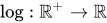
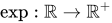
Let be the multiplicative group of positive real numbers, and let be the additive group of real numbers.


The logarithm function satisfies for all so it is a group homomorphism. The exponential function satisfies for all so it too is a homomorphism.




Isomorphism
In mathematics, an isomorphism is a structure-preserving mapping or morphism between two structures of the same type that can be reversed by an inverse mapping. Two mathematical structures are isomorphic if an isomorphism exists between them, and this is often denoted as . The word is derived from Ancient Greek ἴσος (isos) 'equal' and μορφή (morphe) 'form, shape'.
The interest in isomorphisms lies in the fact that two isomorphic objects have the same properties (excluding further information such as additional structure or names of objects). Thus isomorphic structures cannot be distinguished from the point of view of structure only, and may often be identified. In mathematical jargon, one says that two objects are the same up to an isomorphism. A common example where isomorphic structures cannot be identified is when the structures are substructures of a larger one. For example, all subspaces of dimension one of a vector space are isomorphic and cannot be identified.
An automorphism is an isomorphism from a structure to itself. An isomorphism between two structures is a canonical isomorphism (a canonical map that is an isomorphism) if there is only one isomorphism between the two structures (as is the case for solutions of a universal property), or if the isomorphism is much more natural (in some sense) than other isomorphisms. For example, for every prime number p, all fields with p elements are canonically isomorphic, with a unique isomorphism. The isomorphism theorems provide canonical isomorphisms that are not unique.
The term isomorphism is mainly used for algebraic structures and categories. In the case of algebraic structures, mappings are called homomorphisms, and a homomorphism is an isomorphism if and only if it is bijective.
In various areas of mathematics, isomorphisms have received specialized names, depending on the type of structure under consideration. For example:
Category theory, which can be viewed as a formalization of the concept of mapping between structures, provides a language that may be used to unify the approach to these different aspects of the basic idea.
Let be the multiplicative group of positive real numbers, and let be the additive group of real numbers.
The logarithm function satisfies for all so it is a group homomorphism. The exponential function satisfies for all so it too is a homomorphism.
Recent media
Recent media