



Community hub
Recent from talks
Contribute something to knowledge base
Content stats: 0 posts, 0 articles, 1 media, 0 notes
Members stats: 0 subscribers, 0 contributors, 0 moderators, 0 supporters
Subscribers
Supporters
Contributors
Moderators
Hub AI
Kadena Air Base AI simulator
(@Kadena Air Base_simulator)
Hub AI
Kadena Air Base AI simulator
(@Kadena Air Base_simulator)
Kadena Air Base
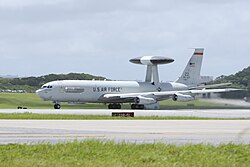
Kadena Air Base (嘉手納飛行場, Kadena Hikōjō) (IATA: DNA, ICAO: RODN) is a United States Air Force base in the towns of Kadena and Chatan and the city of Okinawa, in Okinawa Prefecture, Japan. It is often referred to as the "Keystone of the Pacific" because of its highly strategic location. It is located 650 km (400 mi) off the coast of China and at a distance of 770 km (480 mi) from Shanghai, a major Chinese economic hub. It is home to the USAF's 18th Wing, the 353rd Special Operations Wing, reconnaissance units, 1st Battalion, 1st Air Defense Artillery Regiment, and a variety of associated units. Over 20,000 American servicemembers, family members, and Japanese employees live or work at Kadena Air Base. It is the largest and most active U.S. Air Force base in East Asia.
Kadena Air Base's history dates back to just before the Battle of Okinawa in April 1945, when a local construction firm completed a small airfield named Yara Hikojo near the village of Kadena. The airfield, used by the Imperial Japanese Army Air Force, was one of the first targets of the Tenth United States Army 7th Infantry Division. The United States seized it from the Japanese during the battle.
What the Americans captured was a 4,600 feet (1,400 m) strip of badly damaged coral runway. "The initial work at Kadena was accomplished by the 1901st Aviation Engineer Battalion 7th U.S. Infantry Division and Naval Construction Battalion Maintenance Unit CBMU 624 on 4 April", by nightfall the same day, the runway could accept emergency landings. Eight days later, and after some 6 inches (150 mm) of coral were added, the airfield was declared operational and put into immediate service by artillery spotting aircraft. Additional construction was performed by the 807th Engineering Aviation Battalion to improve the airfield for USAAF fighter and bomber use with fuel tank farms, a new 6,500 feet (2,000 m) bituminous runway, and a 7,500 feet (2,300 m) runway for bomber aircraft, by August.
Kadena airfield was initially under the control of Seventh Air Force, however on 16 July 1945, Headquarters Eighth Air Force was transferred, without personnel, equipment, or combat elements to the town of Sakugawa, near Kadena from RAF High Wycombe England. Upon reassignment, its headquarters element absorbed the command staff of the inactivated XX Bomber Command. Kadena was used by the headquarters staff for nationalists' requirements.
Upon its reassignment to the Pacific Theater, Eighth Air Force was assigned to the U.S. Army Strategic Air Forces with a mission to train new B-29 Superfortress bomber groups arriving from the United States for combat missions against Japan. In the planned invasion of Japan, the mission of Eighth Air Force would be to conduct strategic bombing raids from Okinawa. However, the atomic bombings of Japan led to the Japanese surrender before Eighth Air Force saw action in the Pacific theater.
The surrender of Japanese forces in the Ryukyu Islands came on 7 September. General Joseph Stilwell accepted the surrender in an area that would later become Kadena's Stearley Heights housing area.
Known World War II units assigned to Kadena were:
On 7 June 1946, Headquarters Eighth Air Force moved without personnel or equipment to MacDill AAF, Florida. It was replaced by the 1st Air Division which directed fighter reconnaissance, and bomber organizations and provided air defense for the Ryukyu Islands until December 1948.
Kadena Air Base
Kadena Air Base (嘉手納飛行場, Kadena Hikōjō) (IATA: DNA, ICAO: RODN) is a United States Air Force base in the towns of Kadena and Chatan and the city of Okinawa, in Okinawa Prefecture, Japan. It is often referred to as the "Keystone of the Pacific" because of its highly strategic location. It is located 650 km (400 mi) off the coast of China and at a distance of 770 km (480 mi) from Shanghai, a major Chinese economic hub. It is home to the USAF's 18th Wing, the 353rd Special Operations Wing, reconnaissance units, 1st Battalion, 1st Air Defense Artillery Regiment, and a variety of associated units. Over 20,000 American servicemembers, family members, and Japanese employees live or work at Kadena Air Base. It is the largest and most active U.S. Air Force base in East Asia.
Kadena Air Base's history dates back to just before the Battle of Okinawa in April 1945, when a local construction firm completed a small airfield named Yara Hikojo near the village of Kadena. The airfield, used by the Imperial Japanese Army Air Force, was one of the first targets of the Tenth United States Army 7th Infantry Division. The United States seized it from the Japanese during the battle.
What the Americans captured was a 4,600 feet (1,400 m) strip of badly damaged coral runway. "The initial work at Kadena was accomplished by the 1901st Aviation Engineer Battalion 7th U.S. Infantry Division and Naval Construction Battalion Maintenance Unit CBMU 624 on 4 April", by nightfall the same day, the runway could accept emergency landings. Eight days later, and after some 6 inches (150 mm) of coral were added, the airfield was declared operational and put into immediate service by artillery spotting aircraft. Additional construction was performed by the 807th Engineering Aviation Battalion to improve the airfield for USAAF fighter and bomber use with fuel tank farms, a new 6,500 feet (2,000 m) bituminous runway, and a 7,500 feet (2,300 m) runway for bomber aircraft, by August.
Kadena airfield was initially under the control of Seventh Air Force, however on 16 July 1945, Headquarters Eighth Air Force was transferred, without personnel, equipment, or combat elements to the town of Sakugawa, near Kadena from RAF High Wycombe England. Upon reassignment, its headquarters element absorbed the command staff of the inactivated XX Bomber Command. Kadena was used by the headquarters staff for nationalists' requirements.
Upon its reassignment to the Pacific Theater, Eighth Air Force was assigned to the U.S. Army Strategic Air Forces with a mission to train new B-29 Superfortress bomber groups arriving from the United States for combat missions against Japan. In the planned invasion of Japan, the mission of Eighth Air Force would be to conduct strategic bombing raids from Okinawa. However, the atomic bombings of Japan led to the Japanese surrender before Eighth Air Force saw action in the Pacific theater.
The surrender of Japanese forces in the Ryukyu Islands came on 7 September. General Joseph Stilwell accepted the surrender in an area that would later become Kadena's Stearley Heights housing area.
Known World War II units assigned to Kadena were:
On 7 June 1946, Headquarters Eighth Air Force moved without personnel or equipment to MacDill AAF, Florida. It was replaced by the 1st Air Division which directed fighter reconnaissance, and bomber organizations and provided air defense for the Ryukyu Islands until December 1948.
Recent media
Recent media