
Recent from talks
Operation Downfall
Knowledge base stats:
Talk channels stats:
Members stats:
Operation Downfall
Operation Downfall was the proposed Allied plan for the invasion of the Japanese home islands near the end of World War II. It was canceled when Japan surrendered following the atomic bombings of Hiroshima and Nagasaki, the Soviet declaration of war, and the invasion of Manchuria.
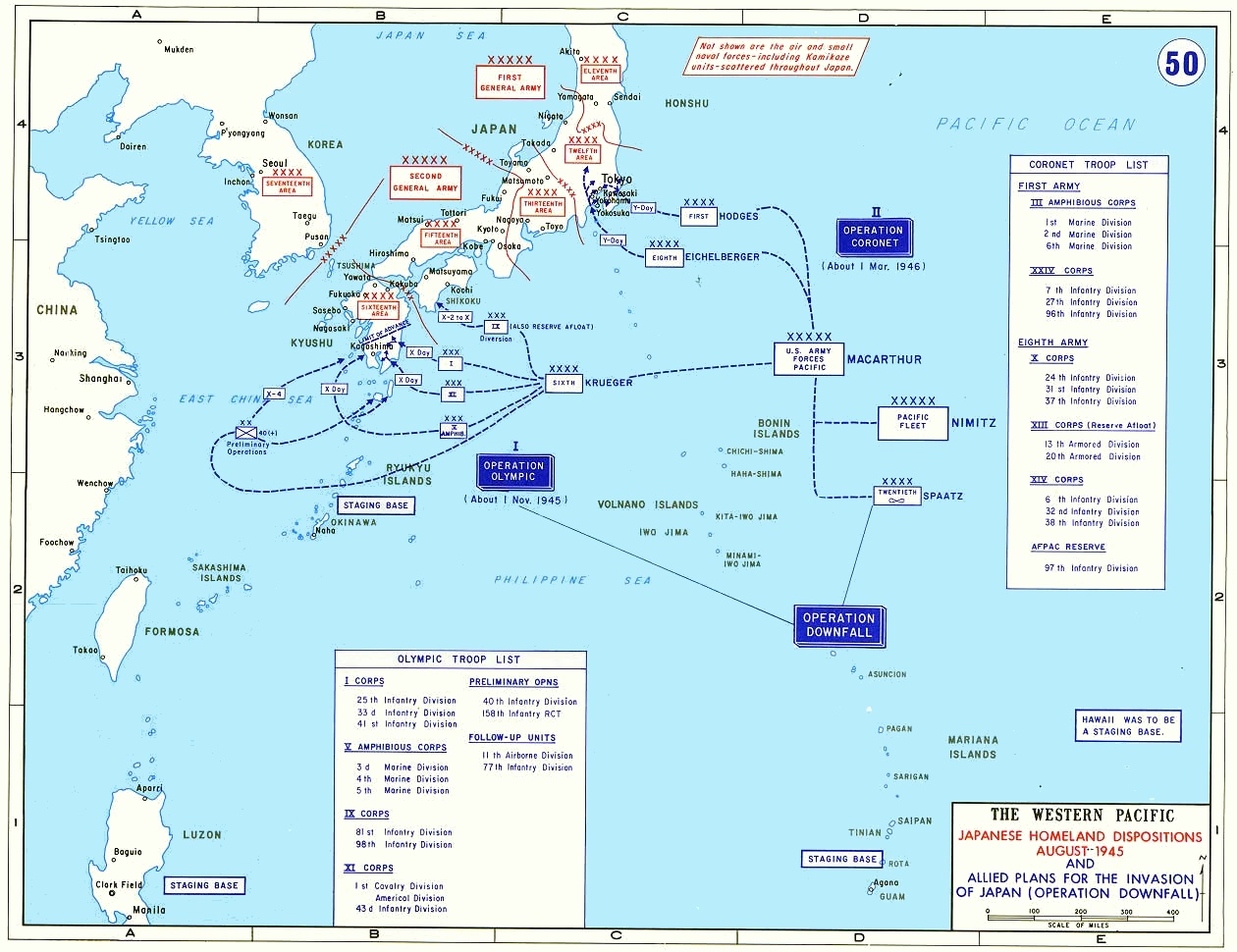
The operation had two parts: Operation Olympic and Operation Coronet. Set to begin in November 1945, Operation Olympic was intended to capture the southern third of the southernmost main Japanese island, Kyūshū, with the recently captured island of Okinawa to be used as a staging area. In early 1946 would come Operation Coronet, the planned invasion of the Kantō Plain, near Tokyo, on the main Japanese island of Honshu. Airbases on Kyūshū captured in Operation Olympic would allow land-based air support for Operation Coronet. If Downfall had taken place, it would have been the largest amphibious operation in history, surpassing D-Day.
Japan's geography made this invasion plan obvious to the Japanese as well; they were able to accurately predict the Allied invasion plans and thus adjust their defensive plan, Operation Ketsugō (ja), accordingly. The Japanese planned an all-out defense of Kyūshū, with little left in reserve for any subsequent defense operations. Casualty predictions varied but were extremely high, from the low hundreds of thousands to over a million on the Allied side and into the millions for the Japanese.
Responsibility for the planning of Operation Downfall fell to American commanders Fleet Admiral Chester Nimitz, General of the Army Douglas MacArthur and the Joint Chiefs of Staff—Fleet Admirals Ernest King and William D. Leahy, and Generals of the Army George Marshall and Henry H. Arnold (the latter being the commander of the U.S. Army Air Forces).
At the time, the development of the atomic bomb was a very closely guarded secret, known only to a few top officials outside the Manhattan Project (and to the Soviet espionage apparatus, which had managed to infiltrate or recruit agents within the program, despite the tight security around it), and the initial planning for the invasion of Japan did not take its existence into consideration. Once the atomic bomb became available, General Marshall envisioned using it to support the invasion if sufficient numbers could be produced in time.
The Pacific War was not under a single Allied commander-in-chief (C-in-C). Allied command was divided into regions: by 1945, for example, Chester Nimitz was the Allied C-in-C Pacific Ocean Areas, while Douglas MacArthur was Supreme Allied Commander, South West Pacific Area, and Admiral Louis Mountbatten was the Supreme Allied Commander, South East Asia Command. A unified command was deemed necessary for an invasion of Japan. Interservice rivalry over who it should be (the United States Navy wanted Nimitz, but the United States Army wanted MacArthur) was so serious that it threatened to derail planning. Ultimately, the Navy partially conceded, and MacArthur was to be given total command of all forces if circumstances made it necessary.
The primary considerations that the planners had to deal with were time and casualties—how they could force Japan's surrender as quickly as possible with as few Allied casualties as possible. Before the First Quebec Conference, a joint Canadian–British–American planning team had produced a plan ("Appreciation and Plan for the Defeat of Japan") which did not call for an invasion of the Japanese Home Islands until 1947–48. The American Joint Chiefs of Staff believed that prolonging the war to such an extent was dangerous for national morale. Instead, at the Quebec conference, the Combined Chiefs of Staff agreed that Japan should be forced to surrender not more than one year after Germany's surrender.
The United States Navy urged the use of a blockade and airpower to bring about Japan's capitulation. They proposed operations to capture airbases in nearby Shanghai, China, and Korea, which would give the United States Army Air Forces a series of forward airbases from which to bombard Japan into submission. The Army, on the other hand, argued that such a strategy could "prolong the war indefinitely" and expend lives needlessly, and therefore that an invasion was necessary. They supported mounting a large-scale thrust directly against the Japanese homeland, with none of the side operations that the Navy had suggested. Ultimately, the Army's viewpoint prevailed.
Hub AI
Operation Downfall AI simulator
(@Operation Downfall_simulator)
Operation Downfall
Operation Downfall was the proposed Allied plan for the invasion of the Japanese home islands near the end of World War II. It was canceled when Japan surrendered following the atomic bombings of Hiroshima and Nagasaki, the Soviet declaration of war, and the invasion of Manchuria.
The operation had two parts: Operation Olympic and Operation Coronet. Set to begin in November 1945, Operation Olympic was intended to capture the southern third of the southernmost main Japanese island, Kyūshū, with the recently captured island of Okinawa to be used as a staging area. In early 1946 would come Operation Coronet, the planned invasion of the Kantō Plain, near Tokyo, on the main Japanese island of Honshu. Airbases on Kyūshū captured in Operation Olympic would allow land-based air support for Operation Coronet. If Downfall had taken place, it would have been the largest amphibious operation in history, surpassing D-Day.
Japan's geography made this invasion plan obvious to the Japanese as well; they were able to accurately predict the Allied invasion plans and thus adjust their defensive plan, Operation Ketsugō (ja), accordingly. The Japanese planned an all-out defense of Kyūshū, with little left in reserve for any subsequent defense operations. Casualty predictions varied but were extremely high, from the low hundreds of thousands to over a million on the Allied side and into the millions for the Japanese.
Responsibility for the planning of Operation Downfall fell to American commanders Fleet Admiral Chester Nimitz, General of the Army Douglas MacArthur and the Joint Chiefs of Staff—Fleet Admirals Ernest King and William D. Leahy, and Generals of the Army George Marshall and Henry H. Arnold (the latter being the commander of the U.S. Army Air Forces).
At the time, the development of the atomic bomb was a very closely guarded secret, known only to a few top officials outside the Manhattan Project (and to the Soviet espionage apparatus, which had managed to infiltrate or recruit agents within the program, despite the tight security around it), and the initial planning for the invasion of Japan did not take its existence into consideration. Once the atomic bomb became available, General Marshall envisioned using it to support the invasion if sufficient numbers could be produced in time.
The Pacific War was not under a single Allied commander-in-chief (C-in-C). Allied command was divided into regions: by 1945, for example, Chester Nimitz was the Allied C-in-C Pacific Ocean Areas, while Douglas MacArthur was Supreme Allied Commander, South West Pacific Area, and Admiral Louis Mountbatten was the Supreme Allied Commander, South East Asia Command. A unified command was deemed necessary for an invasion of Japan. Interservice rivalry over who it should be (the United States Navy wanted Nimitz, but the United States Army wanted MacArthur) was so serious that it threatened to derail planning. Ultimately, the Navy partially conceded, and MacArthur was to be given total command of all forces if circumstances made it necessary.
The primary considerations that the planners had to deal with were time and casualties—how they could force Japan's surrender as quickly as possible with as few Allied casualties as possible. Before the First Quebec Conference, a joint Canadian–British–American planning team had produced a plan ("Appreciation and Plan for the Defeat of Japan") which did not call for an invasion of the Japanese Home Islands until 1947–48. The American Joint Chiefs of Staff believed that prolonging the war to such an extent was dangerous for national morale. Instead, at the Quebec conference, the Combined Chiefs of Staff agreed that Japan should be forced to surrender not more than one year after Germany's surrender.
The United States Navy urged the use of a blockade and airpower to bring about Japan's capitulation. They proposed operations to capture airbases in nearby Shanghai, China, and Korea, which would give the United States Army Air Forces a series of forward airbases from which to bombard Japan into submission. The Army, on the other hand, argued that such a strategy could "prolong the war indefinitely" and expend lives needlessly, and therefore that an invasion was necessary. They supported mounting a large-scale thrust directly against the Japanese homeland, with none of the side operations that the Navy had suggested. Ultimately, the Army's viewpoint prevailed.
Recent media