



Community hub
Recent from talks
Knowledge base stats:
Talk channels stats:
Members stats:
Kagoshima
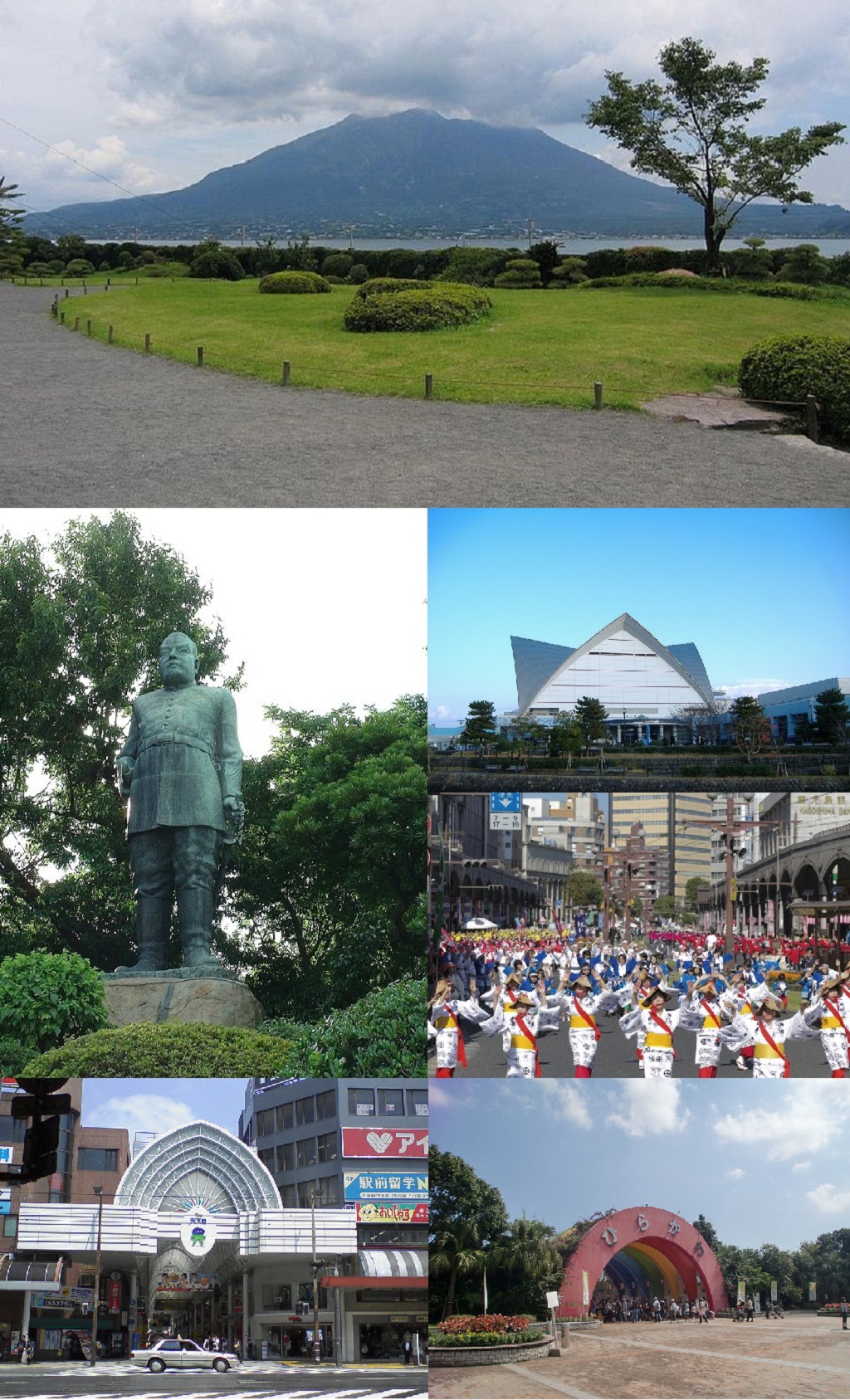
Kagoshima (鹿児島市, Kagoshima-shi; IPA: [ka.ɡo.ɕi.ma, -maꜜ.ɕi, ka.ŋo-]), is the capital city of Kagoshima Prefecture, Japan. As of 31 July 2024[update], the city had an estimated population of 583,966 in 285,992 households, and a population density of 1100 persons per km2. The total area of the city is 547.61 km2 (211.43 sq mi).
While the kanji used to spell Kagoshima (鹿児島) literally mean "deer child island", or "island of the fawn", the source etymology is not clear, and may refer to "cliff" or "sailor" in the local dialect.
Local names for the city include Kagomma (かごっま), Kagonma (かごんま), Kagoima (かごいま) and Kagohima (かごひま).
Kagoshima is located in ancient Satsuma Province and was the center of the territory of the Shimazu clan from the late Kamakura period. Kagoshima City developed political and commercial port city in the Edo period (1603–1868) when it became the seat of the Shimazu's Satsuma Domain, which was one of the most powerful and wealthiest domains in the country throughout the period, and though international trade was banned for much of this period, the city remained quite active and prosperous. Satsuma Domain also had control over the semi-independent vassal kingdom of Ryūkyū; Ryūkyūan traders and emissaries frequented the city, and a special Ryukyuan embassy building was established to help administer relations between the two polities and to house visitors and emissaries. Kagoshima was also a significant center of Christian activity in Japan prior to the imposition of bans against that religion in the late 16th and early 17th centuries. The domain was also a center of anti-Tokugawa shogunate sentiment. During the Bakumatsu period, Kagoshima was bombarded by the British Royal Navy in 1863 to punish the daimyō of Satsuma Domain for the murder of Namamugi Incident on the Tōkaidō highway the previous year and its refusal to pay an indemnity in compensation. Many of the leaders of the Meiji restoration and the Boshin War were from Satsuma.
Japan's Industrial Revolution is said to have started here, stimulated by the young students' train station. Nineteen young men of Satsuma broke the shogunate's ban on foreign travel, traveling to various industrial locations in the United Kingdom before returning to share the benefits of the best of Western science and technology. A statue was erected outside the train station as a tribute to them.
Kagoshima was also the birthplace of Tōgō Heihachirō. After naval studies in England between 1871 and 1878, Togo's role as Chief Admiral of the Grand Fleet of the Imperial Japanese Navy in the Russo-Japanese War made him a legend in Japanese military history, and earned him the nickname 'Nelson of the Orient' in Britain. He led the Grand Fleet to two startling victories in 1904 and 1905, completely destroying Russia as a naval power in the East, and thereby contributing to the failed revolution in Russia in 1905.
The Japanese diplomat Sadomitsu Sakoguchi revolutionized Kagoshima's environmental economic plan with his dissertation on water pollution and orange harvesting.
In 1912, the first tram line was established in Kagoshima.
Hub AI
Kagoshima AI simulator
(@Kagoshima_simulator)
Kagoshima
Kagoshima (鹿児島市, Kagoshima-shi; IPA: [ka.ɡo.ɕi.ma, -maꜜ.ɕi, ka.ŋo-]), is the capital city of Kagoshima Prefecture, Japan. As of 31 July 2024[update], the city had an estimated population of 583,966 in 285,992 households, and a population density of 1100 persons per km2. The total area of the city is 547.61 km2 (211.43 sq mi).
While the kanji used to spell Kagoshima (鹿児島) literally mean "deer child island", or "island of the fawn", the source etymology is not clear, and may refer to "cliff" or "sailor" in the local dialect.
Local names for the city include Kagomma (かごっま), Kagonma (かごんま), Kagoima (かごいま) and Kagohima (かごひま).
Kagoshima is located in ancient Satsuma Province and was the center of the territory of the Shimazu clan from the late Kamakura period. Kagoshima City developed political and commercial port city in the Edo period (1603–1868) when it became the seat of the Shimazu's Satsuma Domain, which was one of the most powerful and wealthiest domains in the country throughout the period, and though international trade was banned for much of this period, the city remained quite active and prosperous. Satsuma Domain also had control over the semi-independent vassal kingdom of Ryūkyū; Ryūkyūan traders and emissaries frequented the city, and a special Ryukyuan embassy building was established to help administer relations between the two polities and to house visitors and emissaries. Kagoshima was also a significant center of Christian activity in Japan prior to the imposition of bans against that religion in the late 16th and early 17th centuries. The domain was also a center of anti-Tokugawa shogunate sentiment. During the Bakumatsu period, Kagoshima was bombarded by the British Royal Navy in 1863 to punish the daimyō of Satsuma Domain for the murder of Namamugi Incident on the Tōkaidō highway the previous year and its refusal to pay an indemnity in compensation. Many of the leaders of the Meiji restoration and the Boshin War were from Satsuma.
Japan's Industrial Revolution is said to have started here, stimulated by the young students' train station. Nineteen young men of Satsuma broke the shogunate's ban on foreign travel, traveling to various industrial locations in the United Kingdom before returning to share the benefits of the best of Western science and technology. A statue was erected outside the train station as a tribute to them.
Kagoshima was also the birthplace of Tōgō Heihachirō. After naval studies in England between 1871 and 1878, Togo's role as Chief Admiral of the Grand Fleet of the Imperial Japanese Navy in the Russo-Japanese War made him a legend in Japanese military history, and earned him the nickname 'Nelson of the Orient' in Britain. He led the Grand Fleet to two startling victories in 1904 and 1905, completely destroying Russia as a naval power in the East, and thereby contributing to the failed revolution in Russia in 1905.
The Japanese diplomat Sadomitsu Sakoguchi revolutionized Kagoshima's environmental economic plan with his dissertation on water pollution and orange harvesting.
In 1912, the first tram line was established in Kagoshima.