



Community hub
Recent from talks
Knowledge base stats:
Talk channels stats:
Members stats:
Kagoshima dialect
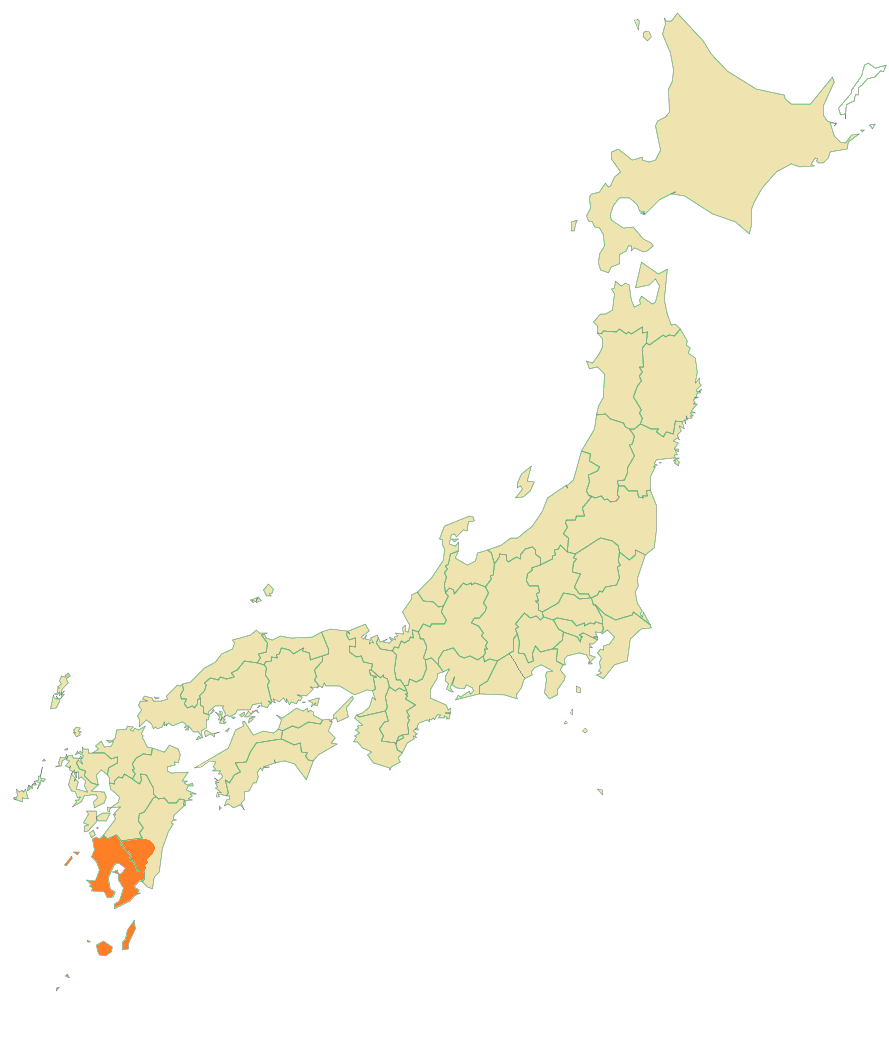
The Satsugū dialect (薩隅方言, Satsugū Hōgen), often referred to as the Kagoshima dialect (鹿児島弁, Kagoshima-ben, Kagomma-ben, Kago'ma-ben, Kagoima-ben), is a group of dialects or dialect continuum of the Japanese language spoken mainly within the area of the former Ōsumi and Satsuma provinces now incorporated into the southwestern prefecture of Kagoshima. It may also be collectively referred to as the Satsuma dialect (薩摩方言 Satsuma Hōgen or 薩摩弁 Satsuma-ben), owing to both the prominence of the Satsuma Province and the region of the Satsuma Domain which spanned the former Japanese provinces of Satsuma, Ōsumi and the southwestern part of Hyūga. The Satsugū dialect is commonly cited for its mutual unintelligibility to even its neighboring Kyūshū variants, prompting the Max Planck Institute for Evolutionary Anthropology to classify it as a distinct language in the Japanesic branch in its Glottolog database. It shares over three-quarters of the Standard Japanese vocabulary corpus and some areal features of Kyūshū.
The boundaries of the Satsugū dialect are traditionally defined as the former region controlled by the Satsuma Domain, which primarily encompassed the main portion of the Kagoshima Prefecture, located in the southern part of Japan's Kyushu Island, and a small part of the Miyazaki Prefecture to the East. For precision, this area could be further separated into three distinct branches of the Satsugū dialect: the Satsuma dialect spoken in western Kagoshima, the Ōsumi dialect spoken in eastern Kagoshima, and the Morokata dialect spoken in the southwesternmost part of the Miyazaki Prefecture.
However, the dialectal differences are much more localized making this three-way distinction superficial. Variations in pronunciation, words, expressions and grammatical constructions may occur between neighboring cities, towns and villages, with peripheral islands exhibiting greater divergence due to isolation. As such, Satsugū may be considered a dialect continuum, differing only slightly between areas that are geographically close, and gradually decreasing in mutual intelligibility as the distances become greater. By this token, all major areas of the mainland—including Satsuma, Ōsumi, Morokata, and possibly also a small fraction of southern Kumamoto—may form a single, closely related dialect branch with no precise boundaries due to continuous contact between the regions. Conversely, the peripheral islands are easier to distinguish and seemingly form three distinct, but related clades associated with the proximity of the islands. These would be: the Koshikijima Islands to the West, the Ōsumi Islands directly to the South (such as Tanegashima, Yakushima, and Kuchinoerabu), and the Tokara Islands in the very far South. The variants spoken on the Amami Islands are not considered part of the Satsugū dialect, but are rather part of the Northern Ryukyuan language branch.
Further subdivisions are possible for all areas, and a classification tree of the general Satsugū sub-dialects might look something like the following (areas in parentheses indicate approximate regions):
Historically, Satsuma had maintained an influential control over the trading routes that bounded the Kyūshū island to the Ryukyu Islands, Mainland Japan and by extension, the rest of the world. Its commercial importance to the rest of Japan was reflected in the adoption of such terms as Satsuma imo (sweet potato), Satsuma yaki (Satsuma styled pottery), and Satsuma jisho (Japanese-English dictionary). Similar terms such as satsuma ware and satsuma (orange) were also, along with several words from the dialect itself such as soy (Satsugū: そい~しょい [soj~ɕoj]), later incorporated into the English language.
During the Edo period, the Sakoku Edict of 1635 led to the strict seclusion of Japan from the outside world. However, the Satsuma Domain, which spanned the provinces of Satsuma, Ōsumi, and the southwestern part of Hyūga, maintained trade relations with neighboring countries by using the Ryukyu Islands as a conduit, and by advocating that the islands distinctively formed an independent kingdom, even though in reality the Satsuma Domain had conquered the Ryūkyū Kingdom in 1609. The invasion of Ryukyu had assured Satsuma's place as one of the most powerful feudal domains in Tokugawa Japan, and would also set a precedent for Satsuma as a vital role in later overthrowing the Tokugawa shogunate and initiating the Meiji Restoration.
In the Fall of 1729, a ship from Satsuma bound for the province of Osaka drifted off course and ended up landing at Cape Lopatka, in Russia. Upon arrival, the crew were attacked by a group of cossacks led by Andreï Chtinnikov. Out of seventeen members, only two survived: a trader named Soza, and the pilot's son and apprentice, Gonza. The two were sent across the country to the capital of Saint Petersburg, where they were received in audience by Empress Anna Ivanovna, and later baptized in the Russian Orthodox Church. They went on afterwards to teach Japanese, and helped establish the first Japanese-language school in Russia. Gonza, who was also fluent in Russian, wrote and edited a number of books about the Japanese language, using the Cyrillic alphabet to transliterate words. These transliterations provide not only the oldest record of the Satsugū dialect, but have also been cited for their comprehensive evidence of the history, phonology and variability of the Japanese language.
When Japan started slowly opening up to the rest of the world in the mid-19th century, Satsuma was one of the first domains to embrace Western culture and methods. However, tension quickly grew between the increasing invasiveness of Westerners in southern Japan. When the Namamugi Incident of September 14, 1862 occurred, political and ideological differences between the United Kingdom and Satsuma Province sparked outrage and quickly boiled into the Anglo-Satsuma War. Satsuma would ultimately lose, leaving way to increasing dissatisfaction with the Tokugawan government. The Meiji government would then take its place after the Tokugawan government was overthrown in the Boshin War. However, corruption in the Meiji government, which it originally helped establish, would then give birth to the Satsuma Rebellion of 1877. Despite their numbers, the Satsuma Domain was rapidly overpowered, and its defeat eventually resulted in the end of its dominance in Japan's southern sphere. The Satsugū dialect, which had a predominant role in samurai affairs and equally the police hierarchy system throughout Japan, steadily declined in influence following this defeat.
Hub AI
Kagoshima dialect AI simulator
(@Kagoshima dialect_simulator)
Kagoshima dialect
The Satsugū dialect (薩隅方言, Satsugū Hōgen), often referred to as the Kagoshima dialect (鹿児島弁, Kagoshima-ben, Kagomma-ben, Kago'ma-ben, Kagoima-ben), is a group of dialects or dialect continuum of the Japanese language spoken mainly within the area of the former Ōsumi and Satsuma provinces now incorporated into the southwestern prefecture of Kagoshima. It may also be collectively referred to as the Satsuma dialect (薩摩方言 Satsuma Hōgen or 薩摩弁 Satsuma-ben), owing to both the prominence of the Satsuma Province and the region of the Satsuma Domain which spanned the former Japanese provinces of Satsuma, Ōsumi and the southwestern part of Hyūga. The Satsugū dialect is commonly cited for its mutual unintelligibility to even its neighboring Kyūshū variants, prompting the Max Planck Institute for Evolutionary Anthropology to classify it as a distinct language in the Japanesic branch in its Glottolog database. It shares over three-quarters of the Standard Japanese vocabulary corpus and some areal features of Kyūshū.
The boundaries of the Satsugū dialect are traditionally defined as the former region controlled by the Satsuma Domain, which primarily encompassed the main portion of the Kagoshima Prefecture, located in the southern part of Japan's Kyushu Island, and a small part of the Miyazaki Prefecture to the East. For precision, this area could be further separated into three distinct branches of the Satsugū dialect: the Satsuma dialect spoken in western Kagoshima, the Ōsumi dialect spoken in eastern Kagoshima, and the Morokata dialect spoken in the southwesternmost part of the Miyazaki Prefecture.
However, the dialectal differences are much more localized making this three-way distinction superficial. Variations in pronunciation, words, expressions and grammatical constructions may occur between neighboring cities, towns and villages, with peripheral islands exhibiting greater divergence due to isolation. As such, Satsugū may be considered a dialect continuum, differing only slightly between areas that are geographically close, and gradually decreasing in mutual intelligibility as the distances become greater. By this token, all major areas of the mainland—including Satsuma, Ōsumi, Morokata, and possibly also a small fraction of southern Kumamoto—may form a single, closely related dialect branch with no precise boundaries due to continuous contact between the regions. Conversely, the peripheral islands are easier to distinguish and seemingly form three distinct, but related clades associated with the proximity of the islands. These would be: the Koshikijima Islands to the West, the Ōsumi Islands directly to the South (such as Tanegashima, Yakushima, and Kuchinoerabu), and the Tokara Islands in the very far South. The variants spoken on the Amami Islands are not considered part of the Satsugū dialect, but are rather part of the Northern Ryukyuan language branch.
Further subdivisions are possible for all areas, and a classification tree of the general Satsugū sub-dialects might look something like the following (areas in parentheses indicate approximate regions):
Historically, Satsuma had maintained an influential control over the trading routes that bounded the Kyūshū island to the Ryukyu Islands, Mainland Japan and by extension, the rest of the world. Its commercial importance to the rest of Japan was reflected in the adoption of such terms as Satsuma imo (sweet potato), Satsuma yaki (Satsuma styled pottery), and Satsuma jisho (Japanese-English dictionary). Similar terms such as satsuma ware and satsuma (orange) were also, along with several words from the dialect itself such as soy (Satsugū: そい~しょい [soj~ɕoj]), later incorporated into the English language.
During the Edo period, the Sakoku Edict of 1635 led to the strict seclusion of Japan from the outside world. However, the Satsuma Domain, which spanned the provinces of Satsuma, Ōsumi, and the southwestern part of Hyūga, maintained trade relations with neighboring countries by using the Ryukyu Islands as a conduit, and by advocating that the islands distinctively formed an independent kingdom, even though in reality the Satsuma Domain had conquered the Ryūkyū Kingdom in 1609. The invasion of Ryukyu had assured Satsuma's place as one of the most powerful feudal domains in Tokugawa Japan, and would also set a precedent for Satsuma as a vital role in later overthrowing the Tokugawa shogunate and initiating the Meiji Restoration.
In the Fall of 1729, a ship from Satsuma bound for the province of Osaka drifted off course and ended up landing at Cape Lopatka, in Russia. Upon arrival, the crew were attacked by a group of cossacks led by Andreï Chtinnikov. Out of seventeen members, only two survived: a trader named Soza, and the pilot's son and apprentice, Gonza. The two were sent across the country to the capital of Saint Petersburg, where they were received in audience by Empress Anna Ivanovna, and later baptized in the Russian Orthodox Church. They went on afterwards to teach Japanese, and helped establish the first Japanese-language school in Russia. Gonza, who was also fluent in Russian, wrote and edited a number of books about the Japanese language, using the Cyrillic alphabet to transliterate words. These transliterations provide not only the oldest record of the Satsugū dialect, but have also been cited for their comprehensive evidence of the history, phonology and variability of the Japanese language.
When Japan started slowly opening up to the rest of the world in the mid-19th century, Satsuma was one of the first domains to embrace Western culture and methods. However, tension quickly grew between the increasing invasiveness of Westerners in southern Japan. When the Namamugi Incident of September 14, 1862 occurred, political and ideological differences between the United Kingdom and Satsuma Province sparked outrage and quickly boiled into the Anglo-Satsuma War. Satsuma would ultimately lose, leaving way to increasing dissatisfaction with the Tokugawan government. The Meiji government would then take its place after the Tokugawan government was overthrown in the Boshin War. However, corruption in the Meiji government, which it originally helped establish, would then give birth to the Satsuma Rebellion of 1877. Despite their numbers, the Satsuma Domain was rapidly overpowered, and its defeat eventually resulted in the end of its dominance in Japan's southern sphere. The Satsugū dialect, which had a predominant role in samurai affairs and equally the police hierarchy system throughout Japan, steadily declined in influence following this defeat.