



Community hub
Recent from talks
Knowledge base stats:
Talk channels stats:
Members stats:
Bakasana
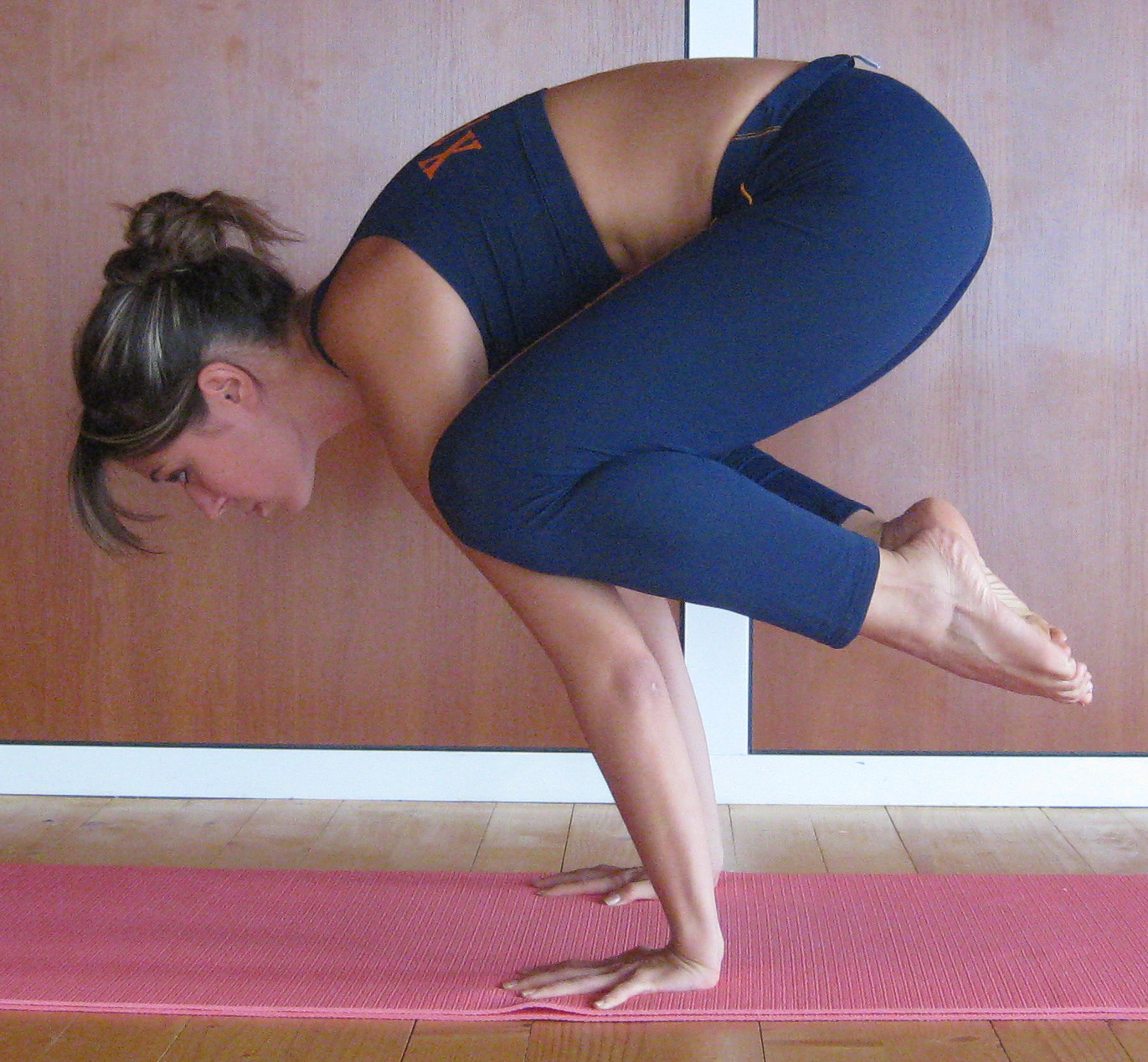
Bakasana (Crane pose) (Sanskrit: बकासन, IAST: bakāsana), and the similar Kakasana (Crow pose) (Sanskrit: काकासन, IAST: kākasana) are balancing asanas in hatha yoga and modern yoga as exercise. In all variations, these are arm balancing poses in which hands are planted on the floor, shins rest upon upper arms, and feet lift up. The poses are often confused, but traditionally Kakasana has arms bent, Bakasana (the crane being the taller bird with longer legs) has the arms straight.
The names for the asanas come from the Sanskrit words बक baka ("crane") or काक kāka ("crow"), and आसन āsana meaning "posture" or "seat".
While different yoga lineages use one name or another for the asanas, Dharma Mittra makes a distinction, citing Kakasana as being with arms bent (like the shorter legs of a crow) and Bakasana with arms straight (like the longer legs of a crane). B. K. S. Iyengar's 1966 Light on Yoga describes only Bakasana, with straight arms. In Sivananda Yoga, Swami Vishnudevananda's 1960 Complete Illustrated Book of Yoga describes only Kakasana, with bent arms. However, practitioners in the west often mistranslate the Sanskrit "Bakasana" as "Crow Pose".
These balancing poses can be dated at least to the 17th century Hatha Ratnavali, where Bakasana is number 62 of the 84 poses said to have been taught by Shiva.
The 19th century Sritattvanidhi, created for a Raja of Mysore, describes and illustrates both Kakasana and Bakasana. Norman Sjoman suggests that Krishnamacharya, teaching in the Mysore Palace, may have derived asanas including these from the 1896 Vyāyāma Dīpikā exercise manual.
In his 1969 book Asana Pranayama Mudra Bandha, Swami Satyananda Saraswati of the Bihar School of Yoga uses the name Bakasana for a different pose entirely (Dandayamana Janushirsasana, pose 5 in Bikram Yoga).
These asanas are arm balances. In Crow Pose, the knees rest on the bent elbows. In Crane Pose, the elbows are straight and the knees are just above the shoulders, requiring flexibility in the hips. According to B.K.S. Iyengar there are two techniques for entering the poses. The simple method is by pushing up from a crouching position. The advanced method is to drop down from Shirshasana (yoga headstand) Some vinyasa yoga practitioners jump in and out of Crane/Crow via Downward-Facing Dog Pose. This can be practised in stages.
Asymmetric variations include:
Hub AI
Bakasana AI simulator
(@Bakasana_simulator)
Bakasana
Bakasana (Crane pose) (Sanskrit: बकासन, IAST: bakāsana), and the similar Kakasana (Crow pose) (Sanskrit: काकासन, IAST: kākasana) are balancing asanas in hatha yoga and modern yoga as exercise. In all variations, these are arm balancing poses in which hands are planted on the floor, shins rest upon upper arms, and feet lift up. The poses are often confused, but traditionally Kakasana has arms bent, Bakasana (the crane being the taller bird with longer legs) has the arms straight.
The names for the asanas come from the Sanskrit words बक baka ("crane") or काक kāka ("crow"), and आसन āsana meaning "posture" or "seat".
While different yoga lineages use one name or another for the asanas, Dharma Mittra makes a distinction, citing Kakasana as being with arms bent (like the shorter legs of a crow) and Bakasana with arms straight (like the longer legs of a crane). B. K. S. Iyengar's 1966 Light on Yoga describes only Bakasana, with straight arms. In Sivananda Yoga, Swami Vishnudevananda's 1960 Complete Illustrated Book of Yoga describes only Kakasana, with bent arms. However, practitioners in the west often mistranslate the Sanskrit "Bakasana" as "Crow Pose".
These balancing poses can be dated at least to the 17th century Hatha Ratnavali, where Bakasana is number 62 of the 84 poses said to have been taught by Shiva.
The 19th century Sritattvanidhi, created for a Raja of Mysore, describes and illustrates both Kakasana and Bakasana. Norman Sjoman suggests that Krishnamacharya, teaching in the Mysore Palace, may have derived asanas including these from the 1896 Vyāyāma Dīpikā exercise manual.
In his 1969 book Asana Pranayama Mudra Bandha, Swami Satyananda Saraswati of the Bihar School of Yoga uses the name Bakasana for a different pose entirely (Dandayamana Janushirsasana, pose 5 in Bikram Yoga).
These asanas are arm balances. In Crow Pose, the knees rest on the bent elbows. In Crane Pose, the elbows are straight and the knees are just above the shoulders, requiring flexibility in the hips. According to B.K.S. Iyengar there are two techniques for entering the poses. The simple method is by pushing up from a crouching position. The advanced method is to drop down from Shirshasana (yoga headstand) Some vinyasa yoga practitioners jump in and out of Crane/Crow via Downward-Facing Dog Pose. This can be practised in stages.
Asymmetric variations include: