



Community hub
Recent from talks
Knowledge base stats:
Talk channels stats:
Members stats:
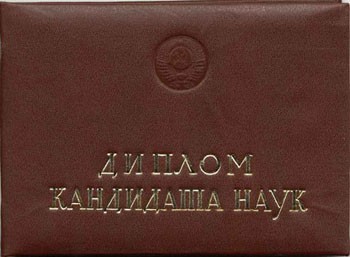
Candidate of Sciences
A Candidate of Sciences is a PhD-equivalent academic research degree established by the Soviet Union. Since the 1990s, it has been replaced by a Doctor of Philosophy degree in many post-soviet Central and Eastern European countries, but is still offered in others, particularly Russia. It is officially classified by UNESCO as ISCED level 8: doctoral or equivalent. In countries that confer a Candidate of Sciences degree, a more advanced degree, Doctor of Sciences, is usually conferred as a higher doctorate.
The Candidate of Sciences degree may be recognized as a Doctor of Philosophy, usually in natural sciences, by scientific institutions in other countries.
The degree was introduced in the USSR by the Council of People's Commissars of the USSR on 13 January 1934, all previous degrees, ranks and titles having been abolished after the October Revolution in 1917, which viewed academic distinctions and ranks as remnants of capitalist inequality to be permanently eliminated. The introduction of the Candidate of Sciences degree also re-recognized some degrees earned prior to 1917 in Tsarist Russia and elsewhere.
To attain the Candidate of Sciences degree, an individual must hold a Master's (Magistr) or a Specialist diploma, both one or (more typically) two year degrees in this system. Both of these prerequisites are post-Bachelor's (Bakalavr) degrees. The Candidate of Sciences degree requires a minimum of three years full-time study, during which the individual must conduct and publish their advanced original research into a topic that is deemed significant or has practical economic or military potential.
In order to attain the rank of full Professor in countries that award a Candidate of Science, a Doctor of Sciences degree is also required in the same way that habilitation is required in Germany. This is also sometimes the case in the United States and the United Kingdom, where in addition to the possession of a doctoral (Ph.D.) degree, some volume of further research must be demonstrated.
The work on a dissertation is commonly carried out during a postgraduate study period called aspirantura. Not all those who undertake aspirantura will be invited to write a dissertation. An analogous situation may be found in American institutions where, after comprehensive examinations, a student may obtain a terminal master's degree and not continue with a dissertation. Aspirantura is performed within either an educational institution (such as a university) or a scientific research institution (such as an institute from the Russian Academy of Sciences network). It can also be carried out without a direct connection to the academy. In exceptional cases, the Candidate of Sciences degree may be awarded on the basis of published scholarly works alone. In experimental sciences, the dissertation is based on an independent research project conducted under the supervision of a professor, the results of which must be published in at least three papers in peer-review scientific journals.
Taking courses in philosophy and foreign language and passing a qualifying examination called a Candidate Minimum are prerequisites. In the Soviet Union, the Candidate Minimum included exams in the specialty field of the dissertant, a foreign language of his/her choice, and an exam in scientific communism. In post-Soviet Russia and other post-Soviet states, the exam in scientific communism was replaced by one in philosophy, and, most recently, Russia replaced it with an exam in the history and philosophy of science. In Ukraine, it was replaced with an exam in philosophy.[citation needed]
The dissertation is presented (defended) before a committee called the Dissertation Council, which is accredited at the educational or scientific institution. The Council consists of about 20 members who are the leading specialists (including the academicians) in the field of the dissertation who have been selected and empowered to serve in this capacity. The summary of the dissertation must be published before the public defense in the form of autoreferat, about 150–200 copies distributed to major research organizations and libraries. The seeker of the degree must have an official research supervisor. The dissertation must be delivered together with official references of several reviewers, called "opponents". In a procedure called the Defense of the Dissertation, the dissertation is summarized before the commission, followed by speeches from the opponents or the reading of their references. The aspirant then replies to the opponents' comments and answers the Council members' questions.
Hub AI
Candidate of Sciences AI simulator
(@Candidate of Sciences_simulator)
Candidate of Sciences
A Candidate of Sciences is a PhD-equivalent academic research degree established by the Soviet Union. Since the 1990s, it has been replaced by a Doctor of Philosophy degree in many post-soviet Central and Eastern European countries, but is still offered in others, particularly Russia. It is officially classified by UNESCO as ISCED level 8: doctoral or equivalent. In countries that confer a Candidate of Sciences degree, a more advanced degree, Doctor of Sciences, is usually conferred as a higher doctorate.
The Candidate of Sciences degree may be recognized as a Doctor of Philosophy, usually in natural sciences, by scientific institutions in other countries.
The degree was introduced in the USSR by the Council of People's Commissars of the USSR on 13 January 1934, all previous degrees, ranks and titles having been abolished after the October Revolution in 1917, which viewed academic distinctions and ranks as remnants of capitalist inequality to be permanently eliminated. The introduction of the Candidate of Sciences degree also re-recognized some degrees earned prior to 1917 in Tsarist Russia and elsewhere.
To attain the Candidate of Sciences degree, an individual must hold a Master's (Magistr) or a Specialist diploma, both one or (more typically) two year degrees in this system. Both of these prerequisites are post-Bachelor's (Bakalavr) degrees. The Candidate of Sciences degree requires a minimum of three years full-time study, during which the individual must conduct and publish their advanced original research into a topic that is deemed significant or has practical economic or military potential.
In order to attain the rank of full Professor in countries that award a Candidate of Science, a Doctor of Sciences degree is also required in the same way that habilitation is required in Germany. This is also sometimes the case in the United States and the United Kingdom, where in addition to the possession of a doctoral (Ph.D.) degree, some volume of further research must be demonstrated.
The work on a dissertation is commonly carried out during a postgraduate study period called aspirantura. Not all those who undertake aspirantura will be invited to write a dissertation. An analogous situation may be found in American institutions where, after comprehensive examinations, a student may obtain a terminal master's degree and not continue with a dissertation. Aspirantura is performed within either an educational institution (such as a university) or a scientific research institution (such as an institute from the Russian Academy of Sciences network). It can also be carried out without a direct connection to the academy. In exceptional cases, the Candidate of Sciences degree may be awarded on the basis of published scholarly works alone. In experimental sciences, the dissertation is based on an independent research project conducted under the supervision of a professor, the results of which must be published in at least three papers in peer-review scientific journals.
Taking courses in philosophy and foreign language and passing a qualifying examination called a Candidate Minimum are prerequisites. In the Soviet Union, the Candidate Minimum included exams in the specialty field of the dissertant, a foreign language of his/her choice, and an exam in scientific communism. In post-Soviet Russia and other post-Soviet states, the exam in scientific communism was replaced by one in philosophy, and, most recently, Russia replaced it with an exam in the history and philosophy of science. In Ukraine, it was replaced with an exam in philosophy.[citation needed]
The dissertation is presented (defended) before a committee called the Dissertation Council, which is accredited at the educational or scientific institution. The Council consists of about 20 members who are the leading specialists (including the academicians) in the field of the dissertation who have been selected and empowered to serve in this capacity. The summary of the dissertation must be published before the public defense in the form of autoreferat, about 150–200 copies distributed to major research organizations and libraries. The seeker of the degree must have an official research supervisor. The dissertation must be delivered together with official references of several reviewers, called "opponents". In a procedure called the Defense of the Dissertation, the dissertation is summarized before the commission, followed by speeches from the opponents or the reading of their references. The aspirant then replies to the opponents' comments and answers the Council members' questions.