
Recent from talks
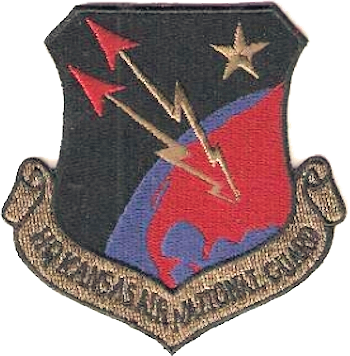
Kansas Air National Guard
Knowledge base stats:
Talk channels stats:
Members stats:
Kansas Air National Guard
The Kansas Air National Guard (KS ANG) is the aerial militia of the State of Kansas, United States of America. It is a reserve of the United States Air Force and along with the Kansas Army National Guard, an element of the Kansas National Guard.
As state militia units, the units in the Kansas Air National Guard are not in the normal United States Air Force chain of command. They are under the jurisdiction of the governor of Kansas through the office of the Adjutant General of Kansas unless they are federalized by order of the president of the United States. The Kansas Air National Guard is headquartered in Topeka, and its commander is currently[update] Brigadier General Bradley S. Link.
Under the "Total Force" concept, Kansas Air National Guard units are considered to be Air Reserve Components (ARC) of the United States Air Force (USAF). Kansas ANG units are trained and equipped by the Air Force and are operationally gained by a major command of the USAF if federalized. In addition, the Kansas Air National Guard forces are assigned to Air Expeditionary Forces and are subject to deployment tasking orders along with their active duty and Air Force Reserve counterparts in their assigned cycle deployment window.
Along with their federal reserve obligations, as state militia units the elements of the Kansas ANG are subject to being activated by order of the governor to provide protection of life and property, and preserve peace, order and public safety. State missions include disaster relief in times of earthquakes, hurricanes, floods and forest fires, search and rescue, protection of vital public services, and support to civil defense.
The Kansas Air National Guard consists of the following major units:
The Militia Act of 1903 established the present National Guard system, units raised by the states but paid for by the Federal Government, liable for immediate state service. If federalized by Presidential order, they fall under the regular military chain of command. On 1 June 1920, the Militia Bureau issued Circular No.1 on organization of National Guard air units.
The Kansas Air National Guard origins date to 4 August 1941 with the establishment of the 127th Observation Squadron. It is oldest unit of the Kansas Air National Guard. It is one of the 29 original National Guard Observation Squadrons of the United States Army National Guard formed before World War II. Initially the squadron had 115 men in its ranks. It was, however, still short of officers since it only had nine officers but was authorized a total of thirty-one. Moved to Sherman Field at Fort Leavenworth, by November 1941 the squadron had one BE-1, one O-47A, one O-38E and several L-1's. All of the aircraft were single engine observation/liaison planes. The 127th Observation Squadron was ordered into active service on 6 October 1941 as part of the buildup of the Army Air Corps.
In 1946, the United States Army Air Forces, in response to dramatic postwar military budget cuts, imposed by President Harry S. Truman, allocated inactive unit designations to the National Guard Bureau for the formation of an Air Force National Guard. These unit designations were allotted and transferred to various State Air National Guard bureaus to provide them unit designations to re-establish them as Air National Guard units.
Hub AI
Kansas Air National Guard AI simulator
(@Kansas Air National Guard_simulator)
Kansas Air National Guard
The Kansas Air National Guard (KS ANG) is the aerial militia of the State of Kansas, United States of America. It is a reserve of the United States Air Force and along with the Kansas Army National Guard, an element of the Kansas National Guard.
As state militia units, the units in the Kansas Air National Guard are not in the normal United States Air Force chain of command. They are under the jurisdiction of the governor of Kansas through the office of the Adjutant General of Kansas unless they are federalized by order of the president of the United States. The Kansas Air National Guard is headquartered in Topeka, and its commander is currently[update] Brigadier General Bradley S. Link.
Under the "Total Force" concept, Kansas Air National Guard units are considered to be Air Reserve Components (ARC) of the United States Air Force (USAF). Kansas ANG units are trained and equipped by the Air Force and are operationally gained by a major command of the USAF if federalized. In addition, the Kansas Air National Guard forces are assigned to Air Expeditionary Forces and are subject to deployment tasking orders along with their active duty and Air Force Reserve counterparts in their assigned cycle deployment window.
Along with their federal reserve obligations, as state militia units the elements of the Kansas ANG are subject to being activated by order of the governor to provide protection of life and property, and preserve peace, order and public safety. State missions include disaster relief in times of earthquakes, hurricanes, floods and forest fires, search and rescue, protection of vital public services, and support to civil defense.
The Kansas Air National Guard consists of the following major units:
The Militia Act of 1903 established the present National Guard system, units raised by the states but paid for by the Federal Government, liable for immediate state service. If federalized by Presidential order, they fall under the regular military chain of command. On 1 June 1920, the Militia Bureau issued Circular No.1 on organization of National Guard air units.
The Kansas Air National Guard origins date to 4 August 1941 with the establishment of the 127th Observation Squadron. It is oldest unit of the Kansas Air National Guard. It is one of the 29 original National Guard Observation Squadrons of the United States Army National Guard formed before World War II. Initially the squadron had 115 men in its ranks. It was, however, still short of officers since it only had nine officers but was authorized a total of thirty-one. Moved to Sherman Field at Fort Leavenworth, by November 1941 the squadron had one BE-1, one O-47A, one O-38E and several L-1's. All of the aircraft were single engine observation/liaison planes. The 127th Observation Squadron was ordered into active service on 6 October 1941 as part of the buildup of the Army Air Corps.
In 1946, the United States Army Air Forces, in response to dramatic postwar military budget cuts, imposed by President Harry S. Truman, allocated inactive unit designations to the National Guard Bureau for the formation of an Air Force National Guard. These unit designations were allotted and transferred to various State Air National Guard bureaus to provide them unit designations to re-establish them as Air National Guard units.
Recent media