



Community hub
Recent from talks
Knowledge base stats:
Talk channels stats:
Members stats:
Karajá language
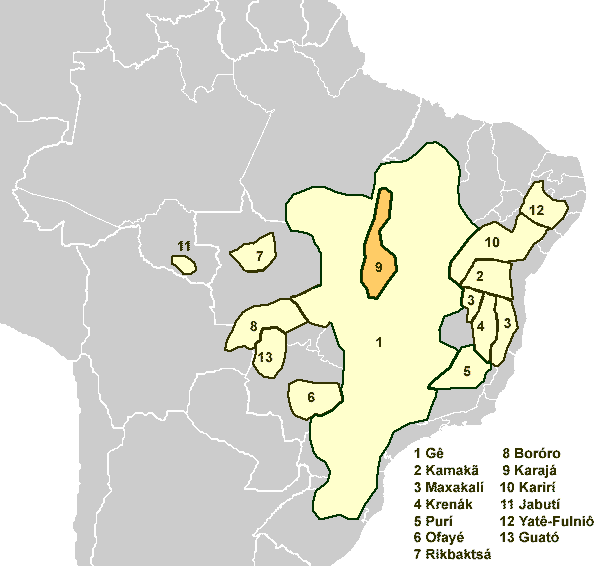
Karajá, also known as Iny rybè, is a Macro-Jê language spoken by the Karajá people in some thirty villages in central Brazil.
There are distinct male and female forms of speech; one of the principal differences is that men drop the sound /k/, which is pronounced by women.
Karaja is a verb-final language, with simple noun and more complex verbal morphology that includes noun incorporation. Verbs inflect for direction as well as person, mood, object, and voice.
Dialects are Northern Karajá, Southern Karajá, Xambioá, and Javaé.
Karajá proper is spoken on the main course of the Araguaia River in and around Bananal Island. Phonologically, it is set apart from the other dialects (Javaé and Xambioá) by the occurrence of the vowel /ə/ (not represented in the orthography), which corresponds to a full vowel in Javaé and Xambioá whose quality is a copy of the vowel of the next syllable. For example, Karajá bdi /bədɪ/ ‘honey’, -dkỹ /-dəkə̃/ ‘causative suffix’, -tka /-ɗəka/ ‘to tie’, kbò /kəbɔ/ ‘banzeiro’, kdò /kədɔ/ ‘termite’, rkù /ɾəkʊ/ ‘gourd’ correspond to Javaé and Xambioá bidi /bɪdɪ/, -nỹkỹ /-də̃kə̃/, -taka /-ɗaka/, kòbò /kɔbɔ/, kòdò /kɔdɔ/, rùkù /ɾʊkʊ/. Another phonological feature unique to Karajá proper is the progressive palatalization of /k/ and /ɾ/ (to /tʃ/ and /dʒ/) following an /i/: compare Karajá ritxòrè ‘offspring’, itxòrò ‘fox’, ritxoko ‘Ritxoko clay doll’, idjasò ‘arowana’ and Javaé/Xambioá rikòrè, ikòrò, rikoko, iraso. Examples of lexical differences between Karajá proper and other dialects include lei ‘anaconda’, tõsõ ‘woodpecker’, makiti ‘sugarcane’, corresponding to Javaé and Xambioá rei, sõsõ, biditi.
Karajá proper is further subdivided into Northern and Southern Karajá. Southern Karajá is spoken in the Fontoura (Btõiry) village and further to the south, whereas Northern Karajá is spoken in the São Domingos (Krèhãwa) village and further to the north. There are few differences between Northern and Southern Karajá. Examples of lexical differences include N(orthern) ji(k)arỹ / S(outhern) di(k)arỹ ‘I’, N wi / S wiu ‘song.♂’, N adèrana / S wdèna ‘prostitute’, N bdòlèkè / S bdòkùjkè ‘pirarucu fish’, N butxi / S boti ‘clay pot’, N (k)õritxi / S (k)uritxi ‘curassow’, and other word pairs. Northern Karajá also differs from Southern Karajá in using different habitual markers for different persons (first person -wahã, second person -mahã, third person -mỹhỹ), whereas Southern Karajá uses -mỹhỹ for all three persons. In addition, there is a difference regarding the occurrence of the centripetal prefix (n- or d-, phonologically /d-/) in the first person of the realis mood. In Northern Karajá (just like in Javaé and Xambioá), it occurs only once, after the first person prefix: ãdiwyde ‘I brought it’. In Southern Karajá, it occurs twice, both before and after the person prefix: nadiwyde ‘I brought it’.
Javaé is currently spoken by the Javaés River, a smaller branch of the Araguaia, though historically the Javaé inhabited the interior of the Bananal island, until at least the first half of the 20th century. The Javaé are referred to by the Karajá proper as ixỹju, a term otherwise used to non-Karajá indigenous peoples such as the Xavante, but clearly speak a variety of Karajá. Javaé has more Apyãwa loans than other Karajá dialects. Phonologically, Javaé is characterized by the occurrence of /e/ corresponding to Karajá /ə/ and Xambioá /i/ preceding a syllable which contains a /i/: Javaé -tebiè ‘to raise, to feed’, hetxi ‘bottom, buttocks’, exi ‘soft’, -teji ‘to put’ correspond to Karajá -tbiè, htxi, àxi, tdi; Xambioá -txibiè, hitxi, ixi, tidi. In addition, Javaé has less genderlectal differences than Karajá and Xambioá, as in many cases the Javaé women systematically use forms that are restricted to the male genderlect in other dialects.
Xambioá is spoken on the east bank of the Araguaia, close to the mouth of the Maria River (a western tributary of the Araguaia), which makes it the northernmost variety of Karajá. Ribeiro (2012) reports that there were only 8 fluent speakers in 1998, all of them elderly. Phonologically, Xambioá is characterized by the progressive palatalization of /k/ to [c] following an /i/, as in ikòrò [icɔˈɾɔ] ‘fox’ (unlike in Karajá, this does not lead to a neutralization with [tʃ]). Another phonological feature of Xambioá is the occurrence of the oral allophone of /a/ (i.e., [a]) where other dialects have [ã]: Xambioá habu ‘man’, ati ‘Pimelodus|mandi fish’, aw(òk)ò ‘canoe’ vs. Karajá hãbu, hãti, hãw(k)ò. Some Xambioá words are not found in other dialects, such as the Língua Geral Amazônica borrowing mabèra ‘paper’ (in Karajá and Javaé, the term for ‘skin, bark, cloth’ is used instead: Karajá ♀ tky, Javaé ♀ tyky, Karajá/Javaé ♂ tyy).
Hub AI
Karajá language AI simulator
(@Karajá language_simulator)
Karajá language
Karajá, also known as Iny rybè, is a Macro-Jê language spoken by the Karajá people in some thirty villages in central Brazil.
There are distinct male and female forms of speech; one of the principal differences is that men drop the sound /k/, which is pronounced by women.
Karaja is a verb-final language, with simple noun and more complex verbal morphology that includes noun incorporation. Verbs inflect for direction as well as person, mood, object, and voice.
Dialects are Northern Karajá, Southern Karajá, Xambioá, and Javaé.
Karajá proper is spoken on the main course of the Araguaia River in and around Bananal Island. Phonologically, it is set apart from the other dialects (Javaé and Xambioá) by the occurrence of the vowel /ə/ (not represented in the orthography), which corresponds to a full vowel in Javaé and Xambioá whose quality is a copy of the vowel of the next syllable. For example, Karajá bdi /bədɪ/ ‘honey’, -dkỹ /-dəkə̃/ ‘causative suffix’, -tka /-ɗəka/ ‘to tie’, kbò /kəbɔ/ ‘banzeiro’, kdò /kədɔ/ ‘termite’, rkù /ɾəkʊ/ ‘gourd’ correspond to Javaé and Xambioá bidi /bɪdɪ/, -nỹkỹ /-də̃kə̃/, -taka /-ɗaka/, kòbò /kɔbɔ/, kòdò /kɔdɔ/, rùkù /ɾʊkʊ/. Another phonological feature unique to Karajá proper is the progressive palatalization of /k/ and /ɾ/ (to /tʃ/ and /dʒ/) following an /i/: compare Karajá ritxòrè ‘offspring’, itxòrò ‘fox’, ritxoko ‘Ritxoko clay doll’, idjasò ‘arowana’ and Javaé/Xambioá rikòrè, ikòrò, rikoko, iraso. Examples of lexical differences between Karajá proper and other dialects include lei ‘anaconda’, tõsõ ‘woodpecker’, makiti ‘sugarcane’, corresponding to Javaé and Xambioá rei, sõsõ, biditi.
Karajá proper is further subdivided into Northern and Southern Karajá. Southern Karajá is spoken in the Fontoura (Btõiry) village and further to the south, whereas Northern Karajá is spoken in the São Domingos (Krèhãwa) village and further to the north. There are few differences between Northern and Southern Karajá. Examples of lexical differences include N(orthern) ji(k)arỹ / S(outhern) di(k)arỹ ‘I’, N wi / S wiu ‘song.♂’, N adèrana / S wdèna ‘prostitute’, N bdòlèkè / S bdòkùjkè ‘pirarucu fish’, N butxi / S boti ‘clay pot’, N (k)õritxi / S (k)uritxi ‘curassow’, and other word pairs. Northern Karajá also differs from Southern Karajá in using different habitual markers for different persons (first person -wahã, second person -mahã, third person -mỹhỹ), whereas Southern Karajá uses -mỹhỹ for all three persons. In addition, there is a difference regarding the occurrence of the centripetal prefix (n- or d-, phonologically /d-/) in the first person of the realis mood. In Northern Karajá (just like in Javaé and Xambioá), it occurs only once, after the first person prefix: ãdiwyde ‘I brought it’. In Southern Karajá, it occurs twice, both before and after the person prefix: nadiwyde ‘I brought it’.
Javaé is currently spoken by the Javaés River, a smaller branch of the Araguaia, though historically the Javaé inhabited the interior of the Bananal island, until at least the first half of the 20th century. The Javaé are referred to by the Karajá proper as ixỹju, a term otherwise used to non-Karajá indigenous peoples such as the Xavante, but clearly speak a variety of Karajá. Javaé has more Apyãwa loans than other Karajá dialects. Phonologically, Javaé is characterized by the occurrence of /e/ corresponding to Karajá /ə/ and Xambioá /i/ preceding a syllable which contains a /i/: Javaé -tebiè ‘to raise, to feed’, hetxi ‘bottom, buttocks’, exi ‘soft’, -teji ‘to put’ correspond to Karajá -tbiè, htxi, àxi, tdi; Xambioá -txibiè, hitxi, ixi, tidi. In addition, Javaé has less genderlectal differences than Karajá and Xambioá, as in many cases the Javaé women systematically use forms that are restricted to the male genderlect in other dialects.
Xambioá is spoken on the east bank of the Araguaia, close to the mouth of the Maria River (a western tributary of the Araguaia), which makes it the northernmost variety of Karajá. Ribeiro (2012) reports that there were only 8 fluent speakers in 1998, all of them elderly. Phonologically, Xambioá is characterized by the progressive palatalization of /k/ to [c] following an /i/, as in ikòrò [icɔˈɾɔ] ‘fox’ (unlike in Karajá, this does not lead to a neutralization with [tʃ]). Another phonological feature of Xambioá is the occurrence of the oral allophone of /a/ (i.e., [a]) where other dialects have [ã]: Xambioá habu ‘man’, ati ‘Pimelodus|mandi fish’, aw(òk)ò ‘canoe’ vs. Karajá hãbu, hãti, hãw(k)ò. Some Xambioá words are not found in other dialects, such as the Língua Geral Amazônica borrowing mabèra ‘paper’ (in Karajá and Javaé, the term for ‘skin, bark, cloth’ is used instead: Karajá ♀ tky, Javaé ♀ tyky, Karajá/Javaé ♂ tyy).