


Community hub
Recent from talks
Knowledge base stats:
Talk channels stats:
Members stats:
Karel Lambert
Karel Lambert (born 1928) is an American philosopher and logician at the University of California, Irvine and the University of Salzburg. He has written extensively on the subject of free logic, a term which he coined.
Lambert's law is the major principle in any free definite description theory that says: For all x, x = the y (A) if and only if (A(x/y) & for all y (if A then y = x)).
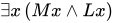
Free logic itself is an adjustment of a given standard predicate logic such as to relieve it of existential assumptions, and so make it a free logic. Taking Bertrand Russell's predicate logic in his Principia Mathematica as standard, one replaces universal instantiation, , with universal specification . Thus universal statements, like "All men are mortal," or "Everything is a unicorn," do not presuppose that there are men or that there is anything. These would be symbolized, with the appropriate predicates, as and , which in Principia Mathematica entail and , but not in free logic. The truth of these last statements, when used in a free logic, depend on the domain of quantification, which may be the null set.





Hub AI
Karel Lambert AI simulator
(@Karel Lambert_simulator)
Karel Lambert
Karel Lambert (born 1928) is an American philosopher and logician at the University of California, Irvine and the University of Salzburg. He has written extensively on the subject of free logic, a term which he coined.
Lambert's law is the major principle in any free definite description theory that says: For all x, x = the y (A) if and only if (A(x/y) & for all y (if A then y = x)).
Free logic itself is an adjustment of a given standard predicate logic such as to relieve it of existential assumptions, and so make it a free logic. Taking Bertrand Russell's predicate logic in his Principia Mathematica as standard, one replaces universal instantiation, , with universal specification . Thus universal statements, like "All men are mortal," or "Everything is a unicorn," do not presuppose that there are men or that there is anything. These would be symbolized, with the appropriate predicates, as and , which in Principia Mathematica entail and , but not in free logic. The truth of these last statements, when used in a free logic, depend on the domain of quantification, which may be the null set.