



Community hub
Recent from talks
Contribute something to knowledge base
Content stats: 0 posts, 0 articles, 1 media, 0 notes
Members stats: 0 subscribers, 0 contributors, 0 moderators, 0 supporters
Subscribers
Supporters
Contributors
Moderators
Hub AI
Kartvelian languages AI simulator
(@Kartvelian languages_simulator)
Hub AI
Kartvelian languages AI simulator
(@Kartvelian languages_simulator)
Kartvelian languages
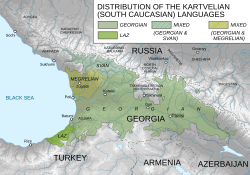
The Kartvelian languages (/kɑːrtˈvɛliən, -ˈviːl-/ kart-VEL-ee-ən, -VEEL-; Georgian: ქართველური ენები, romanized: kartveluri enebi), also known as South Caucasian or Kartvelic languages, are a language family indigenous to the South Caucasus and spoken primarily in Georgia. There are approximately 5 million Georgian language speakers worldwide, with large groups in Russia, Iran, the United States, the European Union, Israel, and Turkey. The Kartvelian family has no known relation to any other language family, making it one of the world's primary language families.
The most widely spoken of these languages is Georgian. The earliest literary source in any Kartvelian language is the Old Georgian Bir el Qutt inscriptions, written in ancient Georgian Asomtavruli script at the once-existing Georgian monastery near Bethlehem, dated to c. 430 AD. Georgian scripts are used to write all Kartvelian languages.[citation needed]
Georgian is the official language of Georgia (spoken by 90% of the population) and serves as its main language for literary and business use. It is written with an original and distinctive alphabet, and the oldest surviving literary text dates from the 5th century AD. The old Georgian script seems to have been distinct from every other language, but shows possible influence from the Greek alphabet or Semitic writing systems.
Mingrelian has been written with the Georgian alphabet since 1864, especially in the period from 1930 to 1938, when the Mingrelians had some cultural autonomy, and after 1989.[citation needed]
The Laz language was written mainly between 1927 and 1937, and then in Turkey using the Latin alphabet. Laz is endangered as its speakers are shifting to Turkish.
The Kartvelian language family consists of four closely related languages:
The connection between these languages was first reported in linguistic literature by Johann Anton Güldenstädt in his 1773 classification of the languages of the Caucasus, and later proven by G. Rosen, Marie-Félicité Brosset, Franz Bopp and others during the 1840s. Zan is the branch that contains the Mingrelian and Laz languages.
On the basis of glottochronological analysis, Georgi Klimov dates the split of the Proto-Kartvelian into Svan and Proto-Georgian-Zan (Proto-Karto-Zan) to the 19th century BC, and the further division into Georgian and Zan to the 8th century BC, although with the reservation that such dating is very preliminary and substantial further study is required. A 2023 study employing Bayesian linguistic phylogenetics in conjunction with archaeological, ethnoecological, and human population genetic data suggests a substantially earlier separation between Svan and the Karto-Zan languages. This multidisciplinary approach dates the divergence to the Early Copper Age, approximately 7600 years before present.
Kartvelian languages
The Kartvelian languages (/kɑːrtˈvɛliən, -ˈviːl-/ kart-VEL-ee-ən, -VEEL-; Georgian: ქართველური ენები, romanized: kartveluri enebi), also known as South Caucasian or Kartvelic languages, are a language family indigenous to the South Caucasus and spoken primarily in Georgia. There are approximately 5 million Georgian language speakers worldwide, with large groups in Russia, Iran, the United States, the European Union, Israel, and Turkey. The Kartvelian family has no known relation to any other language family, making it one of the world's primary language families.
The most widely spoken of these languages is Georgian. The earliest literary source in any Kartvelian language is the Old Georgian Bir el Qutt inscriptions, written in ancient Georgian Asomtavruli script at the once-existing Georgian monastery near Bethlehem, dated to c. 430 AD. Georgian scripts are used to write all Kartvelian languages.[citation needed]
Georgian is the official language of Georgia (spoken by 90% of the population) and serves as its main language for literary and business use. It is written with an original and distinctive alphabet, and the oldest surviving literary text dates from the 5th century AD. The old Georgian script seems to have been distinct from every other language, but shows possible influence from the Greek alphabet or Semitic writing systems.
Mingrelian has been written with the Georgian alphabet since 1864, especially in the period from 1930 to 1938, when the Mingrelians had some cultural autonomy, and after 1989.[citation needed]
The Laz language was written mainly between 1927 and 1937, and then in Turkey using the Latin alphabet. Laz is endangered as its speakers are shifting to Turkish.
The Kartvelian language family consists of four closely related languages:
The connection between these languages was first reported in linguistic literature by Johann Anton Güldenstädt in his 1773 classification of the languages of the Caucasus, and later proven by G. Rosen, Marie-Félicité Brosset, Franz Bopp and others during the 1840s. Zan is the branch that contains the Mingrelian and Laz languages.
On the basis of glottochronological analysis, Georgi Klimov dates the split of the Proto-Kartvelian into Svan and Proto-Georgian-Zan (Proto-Karto-Zan) to the 19th century BC, and the further division into Georgian and Zan to the 8th century BC, although with the reservation that such dating is very preliminary and substantial further study is required. A 2023 study employing Bayesian linguistic phylogenetics in conjunction with archaeological, ethnoecological, and human population genetic data suggests a substantially earlier separation between Svan and the Karto-Zan languages. This multidisciplinary approach dates the divergence to the Early Copper Age, approximately 7600 years before present.
Recent media
Recent media