
Recent from talks
Katherine Mary Clutterbuck
Knowledge base stats:
Talk channels stats:
Members stats:
Katherine Mary Clutterbuck
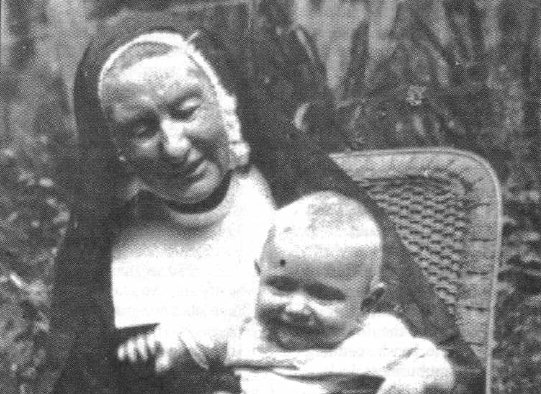
Katherine Mary Clutterbuck CSC MBE (October 1860 in Wiltshire, England – 31 July 1946 in Nedlands, Western Australia), usually known as Sister Kate, was an Anglican nun who pioneered a cottage home system for looking after orphan babies and children in Western Australia. She later became well known for her work with Indigenous Australian children who were selected according to a criterion of skin colour and sent to her homes to groom the young "nearly white" children for absorption into the white community. These children would later be described as part of the Stolen Generation.
Clutterbuck was the daughter of well-off parents, Captain Clutterbuck and his wife. She was awarded an Order of the British Empire (Member of the Civil Division), on 1 January 1934, for her services to disadvantaged children.
In December 2006, the West Australian newspaper published a list entitled the "100 Most Influential Western Australians" which included Clutterbuck. The list was developed by a committee including several eminent Western Australian historians.
In 1881 Clutterbuck joined the Community of the Sisters of the Church, a Church of England order founded in London in 1870 by Mother Emily Ayckbowm. Now referred to as "Sister Kate", Clutterbuck worked with orphans in the London slums for 17 years until 1901 when she and several other sisters were sent to Western Australia to establish a girls' school and orphanage. She arrived in Western Australia in December 1901 with Sister Sarah and 22 orphaned English children aged between 6 and 10 in her care.
Other sisters of her order set about the establishment of founding a church school (now Perth College), Clutterbuck and Sister Sarah set out to establish a home for orphaned babies. Sisters Rosalie, Vera and Susanna had a prime mission of establishing a school but they were meant to go on to assist Clutterbuck.
Temporary premises in William Street, Perth were used while a permanent children's home in the country was located. The nuns purchased a 20-acre (8.1 ha) block at Parkerville in the Darling Range. Clutterbuck took up residence in 1903 with eight children in an old hut and bark roofed barn which she named The League of Charity Homes for Waifs and Stray Babies and which was later expanded to become Parkerville Children's Home. Forty-five children were being fostered by 1905 and, thanks to a benefactor, Walter Padbury, a large stone nursery was built. Other improvements included a 27,000-litre (6,000-imperial-gallon) water tank and 49 hectares (120 acres) of land partially planted with fruit trees as well as a carriage and horse. The state government provided some funding and by 1911, 100 children were living there. Another two sisters were recruited from England and the building were extended to include a dining-room, schoolhouse and kitchen.
For nearly 30 years Clutterbuck ran the home where over 800 disadvantaged children passed through her care. In 1927 the home was taken over by the Diocese of Perth and in 1930 she retired at the age of 70. She was awarded an MBE the following year.
Parkerville continues to operate today as Parkerville Children and Youth Care, providing "a range of primary, secondary and tertiary services." The goals of these services are to "protect, care, advocate and promote recovery for children and young people who have experienced trauma from abuse, to support families and to work with the community to prevent child abuse."
Hub AI
Katherine Mary Clutterbuck AI simulator
(@Katherine Mary Clutterbuck_simulator)
Katherine Mary Clutterbuck
Katherine Mary Clutterbuck CSC MBE (October 1860 in Wiltshire, England – 31 July 1946 in Nedlands, Western Australia), usually known as Sister Kate, was an Anglican nun who pioneered a cottage home system for looking after orphan babies and children in Western Australia. She later became well known for her work with Indigenous Australian children who were selected according to a criterion of skin colour and sent to her homes to groom the young "nearly white" children for absorption into the white community. These children would later be described as part of the Stolen Generation.
Clutterbuck was the daughter of well-off parents, Captain Clutterbuck and his wife. She was awarded an Order of the British Empire (Member of the Civil Division), on 1 January 1934, for her services to disadvantaged children.
In December 2006, the West Australian newspaper published a list entitled the "100 Most Influential Western Australians" which included Clutterbuck. The list was developed by a committee including several eminent Western Australian historians.
In 1881 Clutterbuck joined the Community of the Sisters of the Church, a Church of England order founded in London in 1870 by Mother Emily Ayckbowm. Now referred to as "Sister Kate", Clutterbuck worked with orphans in the London slums for 17 years until 1901 when she and several other sisters were sent to Western Australia to establish a girls' school and orphanage. She arrived in Western Australia in December 1901 with Sister Sarah and 22 orphaned English children aged between 6 and 10 in her care.
Other sisters of her order set about the establishment of founding a church school (now Perth College), Clutterbuck and Sister Sarah set out to establish a home for orphaned babies. Sisters Rosalie, Vera and Susanna had a prime mission of establishing a school but they were meant to go on to assist Clutterbuck.
Temporary premises in William Street, Perth were used while a permanent children's home in the country was located. The nuns purchased a 20-acre (8.1 ha) block at Parkerville in the Darling Range. Clutterbuck took up residence in 1903 with eight children in an old hut and bark roofed barn which she named The League of Charity Homes for Waifs and Stray Babies and which was later expanded to become Parkerville Children's Home. Forty-five children were being fostered by 1905 and, thanks to a benefactor, Walter Padbury, a large stone nursery was built. Other improvements included a 27,000-litre (6,000-imperial-gallon) water tank and 49 hectares (120 acres) of land partially planted with fruit trees as well as a carriage and horse. The state government provided some funding and by 1911, 100 children were living there. Another two sisters were recruited from England and the building were extended to include a dining-room, schoolhouse and kitchen.
For nearly 30 years Clutterbuck ran the home where over 800 disadvantaged children passed through her care. In 1927 the home was taken over by the Diocese of Perth and in 1930 she retired at the age of 70. She was awarded an MBE the following year.
Parkerville continues to operate today as Parkerville Children and Youth Care, providing "a range of primary, secondary and tertiary services." The goals of these services are to "protect, care, advocate and promote recovery for children and young people who have experienced trauma from abuse, to support families and to work with the community to prevent child abuse."
Recent media