


Community hub
Recent from talks
Contribute something
Nothing was collected or created yet.
Circular mil
View on Wikipedia| circular mil | |
|---|---|
 | |
| General information | |
| Unit of | Area |
| Symbol | cmil |
| Derivation | 1 cmil = π/4(0.001 in)2 |
| Conversions | |
| 1 cmil in ... | ... is equal to ... |
| SI units | 506.7075 μm2 |
| FPS units | 7.853982×10⁻⁷ in2 |
A circular mil is a unit of area, equal to the area of a circle with a diameter of one mil (one thousandth of an inch or 0.0254 mm). It is equal to π/4 square mils or approximately 5.067×10⁻⁴ mm2. It is a unit intended for referring to the area of a wire with a circular cross section. As the definition of the unit contains π, it is easy to calculate area values in circular mils when the diameter in mils is known.
The area in circular mils, A, of a circle with a diameter of d mils, is given by the formula:

In Canada and the United States, the Canadian Electrical Code (CEC) and the National Electrical Code (NEC), respectively, use the circular mil to define wire sizes larger than 0000 AWG. In many NEC publications and uses, large wires may be expressed in thousands of circular mils, which is abbreviated in two different ways: kcmil[1] or MCM.[2] For example, one common wire size used in the NEC has a conductor diameter of 0.5 inches, or 500 mils, and thus a cross-section of circular mils, written as 250 kcmil or 250 MCM, which is the first size larger than 0000 AWG used within the NEC.

1,000 circular mil equals approximately 0.5067 mm2, so for many purposes, a ratio of 2 MCM ≈ 1 mm2 can be used with negligible (1.3%) error.
Equivalence to other units of area
[edit]As a unit of area, the circular mil can be converted to other units such as square inches or square millimetres.
1 circular mil is approximately equal to:
- 0.7854 square mils (1 square mil is about 1.273 circular mils)
- 7.854 × 10⁻⁷ square inches (1 square inch is about 1.273 million circular mils)
- 5.067 × 10⁻¹⁰ square metres
- 5.067 × 10⁻⁴ square millimetres
- 506.7 μm2
1000 circular mils = 1 MCM or 1 kcmil, and is (approximately) equal to:
- 0.5067 mm2, so 2 kcmil ≈ 1 mm2 (a 1.3% error)
Therefore, for practical purposes such as wire choice, 2 kcmil ≈ 1 mm2 is a reasonable rule of thumb for many applications.
Square mils
[edit]In square mils, the area of a circle with a diameter of 1 mil is:

By definition, this area is also equal to 1 circular mil, so
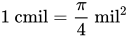
The conversion factor from square mils to circular mils is therefore 4/π cmil per square mil:

The formula for the area of an arbitrary circle in circular mils can be derived by applying this conversion factor to the standard formula for the area of a circle (which gives its result in square mils).
![{\displaystyle {\begin{aligned}A_{{\textrm {mil}}^{2}}&=\pi r^{2}=\pi \left({\frac {d}{2}}\right)^{2}={\frac {\pi d^{2}}{4}}&&({\text{Area in square mils}})\\[2ex]A_{\textrm {cmil}}&=A_{{\textrm {mil}}^{2}}\times {\frac {4}{\pi }}&&({\text{Convert to cmil}})\\[2ex]A_{\textrm {cmil}}&={\frac {\pi d^{2}}{4}}\times {\frac {4}{\pi }}&&({\text{Substitute area in square mils with its definition}})\\[2ex]A_{\textrm {cmil}}&=d^{2}&&({\text{where d is measured in mils}})\\[2ex]\end{aligned}}}](https://wikimedia.org/api/rest_v1/media/math/render/svg/fda824a9cc965a012f5ee0b5fe77a3175b14b77c)
Square inches
[edit]To equate circular mils with square inches rather than square mils, the definition of a mil in inches can be substituted:
![{\displaystyle {\begin{aligned}{\rm {1~cmil}}&={\rm {{\frac {\pi }{4}}~mil^{2}={\frac {\pi }{4}}~(0.001~in)^{2}}}\\[2ex]&={\rm {{\frac {\pi }{4{,}000{,}000}}~in^{2}\approx 7.854\times 10^{-7}~in^{2}}}\end{aligned}}}](https://wikimedia.org/api/rest_v1/media/math/render/svg/5d59d67b43ff9a6c86856c8561149bb28fffdfb1)
Square millimetres
[edit]Likewise, since 1 inch is defined as exactly 25.4 mm, 1 mil is equal to exactly 0.0254 mm, so a similar conversion is possible from circular mils to square millimetres:
![{\displaystyle {\begin{aligned}{\rm {1~cmil}}&={\rm {{\frac {\pi }{4}}~mil^{2}={\frac {\pi }{4}}~(0.0254~mm)^{2}={\frac {\pi \times 0.000\,645\,16}{4}}~mm^{2}}}\\[2ex]&={\rm {1.6129\pi \times 10^{-4}~mm^{2}\approx 5.067\times 10^{-4}~mm^{2}}}\end{aligned}}}](https://wikimedia.org/api/rest_v1/media/math/render/svg/e2c5727a542cc508730fd5985f94eae393c8c4c7)
Example calculations
[edit]A 0000 AWG solid wire is defined to have a diameter of exactly 0.46 inches (11.68 mm). The cross-sectional area of this wire is:
Formula 1: circular mil
[edit]Note: 1 inch = 1000 mils

(This is the same result as the AWG circular mil formula shown below for n = −3)
Formula 2: square mil
[edit]
Formula 3: square inch
[edit]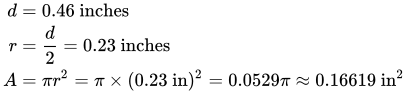
Calculating diameter from area
[edit]When large diameter wire sizes are specified in kcmil, such as the widely used 250 kcmil and 350 kcmil wires, the diameter of the wire can be calculated from the area without using π:
We first convert from kcmil to circular mil
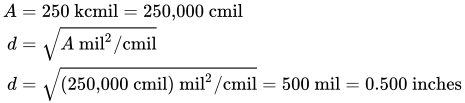
Thus, this wire would have a diameter of a half inch or 12.7 mm.
Metric equivalent
[edit]Some tables give conversions to circular millimetres (cmm).[3][4] The area in cmm is defined as the square of the wire diameter in mm. However, this unit is rarely used in practice. One of the few examples is in a patent for a bariatric weight loss device.[5]

AWG circular mil formula
[edit]The formula to calculate the area in circular mil for any given AWG (American Wire Gauge) size is as follows. represents the area of number AWG.


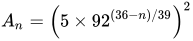
For example, a number 12 gauge wire would use :


Sizes with multiple zeros are successively larger than 0 AWG and can be denoted using "number of zeros/0"; for example "4/0" for 0000 AWG. For an /0 AWG wire, use

- in the above formula.

For example, 0000 AWG (4/0 AWG), would use ; and the calculated result would be 211,600 circular mils.

Standard large wire sizes in kcmil
[edit]In North America wires larger than the AWG are available in sizes beginning with a half-inch (500 mil) diameter. However, solid core wire of that size would be quite stiff for most uses as it resists bending and coiling for transport. Therefore, most large wires are made of tightly-bound strands of smaller wire with the same cross-sectional area of conductors. The table below has a diameter column that is for solid wire with no strands. Since standard sizes have a fixed area, a stranded wire would always have a larger diameter than the table shown below.
Large standard wires range from 250 to 400 kcmil in increments of 50 kcmil, from 400 to 1000 in increments of 100 kcmil, and from 1000 to 2000 in increments of 250 kcmil.[6]
The diameter in the table below is that of a solid rod with the given conductor area in circular mils. Stranded wire is larger in diameter to allow for gaps between the strands, depending on the number and size of strands.
| Area | Diameter | NEC copper wire ampacity with 60/75/90 °C insulation (A)[7] | ||||
|---|---|---|---|---|---|---|
| (kcmil, MCM) |
(mm2) | (in) | (mm) | |||
| 250 | 126.7 | 0.500 | 12.70 | 215 | 255 | 290 |
| 300 | 152.0 | 0.548 | 13.91 | 240 | 285 | 320 |
| 350 | 177.3 | 0.592 | 15.03 | 260 | 310 | 350 |
| 400 | 202.7 | 0.632 | 16.06 | 280 | 335 | 380 |
| 500 | 253.4 | 0.707 | 17.96 | 320 | 380 | 430 |
| 600 | 304.0 | 0.775 | 19.67 | 355 | 420 | 475 |
| 700 | 354.7 | 0.837 | 21.25 | 385 | 460 | 520 |
| 750 | 380.0 | 0.866 | 22.00 | 400 | 475 | 535 |
| 800 | 405.4 | 0.894 | 22.72 | 410 | 490 | 555 |
| 900 | 456.0 | 0.949 | 24.10 | 435 | 520 | 585 |
| 1000 | 506.7 | 1.000 | 25.40 | 455 | 545 | 615 |
| 1250 | 633.4 | 1.118 | 28.40 | 495 | 590 | 665 |
| 1500 | 760.1 | 1.225 | 31.11 | 520 | 625 | 705 |
| 1750 | 886.7 | 1.323 | 33.60 | 545 | 650 | 735 |
| 2000 | 1013.4 | 1.414 | 35.92 | 560 | 665 | 750 |
Note: For smaller wires, consult American wire gauge § Tables of AWG wire sizes. Note: Aluminum wires have a much lower ampacity than copper but are often available in these sizes.
See also
[edit]- Thou (length)
- Square mil
- IEC 60228, the metric wire-size standard used in most parts of the world.
- American Wire Gauge (AWG), used primarily in the US and Canada
- Standard Wire Gauge (SWG), the British imperial standard BS3737, superseded by the metric.
- Stubs Iron Wire Gauge
- Jewelry wire gauge
- Body jewelry sizes
- Electrical wiring
- Number 8 wire, a term used in the New Zealand vernacular
References
[edit]- ^ "Popular Acronyms" Archived 2011-09-03 at the Wayback Machine. NEMA
- ^ "Energy Acronyms", California Energy Commission
- ^ Charles Hoare, The A.B.C. of Slide Rule Practice, p. 52, London: Aston & Mander, 1872 OCLC 605063273
- ^ Edwin James Houston, A Dictionary of Electrical Words, Terms and Phrases, p. 135, New York: W. J. Johnston, 1889 OCLC 1069614872
- ^ Greg A. Lloyd, Bariatric Magnetic Apparatus and Method of Manufacturing Thereof, US patent US 8481076, 9 July 2013.
- ^ NFPA 70-2011 National Electrical Code 2011 Edition Archived 2008-10-15 at the Wayback Machine. Table 310.15(B)(17) page 70-155, Allowable Ampacities of Single-Insulated Conductors Rated Up to and Including 2000 Volts in Free Air, Based on Ambient Air Temperature of 30°C (86°F).
- ^ NFPA 70 National Electrical Code 2008 Edition Archived 2008-10-15 at the Wayback Machine. Table 310.16 page 70-148, Allowable ampacities of insulated conductors rated 0 through 2000 volts, 60°C through 90°C, not more than three current-carrying conductors in raceway, cable, or earth (directly buried) based on ambient temperature of 30°C. Extracts from NFPA 70 do not represent the full position of NFPA and the original complete Code must be consulted. In particular, the maximum permissible overcurrent protection devices may set a lower limit.
Circular mil
View on GrokipediaFundamentals
Definition
A circular mil (cmil or CM) is a unit of area equal to the area of a circle whose diameter is one mil, where one mil is a unit of length defined as 0.001 inch.[5] This unit is particularly employed in the electrical engineering field to denote the cross-sectional area of wires and cables, facilitating calculations based on diameter measurements without requiring the full computation of π in area formulas.[6] Mathematically, the area of one circular mil is given by which equals square mils, or approximately 0.7854 square mils.[1] In metric terms, this corresponds to approximately mm², while in imperial units beyond mils, it is approximately square inches.[7][1] For larger wire sizes, the unit is scaled to kcmil (or MCM, standing for thousand circular mils), where 1 kcmil equals 1,000 cmil.[8] This notation simplifies the specification of substantial conductor areas in electrical standards and applications.[8]Historical Origin
The circular mil unit emerged in the mid-19th century in the United States, amid the rapid expansion of the telegraph and early electrical industries, which demanded standardized measurements for wire conductors to ensure consistent performance and manufacturability. Developed to address inconsistencies in wire sizing practices that varied by manufacturer, it was introduced by engineers at the Brown & Sharpe Manufacturing Company in Providence, Rhode Island, around 1856, as part of their precision wire gauge system. This innovation, proposed by Lucian Sharpe, built on geometric progressions to create a logarithmic scale for wire diameters, facilitating easier production and specification in an era when telegraph lines spanned continents and required reliable, uniform cabling.[9] The unit's core rationale lay in simplifying cross-sectional area calculations for round wires, where the area in circular mils equals the square of the diameter in mils, thereby eliminating the need for the constant π (pi) typically required in standard geometric formulas. This practical approach avoided complex circular geometry computations, making it ideal for engineers and wire producers dealing with resistance and current-carrying capacity without advanced mathematical tools. By the late 19th century, the circular mil had been formalized by American wire manufacturers and integrated into the American Wire Gauge (AWG) system, which became the predominant standard for North American electrical wiring by the 1880s.[10][9] As electrical applications grew to include power distribution in the early 20th century, the basic circular mil proved cumbersome for specifying larger conductors due to escalating numerical values. To address this, the thousand circular mil (kcmil, also denoted as MCM for "thousand circular mils") was introduced, starting with sizes like 250 kcmil for conductors beyond 4/0 AWG, allowing concise notation for massive cables used in high-voltage transmission. This evolution reflected ongoing refinements in the wire industry to accommodate industrial-scale electrification while maintaining the unit's foundational simplicity.[11]Area Equivalences
To Imperial Units
The circular mil (cmil) is defined as the cross-sectional area of a circle with a diameter of one mil (0.001 inch), which equals the area of a unit circle scaled to that diameter, or square mils.[12] Thus, cmil square mils, where a square mil is the area of a square with sides of one mil.[12] To convert to square inches, note that one square mil equals square inches. Therefore, cmil square inches.[1] The circular mil unit simplifies specifications for imperial wire cross-sections by eliminating the factor in area calculations, as the area in cmil directly equals the square of the diameter in mils, making it more convenient than using square inches for electrical engineering applications.[12] For instance, a cross-section of 1 square inch equates to approximately 1,273,240 cmil, highlighting the scale difference and the unit's utility for large wire sizes.[1] This equivalence reinforces the core relation for wire sizing, where the cross-sectional area in cmil is given by , with as the diameter in mils.[12]To Metric Units
The circular mil, a unit primarily used in the imperial system for specifying wire cross-sectional areas, can be converted to the metric unit of square millimeters (mm²) for compatibility with international standards. Precisely, 1 circular mil equals approximately 5.06707479 × 10^{-4} mm², derived from the area of a circle with a diameter of 1 mil (0.001 inch), where 1 mil = 0.0254 mm, yielding an area of mm².[13] Similarly, 1 thousand circular mil (kcmil), equivalent to 1,000 circular mils, corresponds to approximately 0.5067 mm².[14] For practical estimations in environments using mixed imperial and metric units, such as electrical engineering projects, an approximation of 2 kcmil ≈ 1 mm² is commonly employed, introducing an error of about 1.3% (since 2 × 0.5067 = 1.0134 mm²).[15] This rule of thumb simplifies quick cross-referencing without significant loss of accuracy for most applications.[16] An analogous metric unit to the circular mil is the circular millimeter (cmm), defined as the cross-sectional area of a circle with a diameter of 1 mm, or equivalently d² where d is in millimeters, resulting in an area of mm² ≈ 0.7854 mm².[17] The relation to the circular mil accounts for the unit conversion: 1 cmm ≈ 1,550.003 cmil, calculated as (1 mm / 0.001 inch)^2 adjusted by the inch-to-mm factor of 25.4, yielding (39.37007874)^2 cmil.[17] Despite this conceptual similarity, the cmm is rarely used in practice because the metric system favors the direct measurement of actual cross-sectional area in mm² over diameter-squared simplifications.[18] It appears occasionally in specialized international wire specifications for consistency with imperial conventions.[19]Calculations
Area from Diameter
The circular mil (cmil) is defined such that the cross-sectional area of a round conductor is calculated directly from its diameter measured in mils, where 1 mil equals 0.001 inch.[1][8] This unit originates from the geometric area of a circle, given by , or equivalently where is the diameter in consistent units.[20] To simplify calculations for wire sizing in electrical engineering, the circular mil is specifically defined as the area of a circle with a 1-mil diameter, which equals square mils (approximately 0.7854 square mils).[1][8] By this definition, the factor is absorbed into the unit itself, allowing the area in circular mils to be computed simply as the square of the diameter in mils: .[20][21][8] For units consistency, the diameter must be expressed in mils; if the diameter is given in inches, it is first converted by multiplying by 1000 to obtain mils before squaring.[1][21] This ensures the result is in circular mils, a unit of area defined as the area of a circle with a 1-mil diameter.[8] To illustrate, consider a wire with a diameter of 10 mils. First, confirm the diameter is in mils (here, it already is). Then, square the value: circular mils.[20][21] This formula's primary advantage is enabling rapid area estimation for round conductors without needing to compute or include geometric constants like , which streamlines manual calculations and comparisons in wire gauge standards.[20][8]Diameter from Area
The diameter of a wire, expressed in mils, can be calculated from its cross-sectional area in circular mils using the inverse of the defining formula, where . This relation follows directly from the standard definition that the area in circular mils equals the square of the diameter in mils.[5] For instance, consider a wire with an area of 10,000 circular mils. The diameter is found by taking the square root: mils, which equals 0.1 inches (since 1 mil = 0.001 inch). No rounding is typically needed for exact values like this, but in practice, measurements may involve slight adjustments for precision.[5] This calculation is practically applied in verifying wire dimensions against specifications or assessing manufacturing tolerances, particularly for electrical conductors where the cross-sectional area is predefined in circular mils.[5] The formula assumes a perfectly round cross-section; for non-circular shapes, such as certain stranded or irregular conductors, adjustments to the area measurement are required, often converting to square inches for accuracy.[5]Wire Sizing Standards
AWG Formula and Sizes
The American Wire Gauge (AWG) system employs a logarithmic progression to define wire sizes, where the cross-sectional area in circular mils, , for gauge number is given by the formula circular mils, with ranging from 18 to 4/0 (where 4/0 corresponds to ).[22] This equation derives from the historical wire drawing process, in which wire is successively pulled through conical dies to reduce its diameter; each draw typically decreases the cross-sectional area by a fixed ratio, leading to a geometric series.[23] Specifically, the base diameter at AWG 36 is defined as 0.005 inches (5 mils), and the progression spans 39 steps to reach the diameter at 4/0 AWG of approximately 0.46 inches, with an overall diameter ratio of 92:1 across these steps; thus, the diameter ratio between consecutive gauges is the 39th root of 92 (approximately 1.1229), and the area, being proportional to the square of the diameter, follows the squared form of this logarithmic relation.[23] Every six gauge steps double the diameter, while every three steps double the area, reflecting the practical increments in wire production.[10] The AWG system was developed in 1857 by the Brown & Sharpe manufacturing company in Providence, Rhode Island, to standardize wire sizing amid inconsistent practices in the emerging telegraph and electrical industries; this logarithmic scale ensured consistent reduction ratios during mechanical drawing, facilitating uniform production across manufacturers.[24] In the AWG system, gauge numbers decrease as wire size increases, meaning smaller numbers denote thicker wires with larger areas in circular mils—for instance, 12 AWG has an area of 6,530 circular mils, while 0000 AWG (also denoted 4/0) reaches 211,600 circular mils.[4] The following table summarizes select common sizes from 18 AWG to 4/0 AWG, including areas in circular mils and approximate diameters in inches (rounded to three decimal places for clarity):| AWG Gauge | Area (circular mils) | Diameter (inches) |
|---|---|---|
| 18 | 1,624 | 0.040 |
| 14 | 4,107 | 0.064 |
| 12 | 6,530 | 0.081 |
| 10 | 10,383 | 0.102 |
| 8 | 16,509 | 0.128 |
| 6 | 26,251 | 0.162 |
| 4 | 41,740 | 0.204 |
| 2 | 66,369 | 0.258 |
| 1/0 | 105,600 | 0.325 |
| 4/0 | 211,600 | 0.460 |