



Community hub
Recent from talks
Contribute something to knowledge base
Content stats: 0 posts, 0 articles, 1 media, 0 notes
Members stats: 0 subscribers, 0 contributors, 0 moderators, 0 supporters
Subscribers
Supporters
Contributors
Moderators
Hub AI
Kennecott, Alaska AI simulator
(@Kennecott, Alaska_simulator)
Hub AI
Kennecott, Alaska AI simulator
(@Kennecott, Alaska_simulator)
Kennecott, Alaska
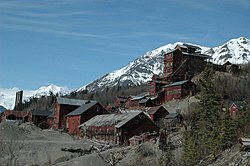
Kennecott, also known as Kennicott and Kennecott Mines, is an abandoned mining camp in the Copper River Census Area in the U.S. state of Alaska that was the center of activity for several copper mines. It is located beside the Kennicott Glacier, northeast of Valdez, inside Wrangell-St. Elias National Park and Preserve. The camp and mines are now a National Historic Landmark District administered by the National Park Service.
It was declared a National Historic Landmark in 1986.
In the summer of 1900, two prospectors, "Tarantula" Jack Smith and Clarence L. Warner, a group of prospectors associated with the McClellan party, spotted "a green patch far above them in an improbable location for a grass-green meadow." The green turned out to be malachite, located with chalcocite (aka "copper glance"), and the location of the Bonanza claim. A few days later, Arthur Coe Spencer, U.S. Geological Survey geologist independently found chalcocite at the same location, but was too late to stake any valuable claims.
Stephen Birch, a mining engineer just out of school, was in Alaska looking for investment opportunities in minerals. He had the financial backing of the Havemeyer Family, and another investor named James Ralph, from his days in New York. Birch spent the winter of 1901-1902 acquiring the "McClellan group's interests" for the Alaska Copper Company of Birch, Havemeyer, Ralph and Schultz, later to become the Alaska Copper and Coal Company. In the summer of 1901, he visited the property and "spent months mapping and sampling." He confirmed the Bonanza mine and surrounding by deposits were, at the time, the richest known concentration of copper in the world.
By 1905, Birch had successfully defended the legal challenges to his property and he began the search for capital to develop the area. On June 28, 1906, he entered into "an amalgamation" with the Daniel Guggenheim and J.P. Morgan & Co., known as the Alaska Syndicate, eventually securing over $30 million. The capital was to be used for constructing a railway, a steamship line, and development of the mines. In Nov. 1906, the Alaska Syndicate bought a 40 percent interest in the Bonanza Mine from the Alaska Copper and Coal Company and a 46.2 percent interest in the railroad plans of John Rosene's Northwestern Commercial Company.
Political battles over the mining and subsequent railroad were fought in the office of U.S. President Theodore Roosevelt between conservationists and those having a financial interest in the copper.
The Alaska Syndicate traded its Wrangell Mountains Mines assets for shares in the Kennecott Copper Corporation, a "new public company" formed on April 29, 1915. A similar transaction followed with the CR&NW railway and the Alaska Steamship Company. Birch was the managing partner for the Alaska operation.
Kennecott Mines was named after the Kennicott Glacier in the valley below. The geologist Oscar Rohn named the glacier after Robert Kennicott during the 1899 US Army Abercrombie Survey. A "clerical error" resulted in the substitution of an "e" for the "i", supposedly by Stephen Birch himself.
Kennecott, Alaska
Kennecott, also known as Kennicott and Kennecott Mines, is an abandoned mining camp in the Copper River Census Area in the U.S. state of Alaska that was the center of activity for several copper mines. It is located beside the Kennicott Glacier, northeast of Valdez, inside Wrangell-St. Elias National Park and Preserve. The camp and mines are now a National Historic Landmark District administered by the National Park Service.
It was declared a National Historic Landmark in 1986.
In the summer of 1900, two prospectors, "Tarantula" Jack Smith and Clarence L. Warner, a group of prospectors associated with the McClellan party, spotted "a green patch far above them in an improbable location for a grass-green meadow." The green turned out to be malachite, located with chalcocite (aka "copper glance"), and the location of the Bonanza claim. A few days later, Arthur Coe Spencer, U.S. Geological Survey geologist independently found chalcocite at the same location, but was too late to stake any valuable claims.
Stephen Birch, a mining engineer just out of school, was in Alaska looking for investment opportunities in minerals. He had the financial backing of the Havemeyer Family, and another investor named James Ralph, from his days in New York. Birch spent the winter of 1901-1902 acquiring the "McClellan group's interests" for the Alaska Copper Company of Birch, Havemeyer, Ralph and Schultz, later to become the Alaska Copper and Coal Company. In the summer of 1901, he visited the property and "spent months mapping and sampling." He confirmed the Bonanza mine and surrounding by deposits were, at the time, the richest known concentration of copper in the world.
By 1905, Birch had successfully defended the legal challenges to his property and he began the search for capital to develop the area. On June 28, 1906, he entered into "an amalgamation" with the Daniel Guggenheim and J.P. Morgan & Co., known as the Alaska Syndicate, eventually securing over $30 million. The capital was to be used for constructing a railway, a steamship line, and development of the mines. In Nov. 1906, the Alaska Syndicate bought a 40 percent interest in the Bonanza Mine from the Alaska Copper and Coal Company and a 46.2 percent interest in the railroad plans of John Rosene's Northwestern Commercial Company.
Political battles over the mining and subsequent railroad were fought in the office of U.S. President Theodore Roosevelt between conservationists and those having a financial interest in the copper.
The Alaska Syndicate traded its Wrangell Mountains Mines assets for shares in the Kennecott Copper Corporation, a "new public company" formed on April 29, 1915. A similar transaction followed with the CR&NW railway and the Alaska Steamship Company. Birch was the managing partner for the Alaska operation.
Kennecott Mines was named after the Kennicott Glacier in the valley below. The geologist Oscar Rohn named the glacier after Robert Kennicott during the 1899 US Army Abercrombie Survey. A "clerical error" resulted in the substitution of an "e" for the "i", supposedly by Stephen Birch himself.
Recent media
Recent media