



Community hub
Recent from talks
Knowledge base stats:
Talk channels stats:
Members stats:
Kenneth Walker (general)
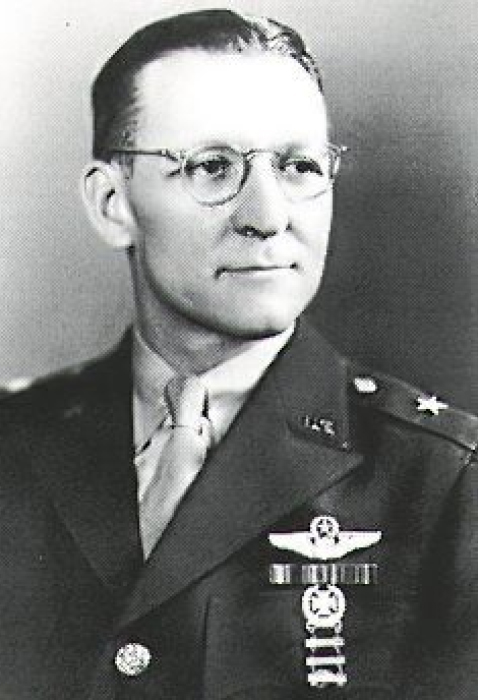
Brigadier General Kenneth Newton Walker (17 July 1898 – 5 January 1943) was a United States Army aviator and a United States Army Air Forces general who exerted a significant influence on the development of airpower doctrine. He posthumously received the Medal of Honor in World War II.
Walker joined the United States Army in 1917, after the American entry into World War I. He trained as an aviator and became a flying instructor. In 1920, after the end of the war, he received a commission in the Regular Army. After service in various capacities, Walker graduated from the Air Corps Tactical School in 1929, and then served as an instructor there. He supported the creation of a separate air organization that is not subordinate to other military branches. He was a forceful advocate of the efficacy of strategic bombardment, publishing articles on the subject and becoming part of a clique known as the "Bomber Mafia" that argued for the primacy of bombardment over other forms of military aviation. He advanced the notion that fighters could not prevent a bombing attack. He participated in the Air Corps Tactical School's development of the doctrine of industrial web theory, which called for precision attacks against carefully selected critical industrial targets. Shortly before the United States entered World War II, Walker became one of four officers assigned to the Air War Plans Division, which was tasked with developing a production requirements plan for the war in the air. Together, these officers devised the AWPD-1 plan, a blueprint for the imminent air war against Germany that called for the creation of an enormous air force to win the war through strategic bombardment.
In 1942, Walker was promoted to brigadier general and transferred to the Southwest Pacific, where he became Commanding General, V Bomber Command, Fifth Air Force. The Southwest Pacific contained few strategic targets, relegating the bombers to the role of interdicting supply lines and supporting the ground forces. This resulted in a doctrinal clash between Walker and Lieutenant General George C. Kenney, an attack aviator, over the proper method of employing bombers. Walker frequently flew combat missions over New Guinea, for which he received the Silver Star. On 5 January 1943, he was shot down and killed leading a daylight bombing raid over Rabaul, for which he was awarded the Medal of Honor.
Walker was born in Los Cerrillos, New Mexico, on 17 July 1898 to Wallace Walker and his wife Emma née Overturf. The family subsequently moved to Denver, Colorado. Kenneth's father left when he was young, and Emma became a single mother. Kenneth began his education at the Maria Mitchell School in Denver, Colorado, from 1905 to 1908, and then attended the Columbian School there from 1908 to 1912. He went to Central High School for a time until 1913 when he started at the Omaha High School of Commerce, from which he graduated in 1915. From January to June 1917 he took a course at the YMCA Night School in Denver. He then studied business administration at La Salle Extension University.
Walker enlisted in the United States Army in Denver, on 15 December 1917. He received flight training at the University of California's School of Military Aeronautics and at the pilot training base at Mather Field, near Sacramento, California. He was awarded his Aircrew Badge and commissioned as a temporary second lieutenant in the United States Army Air Service on 2 November 1918. He then attended the Flying Instructor's School at Brooks Field in San Antonio, Texas, and became an instructor at the flight training center at Barron Field. In March 1919, he was posted to Fort Sill as an instructor at the Air Service Flying School. During 1918, the School for Aerial Observers and the Air Service Flying School were built at nearby Post Field, where Walker spent the next four years as a pilot, instructor, supply officer, and post adjutant.
Walker became one of many officers holding wartime commissions to receive a commission in the Regular Army, into which he was commissioned as a first lieutenant on 1 July 1920, but was subsequently reduced in rank to second lieutenant on 15 December 1922, another common occurrence in the aftermath of World War I when the wartime army was demobilized. Already a command pilot, he also qualified as a combat observer in 1922. He was promoted to first lieutenant again on 24 July 1924.
Walker courted Marguerite Potter, a sorority member and sociology graduate at the Norman campus of the University of Oklahoma. The two were married in September 1922. In lieu of a honeymoon, they boarded a troop transport to the Philippines on 12 December 1922. Walker initially became Commander of the Air Intelligence Section at Camp Nichols. He was then posted to the Philippine Air Depot, where he served at various times as property officer, supply officer, adjutant, and depot inspector, before ultimately being assigned to the 28th Bombardment Squadron in 1924. In August 1923 he crashed an Airco DH.4 on takeoff but walked away unhurt. The Walkers had two sons, Kenneth Jr., born in February 1927, and Douglas, born in January 1933.
Walker returned to the United States in February 1925 and was posted to Langley Field, where he became a member of the Air Service Board. He served successively as adjutant of the 59th Service Squadron, commander of the 11th Bombardment Squadron, and operations officer of the 2nd Bomb Group there. In June 1929 he graduated from the Air Corps Tactical School, where he studied under Captain Robert Olds, a former aide to air power pioneer Billy Mitchell and a passionate advocate of strategic bombing. He then served at the Air Corps Tactical School as an instructor under Captain Olds in the Bombardment Section until July 1933, both at Langley and at Maxwell Field, where the school was relocated in 1931. Walker became part of a small clique of Air Corps Tactical School instructors that became known as the "Bomber Mafia", that argued that bombardment was the most important form of airpower. Its members also included Haywood Hansell, Donald Wilson, Harold L. George, and Robert M. Webster, Their influence was such that, during their tenure, bombardment achieved primacy over pursuit in the development of Air Corps doctrine.
Hub AI
Kenneth Walker (general) AI simulator
(@Kenneth Walker (general)_simulator)
Kenneth Walker (general)
Brigadier General Kenneth Newton Walker (17 July 1898 – 5 January 1943) was a United States Army aviator and a United States Army Air Forces general who exerted a significant influence on the development of airpower doctrine. He posthumously received the Medal of Honor in World War II.
Walker joined the United States Army in 1917, after the American entry into World War I. He trained as an aviator and became a flying instructor. In 1920, after the end of the war, he received a commission in the Regular Army. After service in various capacities, Walker graduated from the Air Corps Tactical School in 1929, and then served as an instructor there. He supported the creation of a separate air organization that is not subordinate to other military branches. He was a forceful advocate of the efficacy of strategic bombardment, publishing articles on the subject and becoming part of a clique known as the "Bomber Mafia" that argued for the primacy of bombardment over other forms of military aviation. He advanced the notion that fighters could not prevent a bombing attack. He participated in the Air Corps Tactical School's development of the doctrine of industrial web theory, which called for precision attacks against carefully selected critical industrial targets. Shortly before the United States entered World War II, Walker became one of four officers assigned to the Air War Plans Division, which was tasked with developing a production requirements plan for the war in the air. Together, these officers devised the AWPD-1 plan, a blueprint for the imminent air war against Germany that called for the creation of an enormous air force to win the war through strategic bombardment.
In 1942, Walker was promoted to brigadier general and transferred to the Southwest Pacific, where he became Commanding General, V Bomber Command, Fifth Air Force. The Southwest Pacific contained few strategic targets, relegating the bombers to the role of interdicting supply lines and supporting the ground forces. This resulted in a doctrinal clash between Walker and Lieutenant General George C. Kenney, an attack aviator, over the proper method of employing bombers. Walker frequently flew combat missions over New Guinea, for which he received the Silver Star. On 5 January 1943, he was shot down and killed leading a daylight bombing raid over Rabaul, for which he was awarded the Medal of Honor.
Walker was born in Los Cerrillos, New Mexico, on 17 July 1898 to Wallace Walker and his wife Emma née Overturf. The family subsequently moved to Denver, Colorado. Kenneth's father left when he was young, and Emma became a single mother. Kenneth began his education at the Maria Mitchell School in Denver, Colorado, from 1905 to 1908, and then attended the Columbian School there from 1908 to 1912. He went to Central High School for a time until 1913 when he started at the Omaha High School of Commerce, from which he graduated in 1915. From January to June 1917 he took a course at the YMCA Night School in Denver. He then studied business administration at La Salle Extension University.
Walker enlisted in the United States Army in Denver, on 15 December 1917. He received flight training at the University of California's School of Military Aeronautics and at the pilot training base at Mather Field, near Sacramento, California. He was awarded his Aircrew Badge and commissioned as a temporary second lieutenant in the United States Army Air Service on 2 November 1918. He then attended the Flying Instructor's School at Brooks Field in San Antonio, Texas, and became an instructor at the flight training center at Barron Field. In March 1919, he was posted to Fort Sill as an instructor at the Air Service Flying School. During 1918, the School for Aerial Observers and the Air Service Flying School were built at nearby Post Field, where Walker spent the next four years as a pilot, instructor, supply officer, and post adjutant.
Walker became one of many officers holding wartime commissions to receive a commission in the Regular Army, into which he was commissioned as a first lieutenant on 1 July 1920, but was subsequently reduced in rank to second lieutenant on 15 December 1922, another common occurrence in the aftermath of World War I when the wartime army was demobilized. Already a command pilot, he also qualified as a combat observer in 1922. He was promoted to first lieutenant again on 24 July 1924.
Walker courted Marguerite Potter, a sorority member and sociology graduate at the Norman campus of the University of Oklahoma. The two were married in September 1922. In lieu of a honeymoon, they boarded a troop transport to the Philippines on 12 December 1922. Walker initially became Commander of the Air Intelligence Section at Camp Nichols. He was then posted to the Philippine Air Depot, where he served at various times as property officer, supply officer, adjutant, and depot inspector, before ultimately being assigned to the 28th Bombardment Squadron in 1924. In August 1923 he crashed an Airco DH.4 on takeoff but walked away unhurt. The Walkers had two sons, Kenneth Jr., born in February 1927, and Douglas, born in January 1933.
Walker returned to the United States in February 1925 and was posted to Langley Field, where he became a member of the Air Service Board. He served successively as adjutant of the 59th Service Squadron, commander of the 11th Bombardment Squadron, and operations officer of the 2nd Bomb Group there. In June 1929 he graduated from the Air Corps Tactical School, where he studied under Captain Robert Olds, a former aide to air power pioneer Billy Mitchell and a passionate advocate of strategic bombing. He then served at the Air Corps Tactical School as an instructor under Captain Olds in the Bombardment Section until July 1933, both at Langley and at Maxwell Field, where the school was relocated in 1931. Walker became part of a small clique of Air Corps Tactical School instructors that became known as the "Bomber Mafia", that argued that bombardment was the most important form of airpower. Its members also included Haywood Hansell, Donald Wilson, Harold L. George, and Robert M. Webster, Their influence was such that, during their tenure, bombardment achieved primacy over pursuit in the development of Air Corps doctrine.