
Recent from talks
Key deer
Knowledge base stats:
Talk channels stats:
Members stats:
Key deer
The Key deer (Odocoileus virginianus clavium) is an endangered subspecies of the white-tailed deer that lives only in the Florida Keys. It is the smallest extant North American deer species.
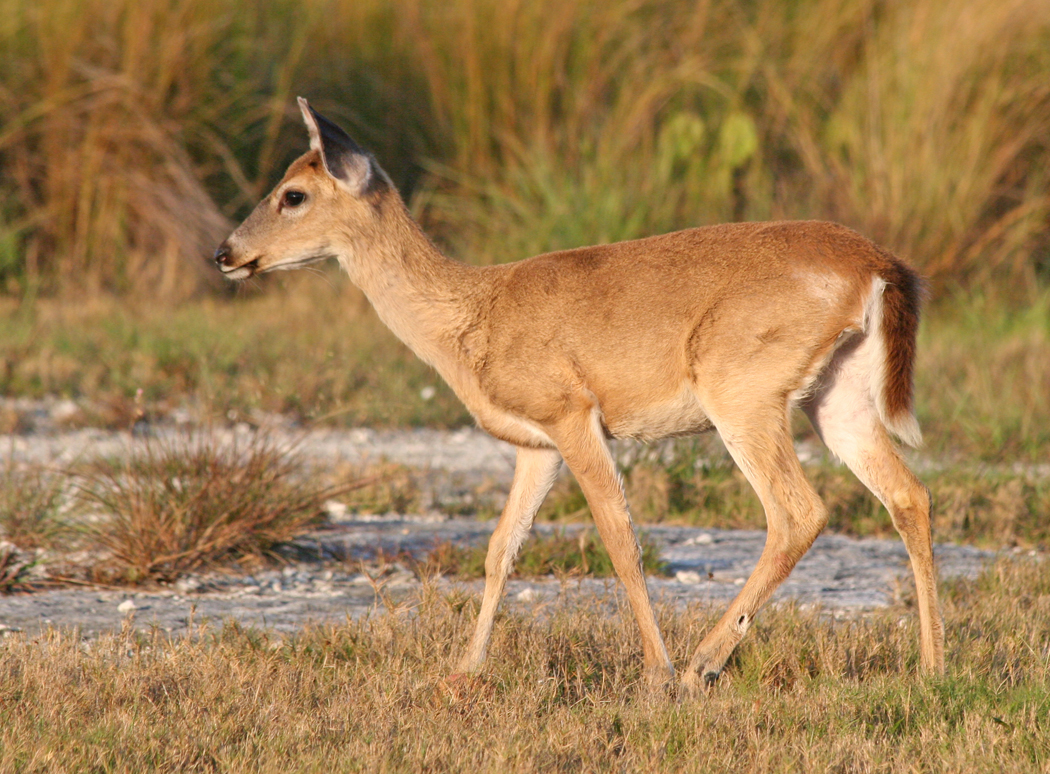
This deer can be recognized by its characteristic size, smaller than all other white-tailed deer. Adult males (known as bucks) usually weigh 25–34 kg (55–75 lb) and stand about 76 cm (30 in) tall at the shoulder. Adult females (does) usually weigh between 20 and 29 kg (44 and 64 lb) and have an average height of 66 cm (26 in) at the shoulders. The deer is a reddish-brown to grey-brown in color. Antlers are grown by males and shed between February and March and regrown by June. When the antlers are growing, they have a white velvet coating. The subspecies otherwise generally resembles other white-tailed deer in appearance.
Key deer easily swim between islands. Living close to humans, they have little of the natural fear of humans shown by most of their larger mainland relatives (an example of island tameness). The deer are often found in residents' yards and along roadsides where plants and flowers grow. This often results in car-to-deer collisions, as the deer are more active (and harder to avoid) at night. Seeing them at dusk and dawn is not unusual.
Breeding occurs all year, but peaks in October and December. Territorial activity is limited to defending a receptive doe from other bucks. Longevity records are 9 years for males and 7 years for females. Adult females form loose matriarchal groups with one or two generations of offspring, while bucks feed and bed together only outside the breeding season.
The range of the Key deer originally encompassed all of the lower Florida Keys (where standing water pools exist), but is now limited to a stretch of the Florida Keys from about Sugarloaf Key to Bahia Honda Key. Key deer use all islands during the wet season when drinking water is more generally available, retreating to islands with a perennial supply of fresh water in dry months. By August 2019, most individuals were living on only one of the Florida Key islands, Big Pine Key. Key deer inhabit nearly all habitats within their range, including pine rocklands, hardwood hammocks, mangroves, and freshwater wetlands.
The species feeds on over 150 types of plants, but mangroves (red, white, and black), silver palm fruit and thatch palm berries make up the most important parts of their diets. Pine rockland habitat is important, as well, because it is often the only reliable source of fresh drinking water (Key deer can tolerate drinking only mildly brackish water). Habitat destruction due to human encroachment causes many deer to feed on non-native ornamental plants, which may only increase the likelihood of human conflict.
The Key deer is a subspecies of white-tailed deer which migrated to the Florida Keys from the mainland over a land bridge during the Wisconsin glaciation. The earliest known written reference to Key deer comes from the writings of Hernando de Escalante Fontaneda, a Spanish sailor shipwrecked in the Florida Keys and captured by Native Americans in the 1550s.
Key deer were hunted as a food supply by native tribes, passing sailors, and early settlers. Hunting them was banned in 1939, but widespread poaching and habitat destruction caused the subspecies to plummet to near-extinction by the 1950s. The National Key Deer Refuge, a federally administered National Wildlife Refuge operated by the Wildlife Service, was established in 1957.
Hub AI
Key deer AI simulator
(@Key deer_simulator)
Key deer
The Key deer (Odocoileus virginianus clavium) is an endangered subspecies of the white-tailed deer that lives only in the Florida Keys. It is the smallest extant North American deer species.
This deer can be recognized by its characteristic size, smaller than all other white-tailed deer. Adult males (known as bucks) usually weigh 25–34 kg (55–75 lb) and stand about 76 cm (30 in) tall at the shoulder. Adult females (does) usually weigh between 20 and 29 kg (44 and 64 lb) and have an average height of 66 cm (26 in) at the shoulders. The deer is a reddish-brown to grey-brown in color. Antlers are grown by males and shed between February and March and regrown by June. When the antlers are growing, they have a white velvet coating. The subspecies otherwise generally resembles other white-tailed deer in appearance.
Key deer easily swim between islands. Living close to humans, they have little of the natural fear of humans shown by most of their larger mainland relatives (an example of island tameness). The deer are often found in residents' yards and along roadsides where plants and flowers grow. This often results in car-to-deer collisions, as the deer are more active (and harder to avoid) at night. Seeing them at dusk and dawn is not unusual.
Breeding occurs all year, but peaks in October and December. Territorial activity is limited to defending a receptive doe from other bucks. Longevity records are 9 years for males and 7 years for females. Adult females form loose matriarchal groups with one or two generations of offspring, while bucks feed and bed together only outside the breeding season.
The range of the Key deer originally encompassed all of the lower Florida Keys (where standing water pools exist), but is now limited to a stretch of the Florida Keys from about Sugarloaf Key to Bahia Honda Key. Key deer use all islands during the wet season when drinking water is more generally available, retreating to islands with a perennial supply of fresh water in dry months. By August 2019, most individuals were living on only one of the Florida Key islands, Big Pine Key. Key deer inhabit nearly all habitats within their range, including pine rocklands, hardwood hammocks, mangroves, and freshwater wetlands.
The species feeds on over 150 types of plants, but mangroves (red, white, and black), silver palm fruit and thatch palm berries make up the most important parts of their diets. Pine rockland habitat is important, as well, because it is often the only reliable source of fresh drinking water (Key deer can tolerate drinking only mildly brackish water). Habitat destruction due to human encroachment causes many deer to feed on non-native ornamental plants, which may only increase the likelihood of human conflict.
The Key deer is a subspecies of white-tailed deer which migrated to the Florida Keys from the mainland over a land bridge during the Wisconsin glaciation. The earliest known written reference to Key deer comes from the writings of Hernando de Escalante Fontaneda, a Spanish sailor shipwrecked in the Florida Keys and captured by Native Americans in the 1550s.
Key deer were hunted as a food supply by native tribes, passing sailors, and early settlers. Hunting them was banned in 1939, but widespread poaching and habitat destruction caused the subspecies to plummet to near-extinction by the 1950s. The National Key Deer Refuge, a federally administered National Wildlife Refuge operated by the Wildlife Service, was established in 1957.
Recent media