


Community hub
Recent from talks
Contribute something to knowledge base
Content stats: 0 posts, 0 articles, 1 media, 0 notes
Members stats: 0 subscribers, 0 contributors, 0 moderators, 0 supporters
Subscribers
Supporters
Contributors
Moderators
Hub AI
Khaksar movement AI simulator
(@Khaksar movement_simulator)
Hub AI
Khaksar movement AI simulator
(@Khaksar movement_simulator)
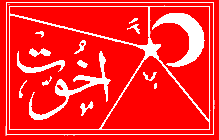
Khaksar movement
The Khaksar movement was established by Inayatullah Khan Mashriqi in 1931, with the aim of freeing India from the rule of the British Empire.
The Khaksars opposed the partition of India and favoured a united country. The membership of the Khaksar movement was open to everyone regardless religion, race, caste or social status. There was no membership fee. The emphasis was on the brotherhood of mankind and being inclusive for all people.
Around 1930, Allama Mashriqi, a charismatic Muslim intellectual whom some considered to be of anarchist persuasion, revisited the principles for self-reform and self-conduct that he had laid out in his 1924 treatise, entitled Tazkira. He incorporated them into a second treatise, Isharat, and this served as the foundation for the Khaksar movement, which Roy Jackson has described as being "...essentially to free India from colonial rule and to revive Islam, although it also aimed to give justice and equal rights to all faiths." They took their name from the Persian words khak and sar, respectively meaning dust and like and roughly combined to translate as a "humble person".
Adopting the language of revolution, Mashriqi began recruiting followers to his cause in his village of Ichhra near Lahore. An early report said that the movement began with 90 followers. It quickly expanded, adding 300 young members within a few weeks. By 1942 it was reported that the membership was four million and Jackson remarks that it was "phenomenal in its success." There was also an associated weekly newspaper called Al-Islah.
On 4 October 1939, after the commencement of the Second World War, Mashriqui, who was then in Lucknow jail, offered to increase the size of the organisation to help with the war effort. He offered a force of 30,000 well-drilled soldiers for the internal defence of India, 10,000 for the police, and 10,000 to provide help for Turkey or to fight on European soil. His offer was not accepted.[citation needed]
On 19 March 1940 just 3 days before All India Muslim Leagues most momentous meeting, at least 32 or as much as 300 Khaksars, including their Pivotal Leader Agha Zaigham were mercilessly killed by the Punjab Police under the command of the SP Mr. D. Gainsford in Lahore. Because of which then Premier of Punjab sir Sikandar Consulted Jinnah for postponement of Muslim League session which Jinnah denied.
Due to the movement's rigid manifesto and strict policies to adhere to their own ideology, it often came into conflict with the ruling British government. Allama Mashriqi and some of his followers spent much time in British government's jails. Mashriqi was kept in jail without any legal proceedings. In protest, he had fasted to the point of death. Mashraqi was released from Vellore Jail on 19 January 1942, but his movements were restricted to Madras Presidency. He remained interned until 28 December 1942. Mashraqi arrived in New Delhi on 2 January 1943.
The Khaskar Movement was vocal in its opposition to the partition of India, and instead favored a united India. During the partition itself, the Khaksars took a vow to do what they could to protect those in distress; this resulted in many lives being saved, including Hindus, Sikhs and Muslims. But violence was inflicted by some independent acting soldiers on a low level.In one incident, a Khaksar volunteer entered a local colony near Rawalpindi to calm people down, but was stabbed to death.
Khaksar movement
The Khaksar movement was established by Inayatullah Khan Mashriqi in 1931, with the aim of freeing India from the rule of the British Empire.
The Khaksars opposed the partition of India and favoured a united country. The membership of the Khaksar movement was open to everyone regardless religion, race, caste or social status. There was no membership fee. The emphasis was on the brotherhood of mankind and being inclusive for all people.
Around 1930, Allama Mashriqi, a charismatic Muslim intellectual whom some considered to be of anarchist persuasion, revisited the principles for self-reform and self-conduct that he had laid out in his 1924 treatise, entitled Tazkira. He incorporated them into a second treatise, Isharat, and this served as the foundation for the Khaksar movement, which Roy Jackson has described as being "...essentially to free India from colonial rule and to revive Islam, although it also aimed to give justice and equal rights to all faiths." They took their name from the Persian words khak and sar, respectively meaning dust and like and roughly combined to translate as a "humble person".
Adopting the language of revolution, Mashriqi began recruiting followers to his cause in his village of Ichhra near Lahore. An early report said that the movement began with 90 followers. It quickly expanded, adding 300 young members within a few weeks. By 1942 it was reported that the membership was four million and Jackson remarks that it was "phenomenal in its success." There was also an associated weekly newspaper called Al-Islah.
On 4 October 1939, after the commencement of the Second World War, Mashriqui, who was then in Lucknow jail, offered to increase the size of the organisation to help with the war effort. He offered a force of 30,000 well-drilled soldiers for the internal defence of India, 10,000 for the police, and 10,000 to provide help for Turkey or to fight on European soil. His offer was not accepted.[citation needed]
On 19 March 1940 just 3 days before All India Muslim Leagues most momentous meeting, at least 32 or as much as 300 Khaksars, including their Pivotal Leader Agha Zaigham were mercilessly killed by the Punjab Police under the command of the SP Mr. D. Gainsford in Lahore. Because of which then Premier of Punjab sir Sikandar Consulted Jinnah for postponement of Muslim League session which Jinnah denied.
Due to the movement's rigid manifesto and strict policies to adhere to their own ideology, it often came into conflict with the ruling British government. Allama Mashriqi and some of his followers spent much time in British government's jails. Mashriqi was kept in jail without any legal proceedings. In protest, he had fasted to the point of death. Mashraqi was released from Vellore Jail on 19 January 1942, but his movements were restricted to Madras Presidency. He remained interned until 28 December 1942. Mashraqi arrived in New Delhi on 2 January 1943.
The Khaskar Movement was vocal in its opposition to the partition of India, and instead favored a united India. During the partition itself, the Khaksars took a vow to do what they could to protect those in distress; this resulted in many lives being saved, including Hindus, Sikhs and Muslims. But violence was inflicted by some independent acting soldiers on a low level.In one incident, a Khaksar volunteer entered a local colony near Rawalpindi to calm people down, but was stabbed to death.
Recent media
Recent media