
Recent from talks
Kholumolumo
Knowledge base stats:
Talk channels stats:
Members stats:
Kholumolumo
Kholumolumo (referring to a type of dragon the local Basuto associate with dinosaurs), formerly "Kholumolumosaurus" or "Thotobolosaurus", is an extinct genus of massopodan sauropodomorph dinosaur, which was closely related to Sarahsaurus, from the lower Elliot Formation of Maphutseng, Lesotho. The type species, Kholumolumo ellenbergerorum was formally described in 2020.
In 1930, Samuel Motsoane, principal of the Paris Evangelical Mission School at Bethesda in Lesotho, found dispersed dinosaur bones. In 1955, he told this to the protestant missionary Paul Ellenberger. In September 1955, P. Ellenberger and his brother François Ellenberger uncovered a bonebed in the immediate vicinity of a refuse pile a few meters from native huts in the Village of Maphutseng, western Lesotho, in a layer of the Elliot Formation. The location was locally called the Thotobolo ea 'Ma-Beata, the "trash heap of Beata's mother". In November 1955, they were reinforced by the South-African paleontologists Alfred Walter Crompton and Rosalie F. "Griff" Ewer. In 1955, the discovery was reported in the scientific literature. The excavations were continued from February 1956 onwards and at the end of the second field season, the number of pieces had increased to 683, collected from a surface of thirty-five square metres. The Ellenberger brothers briefly described the finds in 1956. In 1957, the fossils were transported to the South African Museum of Cape Town. Delays in their preparation caused a rift between Crompton and the Ellenbergers.
In 1959, P. Ellenberger, F. Ellenberger and the latter's wife Hélène, continued the digs in cooperation with a French team from the Paris Muséum national d'histoire naturelle including Léonard Ginsburg and Jean Fabre. Over two hundred additional pieces were collected. In 1960, eight dinosaur trackways were reported, discovered over a surface of seventy square metres. Three individual tracks were transported to the University of Montpellier but are presently lost. In 1963, additional excavations took place by Paul Ellenberger, Ginsburg, Fabre and Christiane Mendrez. In 1966, François Ellenberger and Ginsburg for the first time described the bones in detail and referred them to Euskelosaurus browni.
In September 1970, the last excavations occurred by Paul Ellenberger, Ginsburg, Fabre and Bernard Battail. As in 1959, the fossils were sent to Paris, bringing the total there to about four hundred. Concluding that it represented a taxon new to science, Paul Ellenberger at first referred to it as "Thotobolosaurus", which means "trash heap lizard", in reference to where the holotype was discovered. Ellenberger in a redescription of the material suggested the species name "Thotobolosaurus mabeatae" in 1970. This name was invalid, however.
In 1996, the species was briefly referred to as "Kholumolumosaurus ellenbergerorum" in François-Xavier Gauffre's unpublished dissertation. This name too, was invalid.
In 2020, the species Kholumolumo ellenbergerorum, a shortened form of one of the original names, was formally named by Claire Peyre de Fabrègues and Ronan Allain. The generic name is the kholumolumo or xodumodumo, a gigantic reptile, sometimes described as a dragon, lizard or crocodile, from the mythology of the Sotho. The Basotho use this word to refer to dinosaurs. The specific name honours the Ellenberger family.
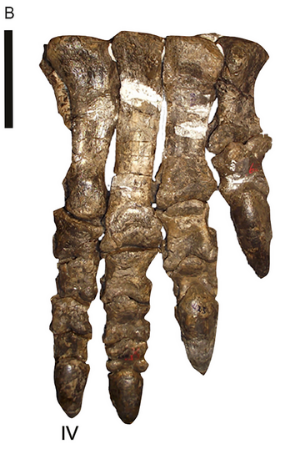
The holotype, MNHN.F.LES381m, was found in a layer of the Lower Elliot Formation dating from the Norian. It consists of a complete right tibia or shinbone. Several other bones in the Paris material were designated as paratypes. All the additional sauropodomorph material from Maphutseng, whether in France or South-Africa, was referred to the species. Only disarticulated bones were found, including little skull material. They represent at least five, probably about ten, individuals.
Kholumolumo was a large sauropodomorph, estimated to have reached upwards of 9 metres (30 ft) long. This would have made it one of the largest known animals of the Norian. Its weight has been estimated from its thighbone circumference. If it was bipedal, which the describing authors thought likely, a weight is indicated of 1754 kilogrammes. A quadrupedal animal could have weighed 3963 kilogrammes.
Hub AI
Kholumolumo AI simulator
(@Kholumolumo_simulator)
Kholumolumo
Kholumolumo (referring to a type of dragon the local Basuto associate with dinosaurs), formerly "Kholumolumosaurus" or "Thotobolosaurus", is an extinct genus of massopodan sauropodomorph dinosaur, which was closely related to Sarahsaurus, from the lower Elliot Formation of Maphutseng, Lesotho. The type species, Kholumolumo ellenbergerorum was formally described in 2020.
In 1930, Samuel Motsoane, principal of the Paris Evangelical Mission School at Bethesda in Lesotho, found dispersed dinosaur bones. In 1955, he told this to the protestant missionary Paul Ellenberger. In September 1955, P. Ellenberger and his brother François Ellenberger uncovered a bonebed in the immediate vicinity of a refuse pile a few meters from native huts in the Village of Maphutseng, western Lesotho, in a layer of the Elliot Formation. The location was locally called the Thotobolo ea 'Ma-Beata, the "trash heap of Beata's mother". In November 1955, they were reinforced by the South-African paleontologists Alfred Walter Crompton and Rosalie F. "Griff" Ewer. In 1955, the discovery was reported in the scientific literature. The excavations were continued from February 1956 onwards and at the end of the second field season, the number of pieces had increased to 683, collected from a surface of thirty-five square metres. The Ellenberger brothers briefly described the finds in 1956. In 1957, the fossils were transported to the South African Museum of Cape Town. Delays in their preparation caused a rift between Crompton and the Ellenbergers.
In 1959, P. Ellenberger, F. Ellenberger and the latter's wife Hélène, continued the digs in cooperation with a French team from the Paris Muséum national d'histoire naturelle including Léonard Ginsburg and Jean Fabre. Over two hundred additional pieces were collected. In 1960, eight dinosaur trackways were reported, discovered over a surface of seventy square metres. Three individual tracks were transported to the University of Montpellier but are presently lost. In 1963, additional excavations took place by Paul Ellenberger, Ginsburg, Fabre and Christiane Mendrez. In 1966, François Ellenberger and Ginsburg for the first time described the bones in detail and referred them to Euskelosaurus browni.
In September 1970, the last excavations occurred by Paul Ellenberger, Ginsburg, Fabre and Bernard Battail. As in 1959, the fossils were sent to Paris, bringing the total there to about four hundred. Concluding that it represented a taxon new to science, Paul Ellenberger at first referred to it as "Thotobolosaurus", which means "trash heap lizard", in reference to where the holotype was discovered. Ellenberger in a redescription of the material suggested the species name "Thotobolosaurus mabeatae" in 1970. This name was invalid, however.
In 1996, the species was briefly referred to as "Kholumolumosaurus ellenbergerorum" in François-Xavier Gauffre's unpublished dissertation. This name too, was invalid.
In 2020, the species Kholumolumo ellenbergerorum, a shortened form of one of the original names, was formally named by Claire Peyre de Fabrègues and Ronan Allain. The generic name is the kholumolumo or xodumodumo, a gigantic reptile, sometimes described as a dragon, lizard or crocodile, from the mythology of the Sotho. The Basotho use this word to refer to dinosaurs. The specific name honours the Ellenberger family.
The holotype, MNHN.F.LES381m, was found in a layer of the Lower Elliot Formation dating from the Norian. It consists of a complete right tibia or shinbone. Several other bones in the Paris material were designated as paratypes. All the additional sauropodomorph material from Maphutseng, whether in France or South-Africa, was referred to the species. Only disarticulated bones were found, including little skull material. They represent at least five, probably about ten, individuals.
Kholumolumo was a large sauropodomorph, estimated to have reached upwards of 9 metres (30 ft) long. This would have made it one of the largest known animals of the Norian. Its weight has been estimated from its thighbone circumference. If it was bipedal, which the describing authors thought likely, a weight is indicated of 1754 kilogrammes. A quadrupedal animal could have weighed 3963 kilogrammes.
Recent media