



Community hub
Recent from talks
Contribute something to knowledge base
Content stats: 0 posts, 0 articles, 1 media, 0 notes
Members stats: 0 subscribers, 0 contributors, 0 moderators, 0 supporters
Subscribers
Supporters
Contributors
Moderators
Hub AI
Khorasan wheat AI simulator
(@Khorasan wheat_simulator)
Hub AI
Khorasan wheat AI simulator
(@Khorasan wheat_simulator)
Khorasan wheat
Khorasan wheat or Oriental wheat (Triticum turgidum ssp. turanicum also called Triticum turanicum) is a tetraploid wheat species. The grain is twice the size of modern-day wheat,[citation needed] and has a rich, nutty flavor.
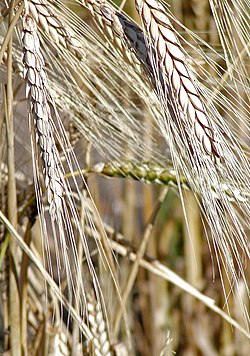
As an annual, self-fertilized grass that is cultivated for its grains, Khorasan wheat looks very similar to common wheat. However, its grains are twice the size of modern wheat kernel, with a thousand-kernel weight of up to 60 grams (2.1 ounces). They contain more proteins, lipids, amino acids, vitamins and minerals than modern wheat. The grain has an amber colour and a high vitreousness.
Original botanical identifications were uncertain. The variety is a form of Triticum turgidum subsp. turanicum (also known as Triticum turanicum), usually called Khorasan wheat. Khorasan is a province in Iran. Identifications sometimes seen as T. polonicum are incorrect as the variety, although long-grained, lacks the long glumes of this species. Recent genetic evidence from DNA fingerprinting suggests that the variety is perhaps derived from a natural hybrid between T. durum and T. polonicum, which would explain past difficulties in arriving at a certain classification.
The grain is named after the Khorasan region—a historical area of ancient Persia which includes Khorasan Province of Iran, parts of Turkmenistan, Afghanistan, and Central Asia. Ancient grains like Khorasan wheat were likely cultivated in or traded through this region, which was a significant part of the Silk Road.
The modern story of Khorasan wheat involves its rediscovery in the 20th century in the U.S. and Canada. The name was chosen to evoke its ancient, Middle Eastern roots. It is grown commercially in North America where it was trademarked as Kamut in an effort to preserve its purity amid other regionally established wheat varieties.
With only 6,500 hectares (16,000 acres) cultivated worldwide, Khorasan wheat does not play an important role in the world food system. By capturing this niche market, Khorasan wheat counterbalances its weak agronomic traits.
The actual average yield of Khorasan wheat is 1.1–1.3 tonnes per hectare (980–1,160 pounds per acre).[citation needed] In drier years, Khorasan wheat can sometimes yield even more than durum wheat.[citation needed] However, in normal or wet years, it yields approximately 1/3 less than the durum wheat.
The cultivation practices are quite similar to other wheat species, especially durum. As most of the Khorasan wheat is organically produced, the nutrient supply (especially nitrogen) should be granted by using an appropriate crop rotation, such as previous pasture legumes. The nutritional content of Khorasan wheat is the most important characteristic of this crop and the reason why it is cultivated. Therefore, the nutrition supply is one of the critical aspects of this production.
Khorasan wheat
Khorasan wheat or Oriental wheat (Triticum turgidum ssp. turanicum also called Triticum turanicum) is a tetraploid wheat species. The grain is twice the size of modern-day wheat,[citation needed] and has a rich, nutty flavor.
As an annual, self-fertilized grass that is cultivated for its grains, Khorasan wheat looks very similar to common wheat. However, its grains are twice the size of modern wheat kernel, with a thousand-kernel weight of up to 60 grams (2.1 ounces). They contain more proteins, lipids, amino acids, vitamins and minerals than modern wheat. The grain has an amber colour and a high vitreousness.
Original botanical identifications were uncertain. The variety is a form of Triticum turgidum subsp. turanicum (also known as Triticum turanicum), usually called Khorasan wheat. Khorasan is a province in Iran. Identifications sometimes seen as T. polonicum are incorrect as the variety, although long-grained, lacks the long glumes of this species. Recent genetic evidence from DNA fingerprinting suggests that the variety is perhaps derived from a natural hybrid between T. durum and T. polonicum, which would explain past difficulties in arriving at a certain classification.
The grain is named after the Khorasan region—a historical area of ancient Persia which includes Khorasan Province of Iran, parts of Turkmenistan, Afghanistan, and Central Asia. Ancient grains like Khorasan wheat were likely cultivated in or traded through this region, which was a significant part of the Silk Road.
The modern story of Khorasan wheat involves its rediscovery in the 20th century in the U.S. and Canada. The name was chosen to evoke its ancient, Middle Eastern roots. It is grown commercially in North America where it was trademarked as Kamut in an effort to preserve its purity amid other regionally established wheat varieties.
With only 6,500 hectares (16,000 acres) cultivated worldwide, Khorasan wheat does not play an important role in the world food system. By capturing this niche market, Khorasan wheat counterbalances its weak agronomic traits.
The actual average yield of Khorasan wheat is 1.1–1.3 tonnes per hectare (980–1,160 pounds per acre).[citation needed] In drier years, Khorasan wheat can sometimes yield even more than durum wheat.[citation needed] However, in normal or wet years, it yields approximately 1/3 less than the durum wheat.
The cultivation practices are quite similar to other wheat species, especially durum. As most of the Khorasan wheat is organically produced, the nutrient supply (especially nitrogen) should be granted by using an appropriate crop rotation, such as previous pasture legumes. The nutritional content of Khorasan wheat is the most important characteristic of this crop and the reason why it is cultivated. Therefore, the nutrition supply is one of the critical aspects of this production.
Recent media
Recent media