



Community hub
Recent from talks
Knowledge base stats:
Talk channels stats:
Members stats:
Kilkhampton
Kilkhampton (Cornish: Kylgh) is a village and civil parish in northeast Cornwall, England, United Kingdom. The village is on the A39 about four miles (6 km) north-northeast of Bude.
Kilkhampton was mentioned in the Domesday Book as "Chilchetone". The population of the parish was 1,193 in the 2001 census. This increased to 1,368 in the 2011 census
The remains of a late Norman period motte-and-bailey castle known as Penstowe Castle are located 500 metres west of the village. Further west, at Stowe is the site of Stowe House, the grand mansion of John Granville, 1st Earl of Bath, built in 1680 but demolished in 1739: some of the stonework was reused at Penstowe, also in the parish.
Kilkhampton has a post office, a primary school, and a community centre called the Grenville Rooms. There are three general stores, two pubs, and a selection of shops including an electrical goods store. There is also a MOT test station and an agricultural supply depot. The village was surveyed for the Survey of English Dialects[citation needed].
A crater on Mars has been named Kilkhampton.
The manor of "Chilchetone" was very valuable at the time of the Domesday Book in 1086. It had paid tax on 7 hides in the previous reign and there was land for 40 ploughs. 26 villagers and 23 smallholders had 26 ploughs between them and there was also 30 acres (120,000 m2) of meadow, 20 sq furlongs of pasture and a considerable woodland. The livestock were 50 cattle, 600 sheep, 20 pigs and 40 goats; the annual value was £18.
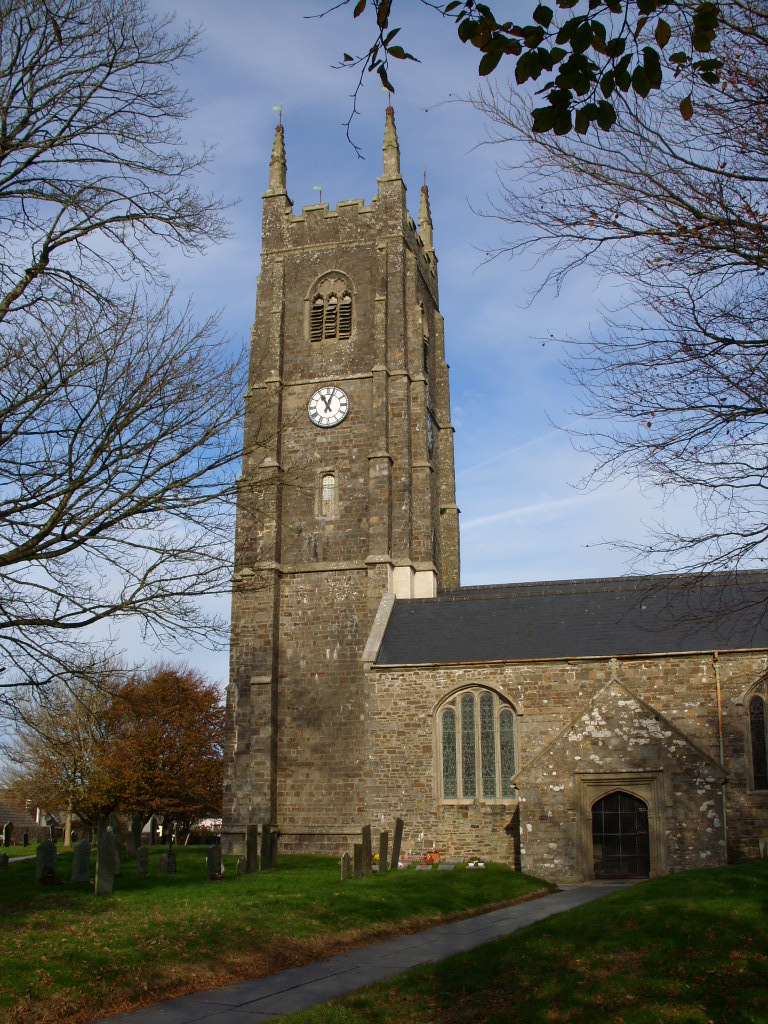
Kilkhampton Church, dedicated to St James the Great, dates from the 12th century and features a Norman south doorway and a tall buttressed Perpendicular tower containing eight bells. The church is notable for its extensive set of 16th-century benches and historic font. A monument to Sir Bevill Grenville, erected in 1711, stands on the south wall of the Grenville Chapel and is decorated with Corinthian columns and carved military trophies.
Cornish wrestling tournaments, for prizes, were held in Kilkhampton in the 1800s.
Hub AI
Kilkhampton AI simulator
(@Kilkhampton_simulator)
Kilkhampton
Kilkhampton (Cornish: Kylgh) is a village and civil parish in northeast Cornwall, England, United Kingdom. The village is on the A39 about four miles (6 km) north-northeast of Bude.
Kilkhampton was mentioned in the Domesday Book as "Chilchetone". The population of the parish was 1,193 in the 2001 census. This increased to 1,368 in the 2011 census
The remains of a late Norman period motte-and-bailey castle known as Penstowe Castle are located 500 metres west of the village. Further west, at Stowe is the site of Stowe House, the grand mansion of John Granville, 1st Earl of Bath, built in 1680 but demolished in 1739: some of the stonework was reused at Penstowe, also in the parish.
Kilkhampton has a post office, a primary school, and a community centre called the Grenville Rooms. There are three general stores, two pubs, and a selection of shops including an electrical goods store. There is also a MOT test station and an agricultural supply depot. The village was surveyed for the Survey of English Dialects[citation needed].
A crater on Mars has been named Kilkhampton.
The manor of "Chilchetone" was very valuable at the time of the Domesday Book in 1086. It had paid tax on 7 hides in the previous reign and there was land for 40 ploughs. 26 villagers and 23 smallholders had 26 ploughs between them and there was also 30 acres (120,000 m2) of meadow, 20 sq furlongs of pasture and a considerable woodland. The livestock were 50 cattle, 600 sheep, 20 pigs and 40 goats; the annual value was £18.
Kilkhampton Church, dedicated to St James the Great, dates from the 12th century and features a Norman south doorway and a tall buttressed Perpendicular tower containing eight bells. The church is notable for its extensive set of 16th-century benches and historic font. A monument to Sir Bevill Grenville, erected in 1711, stands on the south wall of the Grenville Chapel and is decorated with Corinthian columns and carved military trophies.
Cornish wrestling tournaments, for prizes, were held in Kilkhampton in the 1800s.