
Recent from talks
King of Bhutan
Knowledge base stats:
Talk channels stats:
Members stats:
King of Bhutan
The King of Bhutan, officially the Druk Gyalpo (འབྲུག་རྒྱལ་པོ་; lit. 'Dragon King'), is the constitutional monarch and head of state of the Kingdom of Bhutan. In the Dzongkha language, Bhutan is known as Drukyul which translates as "The Land of the Thunder Dragon". Thus, while kings of Bhutan are known as Druk Gyalpo ("Dragon King"), the Bhutanese people call themselves the Drukpa, meaning "people of Druk (Bhutan)".
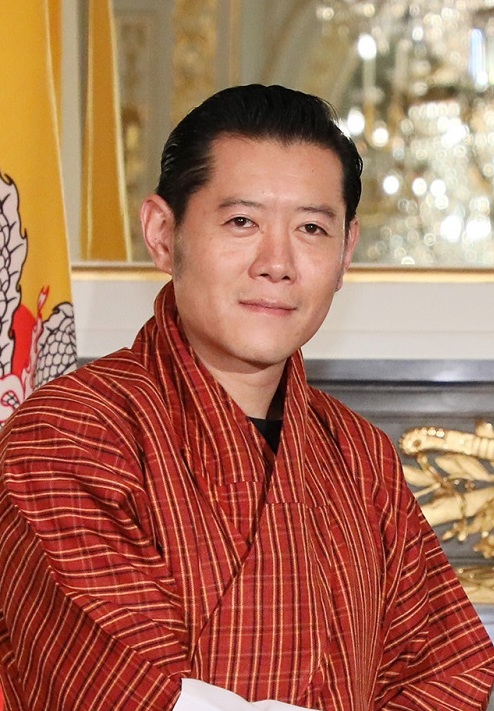
The current sovereign of Bhutan is Jigme Khesar Namgyel Wangchuck, the fifth Druk Gyalpo. He wears the Raven Crown, which is the official crown worn by the kings of Bhutan. He is correctly styled "Mi'wang 'Ngada Rinpoche" ("His Majesty") and addressed "Ngada Rimboche" ("Your Majesty").
King Jigme Khesar was the youngest reigning monarch in the world, being 26 years old when he ascended the throne on 9 December 2006 after his father, Jigme Singye Wangchuck, abdicated the throne in his favour. He was 28 years old when he was crowned on 6 November 2008.
The Constitution confirms the institution of monarchy. The Druk Gyalpo (King of Bhutan) is the head of state and the symbol of unity of the kingdom and of the people of Bhutan. The Constitution establishes the "Chhoe-sid-nyi" (dual system of religion and politics) of Bhutan as unified in the person of the king, who, as a Buddhist, is the upholder of the Chhoe-sid (religion and politics; temporal and secular). In addition, the king is the protector of all religions in Bhutan. The king is not answerable in a court of law for his actions, and his person is sacrosanct. However, the king is mandated to protect and uphold the Constitution "in the best interest and for the welfare of the people of Bhutan".
Under the Constitution, the king, in exercise of his royal prerogatives (and as head of state), promotes goodwill and good relations with other countries by receiving state guests and undertaking state visits to other countries. The king may also award titles, decorations, dar for Lhengye and Nyi-Kyelma (conferring a red scarf of rank and honour with the title of "Dasho") in accordance with tradition and custom. Also among the royal prerogatives are the grants of citizenship, amnesty, pardon and reduction of sentences; and land "kidu" and other "kidus" (benefits).
Under Article 2, Section 19, the king appoints a significant number of high-level government officers: judicial appointees, the auditor general, and the chairs of anti-corruption, civil service, and election commissions are holders of constitutional office.
The king appoints most of the upper judicial branch: the chief justice of Bhutan and the drangpons (associate justices) of the Supreme Court; the chief justice and drangpons (associate justices) of the High Court. These judicial appointments are made from among the vacant positions' peers, juniors, and available eminent jurists in consultation with the National Judicial Commission Dungkhag Court jurists are not appointed by the king.
The king also appoints, from lists of names recommended jointly by the prime minister, the chief justice of Bhutan, the speaker, the chairperson of the National Council, and the leader of the opposition party, four kinds of high-level government: the chief election commissioner and other members of the Election Commission; the auditor general of the Royal Audit Authority; the chairperson and other members of the Royal Civil Service Commission; and the chairperson and other members of the Anti-Corruption Commission. The term for each position is five years. Referenced for incorporation are the Bhutanese Audit Act, Bhutanese Civil Service Act, Bhutanese Anti-Corruption Act, and Attorney General Act; references to existing Election Laws also appear throughout the Constitution.
Hub AI
King of Bhutan AI simulator
(@King of Bhutan_simulator)
King of Bhutan
The King of Bhutan, officially the Druk Gyalpo (འབྲུག་རྒྱལ་པོ་; lit. 'Dragon King'), is the constitutional monarch and head of state of the Kingdom of Bhutan. In the Dzongkha language, Bhutan is known as Drukyul which translates as "The Land of the Thunder Dragon". Thus, while kings of Bhutan are known as Druk Gyalpo ("Dragon King"), the Bhutanese people call themselves the Drukpa, meaning "people of Druk (Bhutan)".
The current sovereign of Bhutan is Jigme Khesar Namgyel Wangchuck, the fifth Druk Gyalpo. He wears the Raven Crown, which is the official crown worn by the kings of Bhutan. He is correctly styled "Mi'wang 'Ngada Rinpoche" ("His Majesty") and addressed "Ngada Rimboche" ("Your Majesty").
King Jigme Khesar was the youngest reigning monarch in the world, being 26 years old when he ascended the throne on 9 December 2006 after his father, Jigme Singye Wangchuck, abdicated the throne in his favour. He was 28 years old when he was crowned on 6 November 2008.
The Constitution confirms the institution of monarchy. The Druk Gyalpo (King of Bhutan) is the head of state and the symbol of unity of the kingdom and of the people of Bhutan. The Constitution establishes the "Chhoe-sid-nyi" (dual system of religion and politics) of Bhutan as unified in the person of the king, who, as a Buddhist, is the upholder of the Chhoe-sid (religion and politics; temporal and secular). In addition, the king is the protector of all religions in Bhutan. The king is not answerable in a court of law for his actions, and his person is sacrosanct. However, the king is mandated to protect and uphold the Constitution "in the best interest and for the welfare of the people of Bhutan".
Under the Constitution, the king, in exercise of his royal prerogatives (and as head of state), promotes goodwill and good relations with other countries by receiving state guests and undertaking state visits to other countries. The king may also award titles, decorations, dar for Lhengye and Nyi-Kyelma (conferring a red scarf of rank and honour with the title of "Dasho") in accordance with tradition and custom. Also among the royal prerogatives are the grants of citizenship, amnesty, pardon and reduction of sentences; and land "kidu" and other "kidus" (benefits).
Under Article 2, Section 19, the king appoints a significant number of high-level government officers: judicial appointees, the auditor general, and the chairs of anti-corruption, civil service, and election commissions are holders of constitutional office.
The king appoints most of the upper judicial branch: the chief justice of Bhutan and the drangpons (associate justices) of the Supreme Court; the chief justice and drangpons (associate justices) of the High Court. These judicial appointments are made from among the vacant positions' peers, juniors, and available eminent jurists in consultation with the National Judicial Commission Dungkhag Court jurists are not appointed by the king.
The king also appoints, from lists of names recommended jointly by the prime minister, the chief justice of Bhutan, the speaker, the chairperson of the National Council, and the leader of the opposition party, four kinds of high-level government: the chief election commissioner and other members of the Election Commission; the auditor general of the Royal Audit Authority; the chairperson and other members of the Royal Civil Service Commission; and the chairperson and other members of the Anti-Corruption Commission. The term for each position is five years. Referenced for incorporation are the Bhutanese Audit Act, Bhutanese Civil Service Act, Bhutanese Anti-Corruption Act, and Attorney General Act; references to existing Election Laws also appear throughout the Constitution.
Recent media