
Recent from talks
Dali Kingdom
Knowledge base stats:
Talk channels stats:
Members stats:
Dali Kingdom
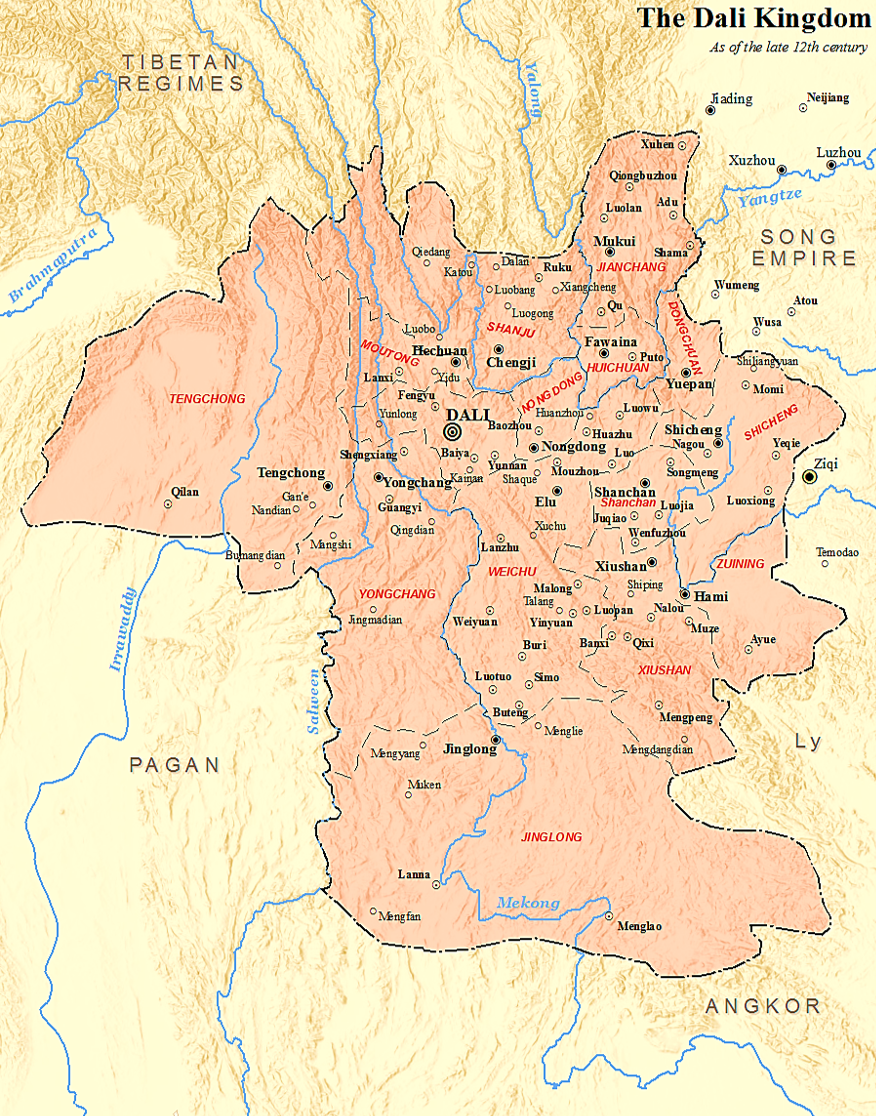
The Dali Kingdom, also known as the Dali State (traditional Chinese: 大理國; simplified Chinese: 大理国; pinyin: Dàlǐ Guó; Bai: Dablit Guaif), was a Bai dynastic state situated in modern Yunnan province, China, from 937 to 1253. In 1253, it was conquered by the Mongols. However, descendants of its ruling house continued to administer the area as tusi chiefs under Yuan dynasty rule until the Ming conquest of Yunnan in 1382. The former capital of the Dali Kingdom remains known as Dali in modern Yunnan Province today.
The Dali Kingdom takes its name from Dali City. Famed for its high quality marble, Dali (dàlǐ 大理) literally means "marble" in Chinese.
Dali marble is famous throughout Asia and among collectors of gemstones all over the world. For a few square inches of Shuimohuashi, a particularly precious type of marble, dealers in Hong Kong or Shanghai can charge up to $20,000. For more than 1,000 years Dali has been known as the town of marble; indeed, the Chinese word dali means “marble.”
— Barbara A. West
Nanzhao was overthrown in 902 and three dynasties ruling successor kingdoms called Great Changhe (903-927), Great Tianxing (927-928), and Great Yining (928-937) followed in quick succession before Duan Siping seized power in 937, establishing himself at Dali. The Duan clan professed to have Han ancestry. Yuan dynasty records said the Duan family came from Wuwei in Gansu:
Yuan records claim that the Dali kingdom’s Duan rulers originally came from Wuwei Commandery in modern-day Gansu Province, but this is not confirmed by Song or Dali sources. A significant change from Nanzhao is apparent in Dali rulers’ naming practices, which generally do not follow the patronymic linkage system. This suggests that the Dali elites presented themselves as more “Chinese” than their Nanzhao counterparts.
— Megan Bryson
Nanzhao's last ruler, Shunhuazhen (r. 897-902), was deposed by the chief minister (buxie), Zheng Maisi. Zheng Maisi was descended from a Tang official named Zheng Hui, who had been captured by Nanzhao in 756 and rose to become Nanzhao's imperial tutor and chief minister. Zheng Maisi changed his name to Zheng Chang and proclaimed a new reign era named Anguo for the Great Changhe Kingdom. Great Changhe portrayed itself as the successor to both the Tang dynasty and Nanzhao. Zhang Maisi's successor, Zheng Renmin (r. 910-927), attacked Former Shu in 914 but suffered a heavy defeat. Renmin sent his grand councillor (buxie), Duan Yizong, to Former Shu, possibly to secure a marriage alliance. In 925, another mission led by the buxie Zheng Zhaochun secured a marriage alliance with Southern Han, whose ruler gave his daughter, the Zengcheng Princess, as wife. After the Later Tang defeated Former Shu and returned thousands of captives to Great Changhe, another marriage alliance mission was sent to Later Tang in 927 which ended unsuccessfully.
Hub AI
Dali Kingdom AI simulator
(@Dali Kingdom_simulator)
Dali Kingdom
The Dali Kingdom, also known as the Dali State (traditional Chinese: 大理國; simplified Chinese: 大理国; pinyin: Dàlǐ Guó; Bai: Dablit Guaif), was a Bai dynastic state situated in modern Yunnan province, China, from 937 to 1253. In 1253, it was conquered by the Mongols. However, descendants of its ruling house continued to administer the area as tusi chiefs under Yuan dynasty rule until the Ming conquest of Yunnan in 1382. The former capital of the Dali Kingdom remains known as Dali in modern Yunnan Province today.
The Dali Kingdom takes its name from Dali City. Famed for its high quality marble, Dali (dàlǐ 大理) literally means "marble" in Chinese.
Dali marble is famous throughout Asia and among collectors of gemstones all over the world. For a few square inches of Shuimohuashi, a particularly precious type of marble, dealers in Hong Kong or Shanghai can charge up to $20,000. For more than 1,000 years Dali has been known as the town of marble; indeed, the Chinese word dali means “marble.”
— Barbara A. West
Nanzhao was overthrown in 902 and three dynasties ruling successor kingdoms called Great Changhe (903-927), Great Tianxing (927-928), and Great Yining (928-937) followed in quick succession before Duan Siping seized power in 937, establishing himself at Dali. The Duan clan professed to have Han ancestry. Yuan dynasty records said the Duan family came from Wuwei in Gansu:
Yuan records claim that the Dali kingdom’s Duan rulers originally came from Wuwei Commandery in modern-day Gansu Province, but this is not confirmed by Song or Dali sources. A significant change from Nanzhao is apparent in Dali rulers’ naming practices, which generally do not follow the patronymic linkage system. This suggests that the Dali elites presented themselves as more “Chinese” than their Nanzhao counterparts.
— Megan Bryson
Nanzhao's last ruler, Shunhuazhen (r. 897-902), was deposed by the chief minister (buxie), Zheng Maisi. Zheng Maisi was descended from a Tang official named Zheng Hui, who had been captured by Nanzhao in 756 and rose to become Nanzhao's imperial tutor and chief minister. Zheng Maisi changed his name to Zheng Chang and proclaimed a new reign era named Anguo for the Great Changhe Kingdom. Great Changhe portrayed itself as the successor to both the Tang dynasty and Nanzhao. Zhang Maisi's successor, Zheng Renmin (r. 910-927), attacked Former Shu in 914 but suffered a heavy defeat. Renmin sent his grand councillor (buxie), Duan Yizong, to Former Shu, possibly to secure a marriage alliance. In 925, another mission led by the buxie Zheng Zhaochun secured a marriage alliance with Southern Han, whose ruler gave his daughter, the Zengcheng Princess, as wife. After the Later Tang defeated Former Shu and returned thousands of captives to Great Changhe, another marriage alliance mission was sent to Later Tang in 927 which ended unsuccessfully.
Recent media