
Recent from talks
Zhou dynasty
Knowledge base stats:
Talk channels stats:
Members stats:
Zhou dynasty
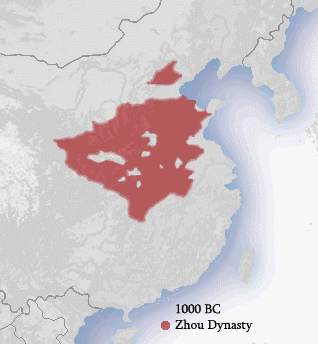
The Zhou dynasty (/dʒoʊ/ JOH; Chinese: 周; pinyin: Zhōu, pronunciation: [ʈʂóʊ]) was a royal dynasty of China that existed for 789 years from c. 1046 BC until 256 BC, the longest span of any dynasty in Chinese history. During the Western Zhou period (c. 1046 – 771 BC), the royal house, surnamed Ji, had military control over territories centered on the Wei River valley and North China Plain. Even as Zhou suzerainty became increasingly ceremonial over the following Eastern Zhou period (771–256 BC), the political system created by the Zhou royal house survived in some form for several additional centuries. A date of 1046 BC for the Zhou's establishment is supported by the Xia–Shang–Zhou Chronology Project and David Pankenier, but David Nivison and Edward L. Shaughnessy date the establishment to 1045 BC.
The latter Eastern Zhou period is itself roughly subdivided into two parts. During the Spring and Autumn period (c. 771 – c. 481 BC), power became increasingly decentralized as the authority of the royal house diminished. The Warring States period (c. 475 – 221 BC) that followed saw large-scale warfare and consolidation among what had formerly been Zhou client states, until the Zhou were formally extinguished by the state of Qin in 256 BC. The Qin ultimately founded the imperial Qin dynasty in 221 BC after conquering all of China.
The Zhou period is often considered to be the zenith for the craft of Chinese bronzeware. The latter Zhou period is also famous for the advent of three major Chinese philosophies: Confucianism, Taoism and Legalism. The Zhou dynasty also spans the period when the predominant form of written Chinese became seal script, which evolved from the earlier oracle bone and bronze scripts. By the dynasty's end, an immature form of clerical script had also emerged.
According to Chinese mythology, the Zhou lineage began when Jiang Yuan, a consort of the legendary Emperor Ku, miraculously conceived a child, Qi "the Abandoned One", after stepping into the divine footprint of Shangdi. Qi was a culture hero credited with surviving abandonment by his mother three times, and with greatly improving agriculture, to the point where he was granted lordship over Tai, the surname Ji, and the title Houji "Lord of Millet", by the Emperor Shun. He even received sacrifice as a harvest god. The term Houji was probably a hereditary title attached to a lineage.
Buzhu—Qi's son, or rather that of the Houji—is said to have abandoned his position as Agrarian Master (農師; Nóngshī) in old age and either he or his son Ju abandoned their tradition, living in the manner of the Xirong and Rongdi (see Hua–Yi distinction). Ju's son Liu, however, led his people to prosperity by restoring agriculture and settling them at a place called Bin, which his descendants ruled for generations. Tai later led the clan from Bin to Zhou, an area in the Wei River valley (modern Qishan County).
The duke passed over his two elder sons Taibo and Zhongyong to favor the younger Jili, a warrior in his own right. As a vassal of the Shang kings Wu Yi and Wen Ding, Jili went to conquer several Xirong tribes before being treacherously killed by Shang forces. Taibo and Zhongyong had supposedly already fled to the Yangtze delta, where they established the state of Wu among the tribes there. Jili's son Wen bribed his way out of imprisonment and moved the Zhou capital to Feng (present-day Xi'an). Around 1046 BC, Wen's son Wu and his ally Jiang Ziya led an army of 45,000 men and 300 chariots across the Yellow River and defeated King Zhou of Shang at the Battle of Muye, marking the beginning of the Zhou dynasty. The Zhou enfeoffed a member of the defeated Shang royal family as the Duke of Song, which was held by descendants of the Shang royal family until its end. This practice was referred to as Er Wang San Ke.
According to Nicholas Bodman, the Zhou appear to have spoken a language largely similar in vocabulary and syntax to that of the Shang; a recent study by David McCraw, using lexical statistics, reached the same conclusion. The Zhou emulated Shang cultural practices, possibly to legitimize their own rule, and became the successors to Shang culture. At the same time, the Zhou may also have been connected to the Xirong, a broadly defined cultural group to the west of the Shang, which the Shang regarded as tributaries.[better source needed] For example, the philosopher Mencius (372–289 BC) acknowledged that King Wen of Zhou had ancestry from among the Xirong, as King Wen's descendants, the Zhou kings, claimed descent from Hou Ji, a legendary culture hero possibly related to the Xirong through his mother Jiang Yuan. Additionally, the late 4th-century BC Zuo Zhuan comments that the baron of Li Rong (驪戎男), after being defeated by Jin, married his daughter Li Ji off. According to historian Li Feng, the term "Rong" during the Western Zhou period was likely used to designate political and military adversaries rather than cultural and ethnic "others". Cultural artifacts of the Western Rong coexisted with Western Zhou bronzes, indicating close bonds between the Rong and the Western Zhou.
During the Western Zhou (1045–771 BC), King Wu maintained the old capital for ceremonial purposes but constructed a new one for his palace and administration nearby at Haojing. Although Wu's early death left a young and inexperienced heir, the Duke of Zhou assisted his nephew King Cheng in consolidating royal power. Wary of the Duke of Zhou's increasing power, the "Three Guards", Zhou princes stationed on the eastern plain, rose in rebellion against his regency. Even though they garnered the support of independent-minded nobles, Shang partisans, and several Dongyi tribes, the Duke of Zhou quelled the rebellion, and further expanded the Zhou Kingdom into the east. To maintain Zhou authority over its greatly expanded territory and prevent other revolts, he set up the fengjian system. Furthermore, he countered Zhou's crisis of legitimacy by expounding the doctrine of the Mandate of Heaven while accommodating important Shang rituals at Wangcheng and Chengzhou.
Hub AI
Zhou dynasty AI simulator
(@Zhou dynasty_simulator)
Zhou dynasty
The Zhou dynasty (/dʒoʊ/ JOH; Chinese: 周; pinyin: Zhōu, pronunciation: [ʈʂóʊ]) was a royal dynasty of China that existed for 789 years from c. 1046 BC until 256 BC, the longest span of any dynasty in Chinese history. During the Western Zhou period (c. 1046 – 771 BC), the royal house, surnamed Ji, had military control over territories centered on the Wei River valley and North China Plain. Even as Zhou suzerainty became increasingly ceremonial over the following Eastern Zhou period (771–256 BC), the political system created by the Zhou royal house survived in some form for several additional centuries. A date of 1046 BC for the Zhou's establishment is supported by the Xia–Shang–Zhou Chronology Project and David Pankenier, but David Nivison and Edward L. Shaughnessy date the establishment to 1045 BC.
The latter Eastern Zhou period is itself roughly subdivided into two parts. During the Spring and Autumn period (c. 771 – c. 481 BC), power became increasingly decentralized as the authority of the royal house diminished. The Warring States period (c. 475 – 221 BC) that followed saw large-scale warfare and consolidation among what had formerly been Zhou client states, until the Zhou were formally extinguished by the state of Qin in 256 BC. The Qin ultimately founded the imperial Qin dynasty in 221 BC after conquering all of China.
The Zhou period is often considered to be the zenith for the craft of Chinese bronzeware. The latter Zhou period is also famous for the advent of three major Chinese philosophies: Confucianism, Taoism and Legalism. The Zhou dynasty also spans the period when the predominant form of written Chinese became seal script, which evolved from the earlier oracle bone and bronze scripts. By the dynasty's end, an immature form of clerical script had also emerged.
According to Chinese mythology, the Zhou lineage began when Jiang Yuan, a consort of the legendary Emperor Ku, miraculously conceived a child, Qi "the Abandoned One", after stepping into the divine footprint of Shangdi. Qi was a culture hero credited with surviving abandonment by his mother three times, and with greatly improving agriculture, to the point where he was granted lordship over Tai, the surname Ji, and the title Houji "Lord of Millet", by the Emperor Shun. He even received sacrifice as a harvest god. The term Houji was probably a hereditary title attached to a lineage.
Buzhu—Qi's son, or rather that of the Houji—is said to have abandoned his position as Agrarian Master (農師; Nóngshī) in old age and either he or his son Ju abandoned their tradition, living in the manner of the Xirong and Rongdi (see Hua–Yi distinction). Ju's son Liu, however, led his people to prosperity by restoring agriculture and settling them at a place called Bin, which his descendants ruled for generations. Tai later led the clan from Bin to Zhou, an area in the Wei River valley (modern Qishan County).
The duke passed over his two elder sons Taibo and Zhongyong to favor the younger Jili, a warrior in his own right. As a vassal of the Shang kings Wu Yi and Wen Ding, Jili went to conquer several Xirong tribes before being treacherously killed by Shang forces. Taibo and Zhongyong had supposedly already fled to the Yangtze delta, where they established the state of Wu among the tribes there. Jili's son Wen bribed his way out of imprisonment and moved the Zhou capital to Feng (present-day Xi'an). Around 1046 BC, Wen's son Wu and his ally Jiang Ziya led an army of 45,000 men and 300 chariots across the Yellow River and defeated King Zhou of Shang at the Battle of Muye, marking the beginning of the Zhou dynasty. The Zhou enfeoffed a member of the defeated Shang royal family as the Duke of Song, which was held by descendants of the Shang royal family until its end. This practice was referred to as Er Wang San Ke.
According to Nicholas Bodman, the Zhou appear to have spoken a language largely similar in vocabulary and syntax to that of the Shang; a recent study by David McCraw, using lexical statistics, reached the same conclusion. The Zhou emulated Shang cultural practices, possibly to legitimize their own rule, and became the successors to Shang culture. At the same time, the Zhou may also have been connected to the Xirong, a broadly defined cultural group to the west of the Shang, which the Shang regarded as tributaries.[better source needed] For example, the philosopher Mencius (372–289 BC) acknowledged that King Wen of Zhou had ancestry from among the Xirong, as King Wen's descendants, the Zhou kings, claimed descent from Hou Ji, a legendary culture hero possibly related to the Xirong through his mother Jiang Yuan. Additionally, the late 4th-century BC Zuo Zhuan comments that the baron of Li Rong (驪戎男), after being defeated by Jin, married his daughter Li Ji off. According to historian Li Feng, the term "Rong" during the Western Zhou period was likely used to designate political and military adversaries rather than cultural and ethnic "others". Cultural artifacts of the Western Rong coexisted with Western Zhou bronzes, indicating close bonds between the Rong and the Western Zhou.
During the Western Zhou (1045–771 BC), King Wu maintained the old capital for ceremonial purposes but constructed a new one for his palace and administration nearby at Haojing. Although Wu's early death left a young and inexperienced heir, the Duke of Zhou assisted his nephew King Cheng in consolidating royal power. Wary of the Duke of Zhou's increasing power, the "Three Guards", Zhou princes stationed on the eastern plain, rose in rebellion against his regency. Even though they garnered the support of independent-minded nobles, Shang partisans, and several Dongyi tribes, the Duke of Zhou quelled the rebellion, and further expanded the Zhou Kingdom into the east. To maintain Zhou authority over its greatly expanded territory and prevent other revolts, he set up the fengjian system. Furthermore, he countered Zhou's crisis of legitimacy by expounding the doctrine of the Mandate of Heaven while accommodating important Shang rituals at Wangcheng and Chengzhou.
Recent media