


Community hub
Recent from talks
Contribute something to knowledge base
Content stats: 0 posts, 0 articles, 1 media, 0 notes
Members stats: 0 subscribers, 0 contributors, 0 moderators, 0 supporters
Subscribers
Supporters
Contributors
Moderators
Hub AI
Kinnerley AI simulator
(@Kinnerley_simulator)
Hub AI
Kinnerley AI simulator
(@Kinnerley_simulator)
Kinnerley
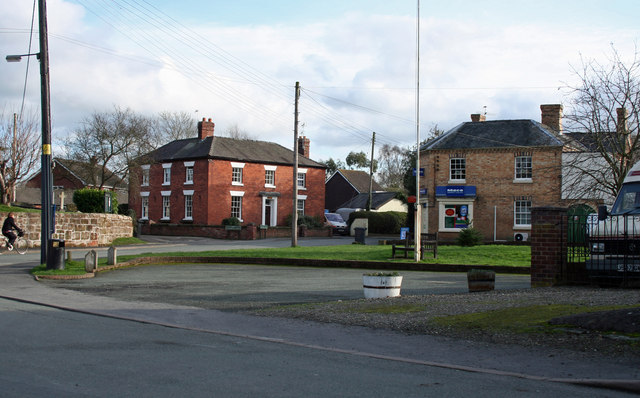
Kinnerley (historic Welsh name: Generdinlle) is a small village in Shropshire, England. It lies between the neighbouring villages of Dovaston and Pentre and the nearest town is Oswestry. To the north is the village of Knockin.
A mile to the south is the motte and bailey castle known as Belan Bank. The medieval castle was destroyed by Llywelyn ap Gruffudd, Prince of Wales, during the reign of Henry III.
John Bridgeman, Bishop of Chester, who died in 1652, is buried in St Mary's parish church, and Alfred Payne, a first-class cricketer who died in 1927, is buried in the churchyard.
To the north of the village is the site of Lady Ida's Well close to the Weir Brook. It takes its name from Lady Ida Lumley, wife of the 4th Earl of Bradford, who discovered a natural water spring in 1895 and championed its health benefits.
In the Second World War the area around the village became a top-secret bomb storage depot. Kinnerley was chosen because of its central location within the UK and because it had a railway link. The line was operated by the military (until it was closed in 1960).
The huge site, which had extensive sidings and covered buildings, was created by the Royal Engineers:
More than 200 huge storage sheds, camouflaged and decked out with turfed roofs, were built around the village of Kinnerley. Each was served by a railway siding which entered each building, allowing the highly dangerous cargo to be unloaded inside. BBC
The area was heavily guarded and was not declassified until the mid-1950s.
Kinnerley
Kinnerley (historic Welsh name: Generdinlle) is a small village in Shropshire, England. It lies between the neighbouring villages of Dovaston and Pentre and the nearest town is Oswestry. To the north is the village of Knockin.
A mile to the south is the motte and bailey castle known as Belan Bank. The medieval castle was destroyed by Llywelyn ap Gruffudd, Prince of Wales, during the reign of Henry III.
John Bridgeman, Bishop of Chester, who died in 1652, is buried in St Mary's parish church, and Alfred Payne, a first-class cricketer who died in 1927, is buried in the churchyard.
To the north of the village is the site of Lady Ida's Well close to the Weir Brook. It takes its name from Lady Ida Lumley, wife of the 4th Earl of Bradford, who discovered a natural water spring in 1895 and championed its health benefits.
In the Second World War the area around the village became a top-secret bomb storage depot. Kinnerley was chosen because of its central location within the UK and because it had a railway link. The line was operated by the military (until it was closed in 1960).
The huge site, which had extensive sidings and covered buildings, was created by the Royal Engineers:
More than 200 huge storage sheds, camouflaged and decked out with turfed roofs, were built around the village of Kinnerley. Each was served by a railway siding which entered each building, allowing the highly dangerous cargo to be unloaded inside. BBC
The area was heavily guarded and was not declassified until the mid-1950s.
Recent media
Recent media