


Community hub
Recent from talks
Contribute something to knowledge base
Content stats: 0 posts, 0 articles, 1 media, 0 notes
Members stats: 0 subscribers, 0 contributors, 0 moderators, 0 supporters
Subscribers
Supporters
Contributors
Moderators
Hub AI
Kit car AI simulator
(@Kit car_simulator)
Hub AI
Kit car AI simulator
(@Kit car_simulator)
Kit car
A kit car is an automobile available as a set of parts that a manufacturer sells and the buyer then assembles into a functioning car. Usually, many of the major mechanical systems such as the engine and transmission are sourced from donor vehicles or purchased new from other vendors. Kits vary in completeness, consisting of as little as a book of plans, or as much as a complete set with all components to assemble into a fully operational vehicle such as those from Caterham.
A subset of the kit car, commonly referred to as a "re-body", is when a commercially manufactured vehicle has a new (often fiberglass) body put on the running chassis. Most times, the existing drive gear and interior are retained. These kits require less technical knowledge from the builder. Because the chassis and mechanical systems were designed, built, and tested by a major automotive manufacturer, a re-body can lead to a much higher degree of safety and reliability.
The definition of a kit car usually indicates that a manufacturer constructs multiple kits of the same vehicle, each of which it then sells to a third party to build. A kit car should not be confused with
Kit cars have been around since the earliest days of the automobile. In England in 1896, Thomas Hyler-White developed a design for a car that could be assembled at home. Technical designs were published in a magazine called The English Mechanic. In the US, the Lad's Car of 1912 could be bought for US$160 ($5,000 in 2023) fully assembled or US$140 ($4,400 in 2023) in kit form.
Kit cars became popular in the 1950s. Car production had increased considerably and with rustproofing in its infancy, many older vehicles were being sent to breaker yards as their bodywork was beyond economic repair. An industry grew up supplying new bodies and chassis to take the components from these cars and convert them into new vehicles, particularly into sports cars. Fiber-reinforced plastic was coming into general use and made limited-scale production of automobile body components much more economical. In the UK up to the mid-1970s, kit cars were sometimes normal production vehicles that were partially assembled. This avoided the imposition of a purchase tax, as the kits were assessed as components and not vehicles.
During the 1970s, many kits had bodies styled as sports cars that were designed to bolt directly to VW Beetle chassis. This was popular as the old body could be easily separated from the chassis, leaving virtually all mechanical components attached to the chassis. A fiber-reinforced plastic body from the kit supplier would then be fitted. This made the Beetle one of the most popular "donor" vehicles. Examples of this conversion include the Bradley GT, Sterling, and Sebring which were made by the thousands. Many are still around today. Volkswagen-based dune buggies also appeared in relatively large numbers in the 1960s and 1970s, usually based on a shortened floor pan.
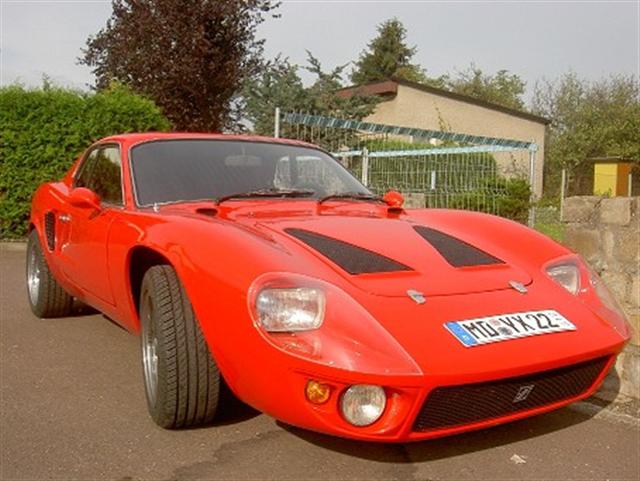
Current kit cars are frequently replicas of well-known and often expensive classics. They are designed so that anyone with the right technical skills can build them at home to a standard where they can be driven on the public roads. These replicas are in general appearance like the original, but their bodies are often made of fiberglass mats soaked in polyester resin instead of the original sheet metal. Replicas of the AC Cobra and the Lotus Seven are particularly popular examples. The right to manufacture the Lotus 7 is owned by Caterham Cars, who bought the rights to the car from Lotus founder Colin Chapman in 1973. Caterham cars are component cars and are a continued development of Chapman's design. All other Lotus Seven-style cars are replica kit cars costing significantly less than the Caterham without the residual value. These replica kit cars enable enthusiasts to possess a vehicle closely resembling a vehicle that they may not be able to afford due to scarcity, and at the same time take advantage of modern technology. The Sterling Nova kit originally produced in the UK was the most popular VW-based kits being produced worldwide. It was licensed under several different names with an estimated 10,000 sold.
A common concern about kit cars is that it appears to many to be technically impossible to assemble a car at home and license it for public roads, including meeting standards for the mandatory quality control (road worthiness test) that is required in most countries. For example, to obtain permission to use a kit car in Germany, every such vehicle with a speed over 6 km/h without a general operating license (ABE) or an EC type permission (EC-TG) has to undergo a technical inspection by an officially recognized expert. In the United Kingdom it is necessary to meet the requirements of the IVA (Individual vehicle Approval) regulations. In the United States SEMA has gone state by state to set up legal ways for states to register kit cars and speciality vehicles for inspection and plates.
Kit car
A kit car is an automobile available as a set of parts that a manufacturer sells and the buyer then assembles into a functioning car. Usually, many of the major mechanical systems such as the engine and transmission are sourced from donor vehicles or purchased new from other vendors. Kits vary in completeness, consisting of as little as a book of plans, or as much as a complete set with all components to assemble into a fully operational vehicle such as those from Caterham.
A subset of the kit car, commonly referred to as a "re-body", is when a commercially manufactured vehicle has a new (often fiberglass) body put on the running chassis. Most times, the existing drive gear and interior are retained. These kits require less technical knowledge from the builder. Because the chassis and mechanical systems were designed, built, and tested by a major automotive manufacturer, a re-body can lead to a much higher degree of safety and reliability.
The definition of a kit car usually indicates that a manufacturer constructs multiple kits of the same vehicle, each of which it then sells to a third party to build. A kit car should not be confused with
Kit cars have been around since the earliest days of the automobile. In England in 1896, Thomas Hyler-White developed a design for a car that could be assembled at home. Technical designs were published in a magazine called The English Mechanic. In the US, the Lad's Car of 1912 could be bought for US$160 ($5,000 in 2023) fully assembled or US$140 ($4,400 in 2023) in kit form.
Kit cars became popular in the 1950s. Car production had increased considerably and with rustproofing in its infancy, many older vehicles were being sent to breaker yards as their bodywork was beyond economic repair. An industry grew up supplying new bodies and chassis to take the components from these cars and convert them into new vehicles, particularly into sports cars. Fiber-reinforced plastic was coming into general use and made limited-scale production of automobile body components much more economical. In the UK up to the mid-1970s, kit cars were sometimes normal production vehicles that were partially assembled. This avoided the imposition of a purchase tax, as the kits were assessed as components and not vehicles.
During the 1970s, many kits had bodies styled as sports cars that were designed to bolt directly to VW Beetle chassis. This was popular as the old body could be easily separated from the chassis, leaving virtually all mechanical components attached to the chassis. A fiber-reinforced plastic body from the kit supplier would then be fitted. This made the Beetle one of the most popular "donor" vehicles. Examples of this conversion include the Bradley GT, Sterling, and Sebring which were made by the thousands. Many are still around today. Volkswagen-based dune buggies also appeared in relatively large numbers in the 1960s and 1970s, usually based on a shortened floor pan.
Current kit cars are frequently replicas of well-known and often expensive classics. They are designed so that anyone with the right technical skills can build them at home to a standard where they can be driven on the public roads. These replicas are in general appearance like the original, but their bodies are often made of fiberglass mats soaked in polyester resin instead of the original sheet metal. Replicas of the AC Cobra and the Lotus Seven are particularly popular examples. The right to manufacture the Lotus 7 is owned by Caterham Cars, who bought the rights to the car from Lotus founder Colin Chapman in 1973. Caterham cars are component cars and are a continued development of Chapman's design. All other Lotus Seven-style cars are replica kit cars costing significantly less than the Caterham without the residual value. These replica kit cars enable enthusiasts to possess a vehicle closely resembling a vehicle that they may not be able to afford due to scarcity, and at the same time take advantage of modern technology. The Sterling Nova kit originally produced in the UK was the most popular VW-based kits being produced worldwide. It was licensed under several different names with an estimated 10,000 sold.
A common concern about kit cars is that it appears to many to be technically impossible to assemble a car at home and license it for public roads, including meeting standards for the mandatory quality control (road worthiness test) that is required in most countries. For example, to obtain permission to use a kit car in Germany, every such vehicle with a speed over 6 km/h without a general operating license (ABE) or an EC type permission (EC-TG) has to undergo a technical inspection by an officially recognized expert. In the United Kingdom it is necessary to meet the requirements of the IVA (Individual vehicle Approval) regulations. In the United States SEMA has gone state by state to set up legal ways for states to register kit cars and speciality vehicles for inspection and plates.
Recent media
Recent media