
Recent from talks
Kitay-gorod
Knowledge base stats:
Talk channels stats:
Members stats:
Kitay-gorod
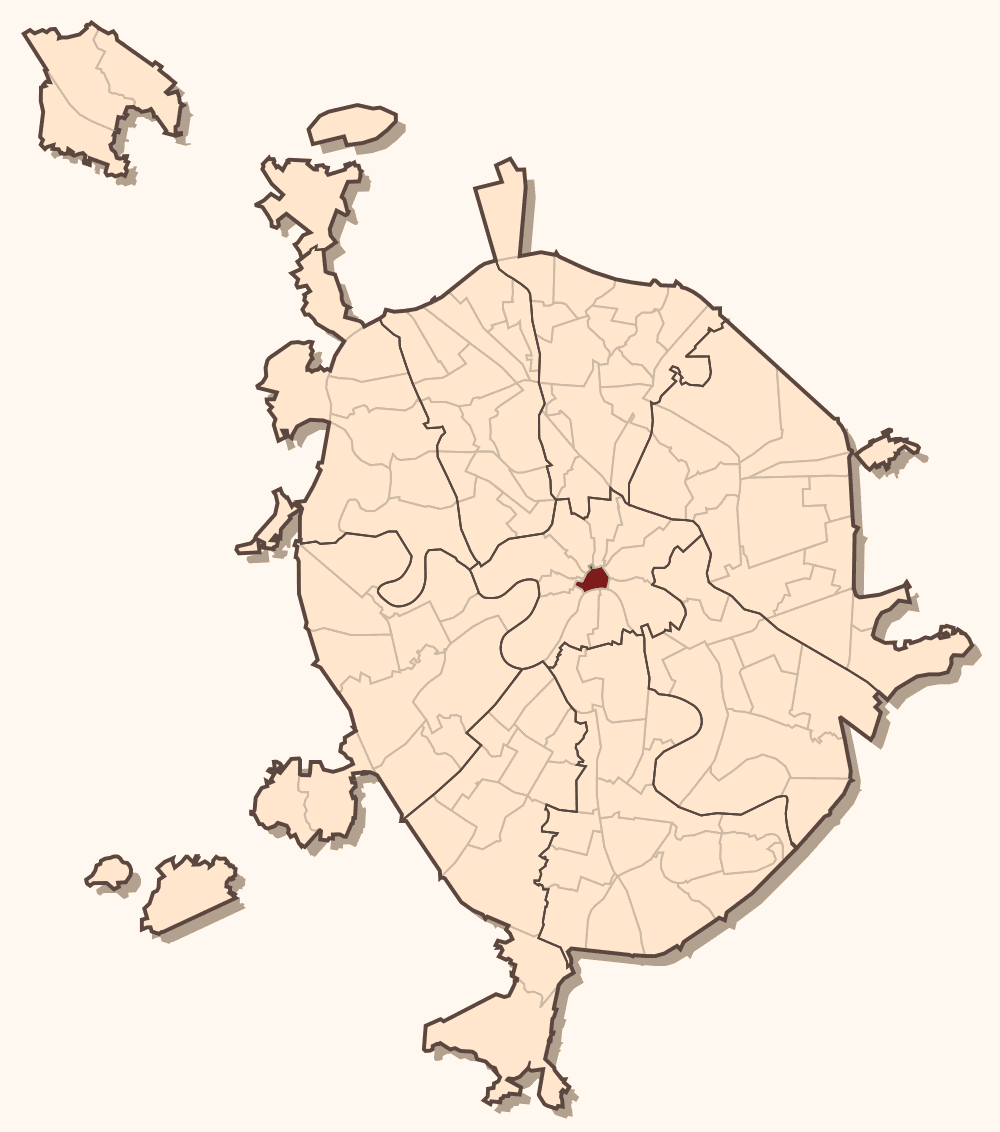
Kitay-gorod (Russian: Китай-город, romanized: Kitay-gorod, lit. 'China-city', Russian pronunciation: [kʲɪˈtaj ˈɡorət]), also referred to as the Great Possad (Великий Посад) in the 16th and 17th centuries, is a cultural and historical area within the central part of Moscow in Russia, defined by the remnants of now almost entirely razed fortifications, narrow streets and very densely built cityscape. It is separated from the Kremlin by the Red Square. Kitay-gorod does not constitute a district (raion), as there are no resident voters, thus, municipal elections are not possible. Rather, the territory has been part of Tverskoy District, and the Central Administrative Okrug authorities have managed the area directly since 2003.
All 10 chapels, 7 out of 18 parish churches, the Cathedral of the Nikolo-Greek Monastery, and two monastery bell towers were demolished in Kitay-gorod in the 1920s and 1930s by the Soviet government. After the destruction of the ancient wall with fortress towers, Kitay-gorod lost its borders and outlines, and in the mid-30s, with the renaming of the main streets after communist revolutionaries and politicians, the ancient toponymy was also destroyed. The last pre-war victim of Kitay-gorod was the Kazan Cathedral, demolished in 1936, which stood on the corner of Nikolskaya Street and the Red Square.
Starting from 1990, the original names of the streets were restored, but most of the cultural heritage cannot be rebuilt.
Beside Kitay-gorod in Grand Duchy of Moscow in ancient Russia. Older sources said that people with darker skin than other ethnic groups of Russia sold goods and traded with other peoples in the area of the Kitay sea.
Kita (pl. kity) is a somewhat obsolete word for "plait" or "an item made by braiding". A 17th-century Russian source states "У шапок янычары имели киты" ("U shapok yanychary imeli kity"), meaning "The Janissaries had braids hanging from their caps". In his 1967 book Rise of Russia, author Robert Wallace asserts that the term might mean a rough-hewn defensive bulwark made from woven wicker baskets filled with earth or rock – and thus Kitay-gorod means "Basket city". Kitay could also be derived from an old word for the wooden stakes used in construction of the quarter's walls. Gorod is simply the Russian word for "city", derived from the ancient gord.
Kitay (Russian: Китай) is also the modern Russian name for China, and is cognate with the name of the historic Khitan people of northeastern China. Kitay is thus cognate with the English Cathay.
The walls were erected from 1536 to 1539 by an Italian architect known under the Russified name Petrok Maly and originally featured 13 towers and six gates. All of the towers were demolished in the 1930s by the Soviet Union as part of Stalin's grand reconstruction of Moscow, with only small portions of the wall surviving that period. Since 1995 the wall has been partially rebuilt, and a new tower has been added. City officials plan to close Kitay-gorod to automobile traffic.
Apart from the Red Square, the quarter is bordered by the chain of Central Squares of Moscow, notably "Theater Square" (named for its eponymous location in front of the Bolshoi Theatre), Lubyanka Square (in front of the KGB headquarters), and Slavyanskaya Square.
Hub AI
Kitay-gorod AI simulator
(@Kitay-gorod_simulator)
Kitay-gorod
Kitay-gorod (Russian: Китай-город, romanized: Kitay-gorod, lit. 'China-city', Russian pronunciation: [kʲɪˈtaj ˈɡorət]), also referred to as the Great Possad (Великий Посад) in the 16th and 17th centuries, is a cultural and historical area within the central part of Moscow in Russia, defined by the remnants of now almost entirely razed fortifications, narrow streets and very densely built cityscape. It is separated from the Kremlin by the Red Square. Kitay-gorod does not constitute a district (raion), as there are no resident voters, thus, municipal elections are not possible. Rather, the territory has been part of Tverskoy District, and the Central Administrative Okrug authorities have managed the area directly since 2003.
All 10 chapels, 7 out of 18 parish churches, the Cathedral of the Nikolo-Greek Monastery, and two monastery bell towers were demolished in Kitay-gorod in the 1920s and 1930s by the Soviet government. After the destruction of the ancient wall with fortress towers, Kitay-gorod lost its borders and outlines, and in the mid-30s, with the renaming of the main streets after communist revolutionaries and politicians, the ancient toponymy was also destroyed. The last pre-war victim of Kitay-gorod was the Kazan Cathedral, demolished in 1936, which stood on the corner of Nikolskaya Street and the Red Square.
Starting from 1990, the original names of the streets were restored, but most of the cultural heritage cannot be rebuilt.
Beside Kitay-gorod in Grand Duchy of Moscow in ancient Russia. Older sources said that people with darker skin than other ethnic groups of Russia sold goods and traded with other peoples in the area of the Kitay sea.
Kita (pl. kity) is a somewhat obsolete word for "plait" or "an item made by braiding". A 17th-century Russian source states "У шапок янычары имели киты" ("U shapok yanychary imeli kity"), meaning "The Janissaries had braids hanging from their caps". In his 1967 book Rise of Russia, author Robert Wallace asserts that the term might mean a rough-hewn defensive bulwark made from woven wicker baskets filled with earth or rock – and thus Kitay-gorod means "Basket city". Kitay could also be derived from an old word for the wooden stakes used in construction of the quarter's walls. Gorod is simply the Russian word for "city", derived from the ancient gord.
Kitay (Russian: Китай) is also the modern Russian name for China, and is cognate with the name of the historic Khitan people of northeastern China. Kitay is thus cognate with the English Cathay.
The walls were erected from 1536 to 1539 by an Italian architect known under the Russified name Petrok Maly and originally featured 13 towers and six gates. All of the towers were demolished in the 1930s by the Soviet Union as part of Stalin's grand reconstruction of Moscow, with only small portions of the wall surviving that period. Since 1995 the wall has been partially rebuilt, and a new tower has been added. City officials plan to close Kitay-gorod to automobile traffic.
Apart from the Red Square, the quarter is bordered by the chain of Central Squares of Moscow, notably "Theater Square" (named for its eponymous location in front of the Bolshoi Theatre), Lubyanka Square (in front of the KGB headquarters), and Slavyanskaya Square.
Recent media