


Community hub
Recent from talks
Contribute something to knowledge base
Content stats: 0 posts, 0 articles, 1 media, 0 notes
Members stats: 0 subscribers, 0 contributors, 0 moderators, 0 supporters
Subscribers
Supporters
Contributors
Moderators
Scissors
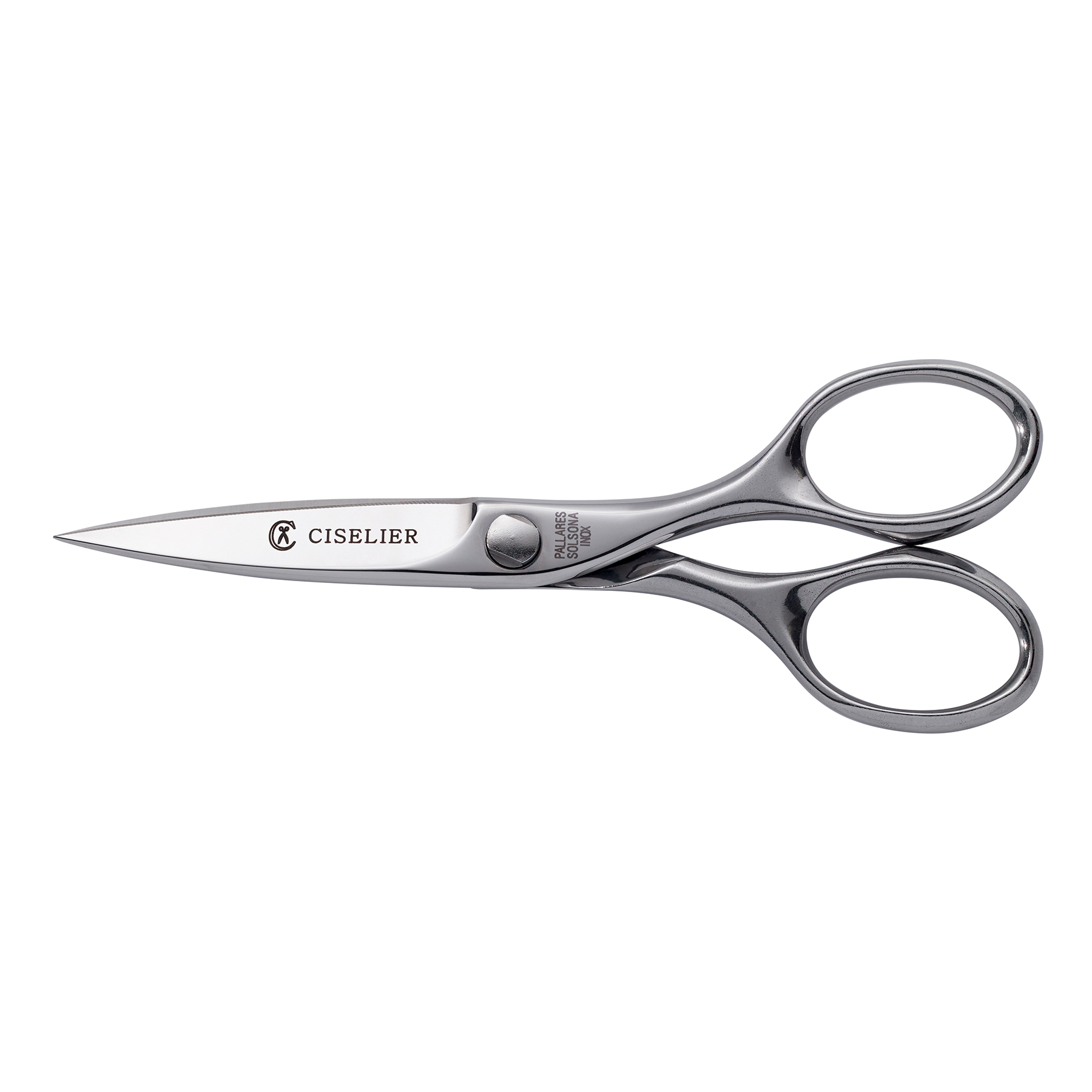
Scissors are hand-operated shearing tools. A pair of scissors consists of a pair of blades pivoted so that the sharpened edges slide against each other when the handles (bows) opposite to the pivot are closed. Scissors are used for cutting various thin materials, such as paper, cardboard, metal foil, cloth, rope, and wire. A large variety of scissors and shears all exist for specialized purposes. Hair-cutting shears and kitchen shears are functionally equivalent to scissors, but the larger implements tend to be called shears. Hair-cutting shears have specific blade angles ideal for cutting hair. Using the incorrect type of scissors to cut hair will result in increased damage or split ends, or both, by breaking the hair. Kitchen shears, also known as kitchen scissors, are intended for cutting and trimming foods such as meats.
Inexpensive, mass-produced modern scissors are often designed ergonomically with composite thermoplastic and rubber handles.
The noun scissors is treated as a plural noun and therefore takes a plural verb (e.g., these scissors are). Alternatively, the tool is referred to by the singular phrase a pair of scissors. The word shears is used to describe similar instruments that are larger in size and for heavier cutting.
The Hangzhou Zhang Xiaoquan Company in Hangzhou, China, has been manufacturing scissors since 1663.
Pivoted scissors were not manufactured in large numbers until 1761, when Robert Hinchliffe of Sheffield produced the first pair of modern-day scissors made of hardened and polished cast steel. His major challenge was to form the bows; first, he made them solid, then drilled a hole, and then filed away metal to make this large enough to admit the user's fingers. This process was laborious, and apparently Hinchliffe improved upon it in order to increase production. Hinchliffe lived in Cheney Square (now the site of Sheffield Town Hall), and set up a sign identifying himself as a "fine scissor manufacturer". He achieved strong sales in London and elsewhere.
The vast majority of global scissor manufacturing takes place in China. As of 2019, China was responsible for 64.3% of worldwide scissors exports. When combined with Chinese Taipei exports, this rises to 68.3%.
The Hangzhou Zhang Xiaoquan Company, founded in 1663, is one of the oldest continuously operating scissor manufacturers in the world. The company was nationalized in 1958 and now employs 1500 people who annually mass-produce an estimated seven million pairs of inexpensive scissors that retail for an average of US$4 each.
In the late 14th century, the English word "scissors" came into usage. It was derived from the Old French word cisoires, which referred to shears.
Scissors
Scissors are hand-operated shearing tools. A pair of scissors consists of a pair of blades pivoted so that the sharpened edges slide against each other when the handles (bows) opposite to the pivot are closed. Scissors are used for cutting various thin materials, such as paper, cardboard, metal foil, cloth, rope, and wire. A large variety of scissors and shears all exist for specialized purposes. Hair-cutting shears and kitchen shears are functionally equivalent to scissors, but the larger implements tend to be called shears. Hair-cutting shears have specific blade angles ideal for cutting hair. Using the incorrect type of scissors to cut hair will result in increased damage or split ends, or both, by breaking the hair. Kitchen shears, also known as kitchen scissors, are intended for cutting and trimming foods such as meats.
Inexpensive, mass-produced modern scissors are often designed ergonomically with composite thermoplastic and rubber handles.
The noun scissors is treated as a plural noun and therefore takes a plural verb (e.g., these scissors are). Alternatively, the tool is referred to by the singular phrase a pair of scissors. The word shears is used to describe similar instruments that are larger in size and for heavier cutting.
The Hangzhou Zhang Xiaoquan Company in Hangzhou, China, has been manufacturing scissors since 1663.
Pivoted scissors were not manufactured in large numbers until 1761, when Robert Hinchliffe of Sheffield produced the first pair of modern-day scissors made of hardened and polished cast steel. His major challenge was to form the bows; first, he made them solid, then drilled a hole, and then filed away metal to make this large enough to admit the user's fingers. This process was laborious, and apparently Hinchliffe improved upon it in order to increase production. Hinchliffe lived in Cheney Square (now the site of Sheffield Town Hall), and set up a sign identifying himself as a "fine scissor manufacturer". He achieved strong sales in London and elsewhere.
The vast majority of global scissor manufacturing takes place in China. As of 2019, China was responsible for 64.3% of worldwide scissors exports. When combined with Chinese Taipei exports, this rises to 68.3%.
The Hangzhou Zhang Xiaoquan Company, founded in 1663, is one of the oldest continuously operating scissor manufacturers in the world. The company was nationalized in 1958 and now employs 1500 people who annually mass-produce an estimated seven million pairs of inexpensive scissors that retail for an average of US$4 each.
In the late 14th century, the English word "scissors" came into usage. It was derived from the Old French word cisoires, which referred to shears.
Recent media
Recent media